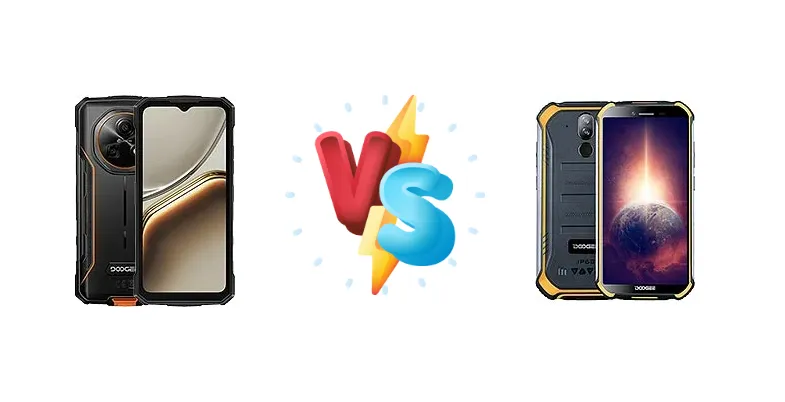
Doogee has carved a niche for itself in the rugged smartphone market, offering durable devices at competitive prices. The Fire 5 and S40 Pro represent two distinct approaches within that portfolio. The Fire 5 prioritizes exceptional battery endurance, while the S40 Pro aims for a slight performance uplift. This comparison dissects the key differences to determine which device best suits your needs.
🏆 Quick Verdict
For the average user prioritizing longevity and minimizing charging frequency, the Doogee Fire 5 is the clear winner. Its 64:40h endurance significantly outpaces the S40 Pro, making it ideal for extended outdoor use or situations where power outlets are scarce. While the S40 Pro offers a marginally faster processor, the battery trade-off isn't worth it for most.
| Network |
|---|
| 2G bands | GSM 850 / 900 / 1800 / 1900 | GSM 850 / 900 / 1800 / 1900 |
| 3G bands | HSDPA 850 / 900 / 1700(AWS) / 1900 / 2100 | HSDPA 900 / 2100 |
| 4G bands | 1, 2, 3, 4, 5, 7, 8, 18, 19, 20, 25, 26, 28, 34, 38, 39, 40, 41, 66 | 1, 3, 7, 8, 20 |
| Speed | HSPA, LTE | HSPA, LTE |
| Technology | GSM / HSPA / LTE | GSM / HSPA / LTE |
| Launch |
|---|
| Announced | 2025, September | 2020, July 17. Released 2020, July |
| Status | Available. Released 2025, September | Discontinued |
| Body |
|---|
| Dimensions | 176.5 x 82.5 x 18.7 mm (6.95 x 3.25 x 0.74 in) | 158.2 x 79.4 x 14.1 mm (6.23 x 3.13 x 0.56 in) |
| SIM | Nano-SIM + Nano-SIM | Nano-SIM + Nano-SIM |
| Weight | 389 g (13.72 oz) | 238 g (8.40 oz) |
| Display |
|---|
| Protection | Mohs level 6 | Corning Gorilla Glass |
| Resolution | 720 x 1612 pixels, 20:9 ratio (~267 ppi density) | 720 x 1440 pixels, 18:9 ratio (~295 ppi density) |
| Size | 6.6 inches, 104.6 cm2 (~71.9% screen-to-body ratio) | 5.45 inches, 76.7 cm2 (~61.0% screen-to-body ratio) |
| Type | IPS LCD, 90Hz, 400 nits | IPS LCD |
| Platform |
|---|
| CPU | Octa-core (4x1.6 GHz Cortex-A55 & 4x1.2 GHz Cortex-A55) | Octa-core (4x1.8 GHz Cortex-A53 & 4x1.5 GHz Cortex-A53) |
| Chipset | Unisoc SC9863A (28 nm) | Mediatek MT6762 Helio A25 (12 nm) |
| GPU | IMG8322 | PowerVR GE8320 |
| OS | Android 15 (Go edition) | Android 10 |
| Memory |
|---|
| Card slot | microSDXC (dedicated slot) | microSDXC (uses shared SIM slot) |
| Internal | 64GB 3GB RAM | 64GB 4GB RAM |
| Main Camera |
|---|
| Dual | - | 13 MP, f/2.8, (wide)
Auxiliary lens |
| Features | Dual-LED flash, HDR, panorama | LED flash |
| Single | 13 MP, f/2.0, (wide), AF | - |
| Video | 1080p@30fps | 1080p |
| Selfie camera |
|---|
| Single | 8 MP, f/2.0, (wide) | 5 MP, f/2.8, (wide) |
| Video | 720p@30fps | Yes |
| Sound |
|---|
| 35mm jack | No | Yes |
| Loudspeaker | Yes | Yes |
| Comms |
|---|
| Bluetooth | 4.2, A2DP | 5.0, A2DP, LE |
| NFC | Yes | Yes |
| Positioning | GPS, GLONASS, GALILEO, BDS | GPS, GLONASS, GALILEO, BDS |
| Radio | FM radio | FM radio |
| USB | USB Type-C | microUSB 2.0, OTG |
| WLAN | Wi-Fi 802.11 b/g/n | Wi-Fi 802.11 a/b/g/n |
| Features |
|---|
| Sensors | Fingerprint (side-mounted), accelerometer, proximity, compass | Fingerprint (rear-mounted), accelerometer, proximity, compass |
| Battery |
|---|
| Charging | 10W wired | 10W wired |
| Type | 13000 mAh | 4650 mAh |
| Misc |
|---|
| Colors | Gray, Orange, Green | Black, Orange, Green |
| Price | About 170 EUR | About 150 EUR |
| EU LABEL |
|---|
| Battery | 64:40h endurance, 1100 cycles | - |
| Energy | Class F | - |
| Free fall | Class A (270 falls) | - |
| Repairability | Class C | - |
Doogee Fire 5
- Exceptional battery life (64:40h endurance)
- High battery cycle count (1100 cycles)
- More affordable (likely)
- Older, less efficient chipset (Unisoc SC9863A)
- Slower processor performance
Doogee S40 Pro
- More modern chipset (MediaTek Helio A25)
- Slightly faster processor performance
- More efficient manufacturing process (12nm)
- Significantly shorter battery life
- Likely more expensive than Fire 5
Display Comparison
Neither device boasts a standout display. Both likely utilize LCD panels, common in this price bracket. Detailed display specs (resolution, brightness) are unavailable, but the focus here is clearly on durability, not visual fidelity. Bezels are likely substantial on both models, prioritizing screen protection. Color accuracy is expected to be standard for budget devices.
Camera Comparison
Camera performance is unlikely to be a key differentiator. Both phones likely feature basic camera setups geared towards functional photography rather than high-quality imaging. Without specific sensor details, it’s safe to assume both will struggle in low-light conditions. Any 2MP macro or depth sensors present on either device should be considered marketing features rather than genuinely useful components. Image processing will likely be minimal, resulting in images that are adequate for social media sharing but lack detail and dynamic range.
Performance
The core difference lies in the chipset. The Doogee S40 Pro’s MediaTek Helio A25, fabricated on a 12nm process, represents a step up in manufacturing technology compared to the Fire 5’s Unisoc SC9863A (28nm). This smaller node generally translates to improved power efficiency and potentially higher clock speeds. The S40 Pro’s CPU, with Cortex-A53 cores clocked up to 1.8 GHz, offers a modest performance advantage over the Fire 5’s Cortex-A55 cores peaking at 1.6 GHz. However, this difference is likely noticeable only during moderately demanding tasks. The Fire 5’s older, larger-node chipset will consume more power for similar tasks, contributing to its exceptional battery life.
Battery Life
The Doogee Fire 5’s 64:40h endurance is its defining feature. This translates to roughly two and a half days of typical usage, a significant advantage over the S40 Pro. While both phones offer 10W wired charging, the Fire 5’s larger battery capacity means it will take longer to fully charge. However, the extended runtime more than compensates for the slower charging speed. The Fire 5 also boasts a claimed 1100 charge cycles, suggesting a longer lifespan before significant battery degradation.
Buying Guide
Buy the Doogee Fire 5 if you need a phone that can genuinely last for days on a single charge, and your usage primarily involves basic communication, navigation, and occasional media consumption. It's the perfect companion for camping, hiking, or any activity where access to power is limited. Buy the Doogee S40 Pro if you prefer a slightly more responsive user experience for light multitasking and app usage, and are willing to compromise on battery life to achieve that.
Frequently Asked Questions
❓ Will the Unisoc SC9863A in the Fire 5 struggle with modern apps?
The Unisoc SC9863A is an entry-level chipset. While it can handle basic tasks like calling, texting, and web browsing, it may exhibit slowdowns with demanding apps or heavy multitasking. It's best suited for users with modest smartphone needs.
❓ How much faster is the Helio A25 in the S40 Pro in real-world use?
The Helio A25 offers a modest performance improvement over the SC9863A, primarily noticeable when launching apps or switching between them. However, the difference isn't substantial enough to significantly impact the overall user experience for typical tasks.
❓ Is the 10W charging speed on either phone a significant drawback?
10W charging is relatively slow by modern standards. However, given the Fire 5’s exceptional battery life, the slower charging speed is less of a concern. You’ll likely only need to charge it every other day, minimizing the impact of the slow charging.
❓ Are these phones waterproof, or just water-resistant?
Doogee markets these as 'rugged' phones, implying resistance to dust and water. However, specific IP ratings are crucial. Without that information, assume they are splash-proof at best, and avoid full submersion.