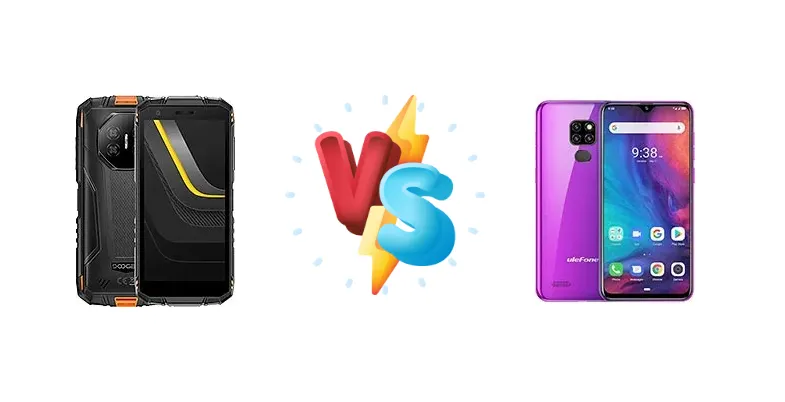
The Doogee Fire 3 Ultra and Ulefone Note 7P represent opposite ends of the budget smartphone spectrum. The Doogee prioritizes longevity and a more capable processor, while the Ulefone aims for absolute affordability. This comparison dissects their key differences to help you determine which device best suits your needs.
🏆 Quick Verdict
For the average user prioritizing performance and battery life, the Doogee Fire 3 Ultra is the clear winner. Its Unisoc T7200 chipset offers a significantly more responsive experience than the Ulefone Note 7P’s Helio A22, and the impressive 91-hour endurance makes it ideal for those away from a charger for extended periods.
| Network |
|---|
| 2G bands | GSM 850 / 900 / 1800 / 1900 | GSM 850 / 900 / 1800 / 1900 |
| 3G bands | HSDPA 850 / 900 / 1700(AWS) / 1900 / 2100 | HSDPA 850 / 900 / 2100 |
| 4G bands | 1, 2, 3, 4, 5, 7, 8, 18, 19, 20, 25, 26, 28, 34, 38, 39, 40, 41, 66 | 1, 3, 5, 7, 8, 20 |
| Speed | HSPA, LTE | HSPA 42.2/11.5 Mbps, LTE (2CA) Cat7 300/150 Mbps |
| Technology | GSM / HSPA / LTE | GSM / HSPA / LTE |
| Launch |
|---|
| Announced | 2025, August | 2019, May. Released 2019, May |
| Status | Available. Released 2025, August | Discontinued |
| Body |
|---|
| Dimensions | 162.5 x 77.4 x 17.8 mm (6.40 x 3.05 x 0.70 in) | 156.1 x 73.7 x 9.7 mm (6.15 x 2.90 x 0.38 in) |
| SIM | Nano-SIM + Nano-SIM | Nano-SIM + Micro-SIM |
| Weight | 290 g (10.23 oz) | 178.8 g (6.31 oz) |
| Display |
|---|
| Protection | Mohs level 5 | - |
| Resolution | 720 x 1440 pixels, 18:9 ratio (~293 ppi density) | 600 x 1280 pixels (~232 ppi density) |
| Size | 5.5 inches, 78.1 cm2 (~62.1% screen-to-body ratio) | 6.1 inches, 92.3 cm2 (~80.2% screen-to-body ratio) |
| Type | IPS LCD | IPS LCD |
| Platform |
|---|
| CPU | Octa-core (2x1.6 GHz Cortex-A75 & 6x1.6 GHz Cortex-A55) | Quad-core 2.0 GHz Cortex-A53 |
| Chipset | Unisoc T7200 (12 nm) | Mediatek MT6761 Helio A22 (16 nm) |
| GPU | Mali-G57 MP1 | PowerVR GE8320 |
| OS | Android 15 | Android 9.0 (Pie) |
| Memory |
|---|
| Card slot | microSDXC (uses shared SIM slot) | microSDXC (uses shared SIM slot) |
| Internal | 256GB 6GB RAM | 32GB 3GB RAM |
| | - | eMMC 5.1 |
| Main Camera |
|---|
| Dual | 16 MP, f/1.8, (wide), AF
20 MP, f/1.8, (night vision), infrared night vision light | - |
| Features | LED flash, HDR, panorama | LED flash, HDR |
| Triple | - | 8 MP, f/1.8, (wide), AF
2 MP
2 MP |
| Video | 1080p@30fps | 1080p@30fps |
| Selfie camera |
|---|
| Features | HDR | - |
| Single | 8 MP, f/2.0, (wide) | 5 MP |
| Video | 720p@30fps | - |
| Sound |
|---|
| 3.5mm jack | - | Yes |
| 35mm jack | Yes | Yes |
| Loudspeaker | Yes | Yes |
| Comms |
|---|
| Bluetooth | 5.0, A2DP, LE | 5.0, A2DP, LE |
| NFC | Yes | No |
| Positioning | GPS, GLONASS, GALILEO, BDS | GPS, GLONASS |
| Radio | FM radio | Stereo FM radio, RDS, recording |
| USB | USB Type-C 2.0 | microUSB 2.0 |
| WLAN | Wi-Fi 802.11 a/b/g/n/ac, dual-band | Wi-Fi 802.11 a/b/g/n/ac, dual-band, Wi-Fi Direct |
| Features |
|---|
| Sensors | Fingerprint (side-mounted), accelerometer, gyro, proximity, compass | Fingerprint (rear-mounted), accelerometer, proximity |
| Battery |
|---|
| Charging | 18W wired | - |
| Type | 8350 mAh | Li-Po 3500 mAh |
| Misc |
|---|
| Colors | Gray, Orange, Green | Black, Gold, Twilight |
| Price | About 160 EUR | - |
| EU LABEL |
|---|
| Battery | 91:00h endurance, 1100 cycles | - |
| Energy | Class A | - |
| Free fall | Class D (45 falls) | - |
| Repairability | Class C | - |
Doogee Fire 3 Ultra
- Significantly faster processor for smoother performance
- Exceptional 91-hour battery endurance
- Faster 18W charging
- Longer battery lifespan with 1100 charge cycles
- Likely higher price point than the Ulefone Note 7P
- Rugged design may not appeal to all users
Ulefone Note 7P
- Extremely affordable price
- Simple and easy-to-use interface
- Lightweight and compact design
- Sufficient for basic communication tasks
- Slow and unresponsive processor
- Limited multitasking capabilities
- Poor performance in demanding applications
- Likely shorter battery lifespan
Display Comparison
Neither device provides display specifications, but given their price points, we can assume both utilize IPS LCD panels. The focus here isn't on display quality, but rather on the underlying performance that drives the UI. The Doogee’s more powerful processor will contribute to smoother animations and faster app loading times, indirectly improving the perceived display experience.
Camera Comparison
Without detailed camera specifications, a direct comparison is difficult. However, it’s safe to assume both phones feature basic camera setups geared towards casual photography. The Ulefone Note 7P likely relies heavily on software processing to compensate for its less capable chipset, potentially leading to slower image capture and processing times. The Doogee’s more powerful processor should translate to faster image processing and potentially better low-light performance, even with similar sensor hardware.
Performance
The performance gap between these two devices is substantial. The Doogee Fire 3 Ultra’s Unisoc T7200, built on a 12nm process, features an octa-core configuration with two Cortex-A75 cores for performance and six Cortex-A55 cores for efficiency. This contrasts sharply with the Ulefone Note 7P’s MediaTek Helio A22, a quad-core Cortex-A53 processor fabricated on a larger 16nm node. The larger node and fewer cores mean the Helio A22 will struggle with demanding applications and multitasking, while the T7200 offers a noticeably smoother and more responsive experience. The T7200’s architecture allows for better sustained performance under load.
Battery Life
The Doogee Fire 3 Ultra boasts an impressive 91-hour endurance rating, a testament to its efficient chipset and likely a large battery capacity (though the exact mAh is unspecified). This is a significant advantage over the Ulefone Note 7P, which lacks a published endurance rating. The Doogee also supports 18W wired charging, offering a faster recharge rate than the Ulefone, which likely utilizes a slower charging standard. The 1100 charge cycles also suggest a longer lifespan for the Doogee's battery.
Buying Guide
Buy the Doogee Fire 3 Ultra if you need a phone that can handle multitasking, moderate gaming, and last for days on a single charge. It’s ideal for outdoor workers, travelers, or anyone who demands reliability. Buy the Ulefone Note 7P if you prioritize absolute affordability and only need a phone for basic tasks like calls, texts, and light social media browsing. It’s a suitable option for first-time smartphone users or as a backup device.
Frequently Asked Questions
❓ Will the Unisoc T7200 in the Doogee Fire 3 Ultra handle modern mobile games?
The Unisoc T7200 is capable of running many modern mobile games, but you’ll likely need to lower graphics settings for a smooth experience. It’s not a gaming powerhouse, but it’s a substantial upgrade over the Helio A22 and will provide a playable experience in titles like PUBG Mobile and Call of Duty Mobile.
❓ Is the Ulefone Note 7P suitable for someone who frequently uses social media apps?
The Ulefone Note 7P can handle basic social media browsing, but expect noticeable lag when scrolling through feeds or loading images. The Helio A22’s limited processing power will struggle with the demands of modern social media apps, leading to a frustrating user experience for frequent users.
❓ How does the 16nm process of the Helio A22 affect battery life compared to the 12nm process of the Unisoc T7200?
A larger process node (16nm vs 12nm) generally means lower energy efficiency. The Helio A22 will consume more power to perform the same tasks as the Unisoc T7200, contributing to the Doogee Fire 3 Ultra’s significantly longer battery life.