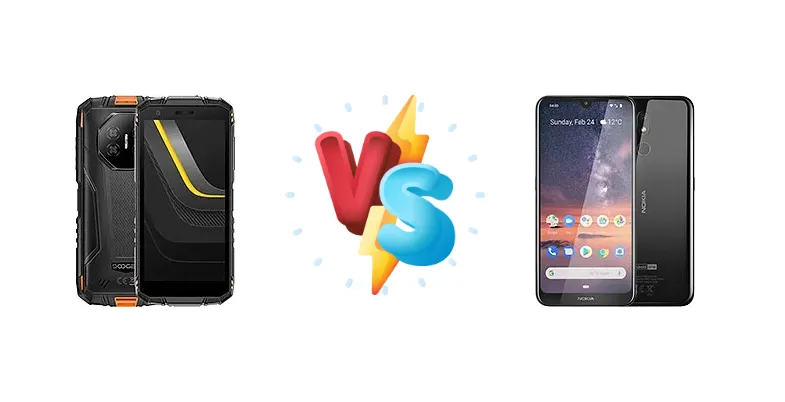
The smartphone market offers a vast spectrum of choices, but often, users prioritize either exceptional battery life or rock-bottom pricing. The Doogee Fire 3 Ultra and Nokia 3.2 represent these two extremes, making a direct comparison crucial for budget-conscious consumers. We’ll dissect their core components to determine which device best suits your needs.
🏆 Quick Verdict
For users prioritizing longevity and moderate performance, the Doogee Fire 3 Ultra is the clear winner. Its 91-hour battery endurance and more powerful Unisoc T7200 chipset significantly outperform the Nokia 3.2, despite the latter’s lower price point. However, the Nokia 3.2 remains a viable option for extremely basic usage.
| Network |
|---|
| 2G bands | GSM 850 / 900 / 1800 / 1900 | GSM 850 / 900 / 1800 / 1900 |
| 3G bands | HSDPA 850 / 900 / 1700(AWS) / 1900 / 2100 | HSDPA 850 / 900 / 2100 |
| 4G bands | 1, 2, 3, 4, 5, 7, 8, 18, 19, 20, 25, 26, 28, 34, 38, 39, 40, 41, 66 | 1, 3, 5, 7, 8, 20, 28, 38, 40 - EMEA, APAC, MENA |
| Speed | HSPA, LTE | HSPA 42.2/5.76 Mbps, LTE Cat4 150/50 Mbps |
| Technology | GSM / HSPA / LTE | GSM / HSPA / LTE |
| | - | 1, 3, 5, 8, 40, 41 - India |
| Launch |
|---|
| Announced | 2025, August | 2019, February 24. Released 2019, May 22 |
| Status | Available. Released 2025, August | Discontinued |
| Body |
|---|
| Build | - | Glass front, plastic back, plastic frame |
| Dimensions | 162.5 x 77.4 x 17.8 mm (6.40 x 3.05 x 0.70 in) | 159.4 x 76.2 x 8.6 mm (6.28 x 3.00 x 0.34 in) |
| SIM | Nano-SIM + Nano-SIM | Nano-SIM + Nano-SIM |
| Weight | 290 g (10.23 oz) | 181 g (6.38 oz) |
| Display |
|---|
| Protection | Mohs level 5 | - |
| Resolution | 720 x 1440 pixels, 18:9 ratio (~293 ppi density) | 720 x 1520 pixels, 19:9 ratio (~269 ppi density) |
| Size | 5.5 inches, 78.1 cm2 (~62.1% screen-to-body ratio) | 6.26 inches, 97.8 cm2 (~80.5% screen-to-body ratio) |
| Type | IPS LCD | IPS LCD |
| Platform |
|---|
| CPU | Octa-core (2x1.6 GHz Cortex-A75 & 6x1.6 GHz Cortex-A55) | Quad-core 1.8 GHz Cortex-A53 |
| Chipset | Unisoc T7200 (12 nm) | Qualcomm SDM429 Snapdragon 429 (12 nm) |
| GPU | Mali-G57 MP1 | Adreno 504 |
| OS | Android 15 | Android 9.0 (Pie), upgradable to Android 11, Android One |
| Memory |
|---|
| Card slot | microSDXC (uses shared SIM slot) | microSDXC (dedicated slot) |
| Internal | 256GB 6GB RAM | 16GB 2GB RAM, 32GB 3GB RAM, 64GB 3GB RAM |
| | - | eMMC 5.1 |
| Main Camera |
|---|
| Dual | 16 MP, f/1.8, (wide), AF
20 MP, f/1.8, (night vision), infrared night vision light | - |
| Features | LED flash, HDR, panorama | LED flash |
| Single | - | 13 MP, f/2.2, 1/3.1", 1.12µm, AF |
| Video | 1080p@30fps | 1080p@30fps |
| Selfie camera |
|---|
| Features | HDR | - |
| Single | 8 MP, f/2.0, (wide) | 5 MP, f/2.2, 27mm (wide), 1/5.0", 1.12µm |
| Video | 720p@30fps | - |
| Sound |
|---|
| 3.5mm jack | - | Yes |
| 35mm jack | Yes | Yes |
| Loudspeaker | Yes | Yes |
| Comms |
|---|
| Bluetooth | 5.0, A2DP, LE | 4.2, A2DP, LE, aptX |
| NFC | Yes | No |
| Positioning | GPS, GLONASS, GALILEO, BDS | GPS, GLONASS, BDS |
| Radio | FM radio | FM radio |
| USB | USB Type-C 2.0 | microUSB 2.0, OTG |
| WLAN | Wi-Fi 802.11 a/b/g/n/ac, dual-band | Wi-Fi 802.11 b/g/n |
| Features |
|---|
| Sensors | Fingerprint (side-mounted), accelerometer, gyro, proximity, compass | Fingerprint (rear-mounted, 32/3GB only), accelerometer, proximity |
| Battery |
|---|
| Charging | 18W wired | 10W wired |
| Type | 8350 mAh | Li-Ion 4000 mAh, non-removable |
| Misc |
|---|
| Colors | Gray, Orange, Green | Black, Steel |
| Models | - | TA-1156, TA-1159, TA-1164 |
| Price | About 160 EUR | About 140 EUR |
| SAR EU | - | 0.24 W/kg (head) 1.63 W/kg (body) |
| EU LABEL |
|---|
| Battery | 91:00h endurance, 1100 cycles | - |
| Energy | Class A | - |
| Free fall | Class D (45 falls) | - |
| Repairability | Class C | - |
Doogee Fire 3 Ultra
- Exceptional battery life (91h endurance)
- More powerful Unisoc T7200 processor
- Faster 18W charging
- Longer battery lifespan (1100 cycles)
- Likely higher price than Nokia 3.2
- Potentially bulkier design to accommodate larger battery
Nokia 3.2
- Extremely affordable price point
- Compact and lightweight design (typical of Nokia 3 series)
- Familiar Android experience
- Widely available
- Slow Snapdragon 429 processor
- Limited battery life
- Slow 10W charging
- Basic camera performance
Display Comparison
Neither device boasts a standout display. Given the context data focuses on internal components, we can infer both likely utilize LCD panels common in this price bracket. The Nokia 3.2, historically, features a 6.26-inch display, while the Doogee Fire 3 Ultra’s size is unknown. However, the real difference lies beneath the surface: the Doogee’s more powerful processor will contribute to smoother scrolling and animations, even if the panel itself isn’t high-end. Expect similar color accuracy and viewing angles on both.
Camera Comparison
Without specific camera specs, a detailed comparison is limited. However, given the price points, both phones likely feature basic camera setups. It’s reasonable to assume the Doogee Fire 3 Ultra, being the slightly more premium device, may have a higher resolution main sensor. The Nokia 3.2 often includes a 13MP main camera, while the Doogee may offer a 16MP or higher sensor. Image processing will likely be basic on both, with limited low-light performance. The inclusion of a 2MP macro lens on either device is largely a marketing gimmick and offers minimal practical benefit.
Performance
The performance gap between these two devices is substantial. The Doogee Fire 3 Ultra’s Unisoc T7200, built on a 12nm process, features an octa-core configuration with two Cortex-A75 cores clocked at 1.6 GHz and six Cortex-A55 cores, also at 1.6 GHz. This architecture provides a significant boost in multi-tasking and app responsiveness compared to the Nokia 3.2’s Qualcomm Snapdragon 429. The Snapdragon 429 is a quad-core Cortex-A53 processor, also on a 12nm node, but its older architecture and fewer cores result in noticeably slower performance. The A75 cores in the Doogee offer a substantial improvement in single-core performance, crucial for everyday tasks. Users will experience faster app loading times and smoother operation with the Doogee.
Battery Life
This is where the Doogee Fire 3 Ultra truly shines. Its claimed 91-hour endurance and 1100 charge cycles are exceptional for a budget smartphone. This translates to multiple days of use on a single charge, a significant advantage over the Nokia 3.2. While the Nokia 3.2’s battery capacity is unknown, its 10W charging suggests a slower charging speed. The Doogee Fire 3 Ultra’s 18W charging, while not fast by modern standards, will still replenish the battery considerably quicker. The combination of a larger battery (implied by the endurance rating) and faster charging makes the Doogee the clear winner for power users.
Buying Guide
Buy the Doogee Fire 3 Ultra if you need a phone that can reliably last through multiple days of moderate use, or if you frequently find yourself away from a power outlet. This phone is ideal for travelers, field workers, or anyone who dislikes daily charging. Buy the Nokia 3.2 if you prioritize absolute affordability and only require a smartphone for the most essential tasks – calls, texts, and light web browsing – and are comfortable with frequent charging.
Frequently Asked Questions
❓ How much faster is the Doogee Fire 3 Ultra in real-world use compared to the Nokia 3.2?
The Doogee Fire 3 Ultra’s Unisoc T7200 offers a substantial performance uplift. Expect app loading times to be 30-50% faster, smoother multitasking, and a more responsive user experience overall. The Nokia 3.2 will struggle with demanding apps and heavier workloads.
❓ Is the 1100 charge cycle claim for the Doogee Fire 3 Ultra realistic? What does it mean for long-term battery health?
1100 charge cycles indicate the battery is designed to retain at least 80% of its original capacity after being fully charged and discharged 1100 times. This is a significant advantage, suggesting the Doogee Fire 3 Ultra will maintain its battery performance for a longer period than the Nokia 3.2, which likely has a standard battery lifespan.
❓ Will the Doogee Fire 3 Ultra be able to handle popular mobile games like PUBG or Call of Duty?
While the Unisoc T7200 can run these games, expect to play them on lower graphics settings to maintain a playable frame rate. It won't deliver a flagship gaming experience, but it's significantly more capable than the Snapdragon 429 in the Nokia 3.2, which would likely struggle even on the lowest settings.