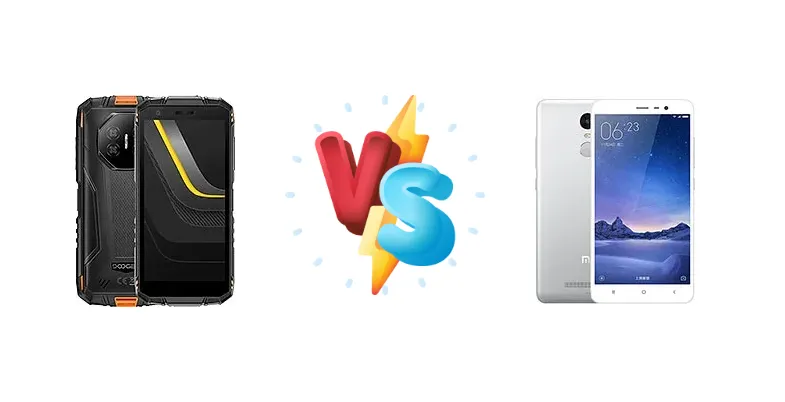
The Doogee Fire 3 Pro and Xiaomi Redmi Note 3 represent distinct approaches to the budget smartphone market. The Redmi Note 3, while older, established a strong reputation for value, while the Fire 3 Pro aims to deliver exceptional battery life and a modern chipset at a competitive price. This comparison dissects their key differences to help you choose the right device.
🏆 Quick Verdict
For users prioritizing sheer battery endurance and a more modern processor, the Doogee Fire 3 Pro emerges as the winner. Its 91-hour endurance and Unisoc T7200 chipset offer a significant advantage. However, the Redmi Note 3’s superior display contrast makes it a viable option for media consumption.
| Network |
|---|
| 2G bands | GSM 850 / 900 / 1800 / 1900 | GSM 850 / 900 / 1800 / 1900 - SIM 1 & SIM 2 |
| 3G bands | HSDPA 850 / 900 / 1700(AWS) / 1900 / 2100 | HSDPA 850 / 900 / 1700(AWS) / 1900 / 2100 - Global |
| 4G bands | 1, 2, 3, 4, 5, 7, 8, 18, 19, 20, 25, 26, 28, 34, 38, 39, 40, 41, 66 | 1, 3, 5, 7, 8, 38, 39, 40, 41 - Global |
| Speed | HSPA, LTE | HSPA 42.2/5.76 Mbps, LTE Cat6 300/50 Mbps |
| Technology | GSM / HSPA / LTE | GSM / HSPA / LTE |
| | - | 1, 2, 3, 4, 5, 7, 8, 20, 28, 40 - Special edition (Taiwan) |
| Launch |
|---|
| Announced | 2025, August | 2016, January 14. Released 2016, March 03 |
| Status | Available. Released 2025, August | Discontinued |
| Body |
|---|
| Build | - | Glass front, aluminum back, aluminum frame |
| Dimensions | 162.5 x 77.4 x 17.8 mm (6.40 x 3.05 x 0.70 in) | 150 x 76 x 8.7 mm (5.91 x 2.99 x 0.34 in) |
| SIM | Nano-SIM + Nano-SIM | Nano-SIM + Micro-SIM |
| Weight | 290 g (10.23 oz) | 164 g (5.78 oz) |
| Display |
|---|
| Protection | Mohs level 5 | - |
| Resolution | 720 x 1440 pixels, 18:9 ratio (~293 ppi density) | 1080 x 1920 pixels, 16:9 ratio (~403 ppi density) |
| Size | 5.5 inches, 78.1 cm2 (~62.1% screen-to-body ratio) | 5.5 inches, 82.6 cm2 (~72.4% screen-to-body ratio) |
| Type | IPS LCD | IPS LCD |
| Platform |
|---|
| CPU | Octa-core (2x1.6 GHz Cortex-A75 & 6x1.6 GHz Cortex-A55) | Hexa-core (4x1.4 GHz Cortex-A53 & 2x1.8 GHz Cortex-A72) |
| Chipset | Unisoc T7200 (12 nm) | Qualcomm MSM8956 Snapdragon 650 |
| GPU | Mali-G57 MP1 | Adreno 510 |
| OS | Android 15 | Android 5.1.1 (Lollipop), upgradable to 6.0.1 (Marshmallow), MIUI 9.5 |
| Memory |
|---|
| Card slot | microSDXC (uses shared SIM slot) | microSDXC (uses shared SIM slot) |
| Internal | 128GB 4GB RAM | 16GB 2GB RAM (Standard version), 32GB 3GB RAM (High/Special version) |
| | - | eMMC 4.5 |
| Main Camera |
|---|
| Features | LED flash, HDR, panorama | Dual-LED dual-tone flash, HDR, panorama |
| Single | 16 MP, f/1.8, (wide), AF | 16 MP, f/2.0, PDAF |
| Video | 1080p@30fps | 1080p@30fps |
| Selfie camera |
|---|
| Features | HDR | - |
| Single | 8 MP, f/2.0, (wide) | 5 MP, f/2.0 |
| Video | 720p@30fps | 1080p@30fps |
| Sound |
|---|
| 3.5mm jack | - | Yes |
| 35mm jack | Yes | Yes |
| Loudspeaker | Yes | Yes |
| | - | 24-bit/192kHz audio
|
| Comms |
|---|
| Bluetooth | 5.0, A2DP, LE | 4.1, A2DP, LE |
| Infrared port | - | Yes |
| NFC | Yes | No |
| Positioning | GPS, GLONASS, GALILEO, BDS | GPS, GLONASS, BDS |
| Radio | FM radio | Stereo FM radio, recording |
| USB | USB Type-C 2.0 | microUSB 2.0, OTG |
| WLAN | Wi-Fi 802.11 a/b/g/n/ac, dual-band | Wi-Fi 802.11 a/b/g/n/ac, dual-band, Wi-Fi Direct, hotspot |
| Features |
|---|
| Sensors | Fingerprint (side-mounted), accelerometer, gyro, proximity, compass | Fingerprint (rear-mounted), accelerometer, gyro, proximity, compass |
| Battery |
|---|
| Charging | 18W wired | 10W wired |
| Type | 8350 mAh | Li-Po 4050 mAh, non-removable |
| Misc |
|---|
| Colors | Gray, Orange, Green | Silver, Gray, Gold |
| Models | - | 2015116, 2015161 |
| Price | - | About 160 EUR |
| SAR | - | 0.49 W/kg (head) 0.50 W/kg (body) |
| SAR EU | - | 0.56 W/kg (head) |
| Tests |
|---|
| Audio quality | - |
Noise -96.0dB / Crosstalk -95.6dB |
| Battery life | - | Endurance rating 93h |
| Camera | - |
Photo / Video |
| Display | - |
Contrast ratio: 953:1 (nominal), 2.249 (sunlight) |
| Loudspeaker | - |
Voice 66dB / Noise 66dB / Ring 75dB |
| Performance | - |
Basemark OS II 2.0: 1426Basemark X: 14717 |
| EU LABEL |
|---|
| Battery | 91:00h endurance, 1100 cycles | - |
| Energy | Class A | - |
| Free fall | Class D (45 falls) | - |
| Repairability | Class C | - |
Doogee Fire 3 Pro
- Exceptional 91-hour battery endurance
- Modern Unisoc T7200 chipset for improved efficiency
- Faster 18W wired charging
- Display specifications are unknown, potentially lacking contrast
- Camera details are limited, making performance uncertain
Xiaomi Redmi Note 3
- Excellent display contrast ratio (953:1 nominal, 2.249 sunlight)
- Established reputation for value
- Decent 93-hour battery endurance
- Older Snapdragon 650 chipset
- Slower 10W wired charging
Display Comparison
The Xiaomi Redmi Note 3 boasts a display with a nominal contrast ratio of 953:1, peaking at 2.249 under sunlight, indicating strong visibility in bright conditions. The Doogee Fire 3 Pro’s display specifications are not provided, making a direct comparison difficult. However, given its market positioning, it likely utilizes an IPS LCD panel, potentially lacking the Redmi Note 3’s superior contrast. This makes the Redmi Note 3 the better choice for users who frequently consume media outdoors or appreciate vibrant visuals.
Camera Comparison
Both devices feature photo and video capabilities, but detailed camera specifications are lacking. Without sensor size, aperture, or image processing details, a meaningful comparison is impossible. However, given the Redmi Note 3’s historical reputation, it likely offers a more refined camera experience, though the Fire 3 Pro’s newer chipset *could* provide improved image processing capabilities. We can assume both phones will struggle in low-light conditions without dedicated night modes.
Performance
The Doogee Fire 3 Pro’s Unisoc T7200 (12nm) chipset features an octa-core configuration with a mix of Cortex-A75 and A55 cores, offering a more modern architecture than the Xiaomi Redmi Note 3’s Qualcomm Snapdragon 650 (MSM8956). The Snapdragon 650 utilizes a hexa-core setup with Cortex-A72 and A53 cores. While the Snapdragon 650’s Cortex-A72 cores have a higher peak clock speed (1.8 GHz vs 1.6 GHz), the Unisoc T7200’s newer architecture and more efficient 12nm process should translate to better sustained performance and thermal management, particularly in demanding tasks. This benefits users who engage in moderate gaming or multitasking.
Battery Life
The Doogee Fire 3 Pro shines with a remarkable 91-hour endurance rating and a claimed 1100 charge cycles, suggesting exceptional longevity. The Xiaomi Redmi Note 3, while still respectable at 93 hours, falls slightly behind. Furthermore, the Fire 3 Pro supports 18W wired charging, a step up from the Redmi Note 3’s 10W charging. This faster charging speed, combined with the longer endurance, makes the Doogee Fire 3 Pro the clear winner for users prioritizing battery life and minimizing downtime.
Buying Guide
Buy the Doogee Fire 3 Pro if you need a phone that can reliably last through multiple days of moderate use, and you value a newer chipset for improved efficiency. Buy the Xiaomi Redmi Note 3 if you prioritize a display with excellent contrast for viewing photos and videos, and are comfortable with an older, but still capable, processor.
Frequently Asked Questions
❓ How does the Unisoc T7200 in the Doogee Fire 3 Pro handle graphically intensive games like PUBG?
While the Unisoc T7200 isn't a flagship gaming chip, its Cortex-A75 cores and modern architecture should allow for playable performance in PUBG at medium settings. However, expect some frame drops during intense firefights. The Snapdragon 650 in the Redmi Note 3 will likely struggle more with consistent frame rates in the same game.
❓ Is the 1100 charge cycle claim for the Doogee Fire 3 Pro realistic, and what does it mean for long-term battery health?
1100 charge cycles is a significant claim, suggesting the battery is designed to retain a substantial portion of its capacity even after extensive use. This means the battery should remain usable for a longer period before needing replacement compared to phones with lower cycle counts. However, actual battery degradation will also depend on usage patterns and charging habits.
❓ Does the Xiaomi Redmi Note 3 support fast charging, and if not, how long does it take to fully charge?
The Xiaomi Redmi Note 3 only supports 10W charging, which is relatively slow by today's standards. A full charge from 0% to 100% will likely take around 3-4 hours, depending on the charger used. The Doogee Fire 3 Pro's 18W charging offers a significantly faster charging experience.