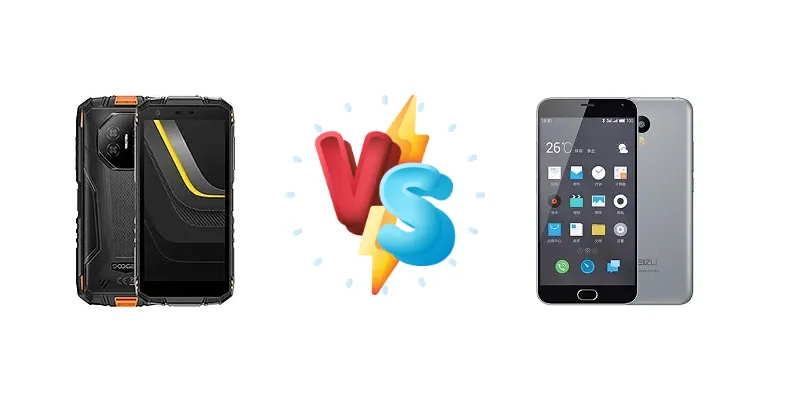
The smartphone landscape is littered with choices, but often, users prioritize battery life and reliable performance. We pit the Doogee Fire 3 Pro, a modern device boasting impressive endurance, against the Meizu M2 Note, a slightly older model that still holds appeal for budget-conscious buyers. This comparison will dissect their core components to determine which phone delivers the best value.
🏆 Quick Verdict
For the average user prioritizing longevity and responsiveness, the Doogee Fire 3 Pro is the clear winner. Its Unisoc T7200 chipset and exceptional 91-hour battery endurance significantly outperform the Meizu M2 Note’s older Mediatek MT6753 and 69-hour rating, making it ideal for power users and travelers.
| Network |
|---|
| 2G bands | GSM 850 / 900 / 1800 / 1900 | GSM 850 / 900 / 1800 / 1900 - SIM 1 & SIM 2 |
| 3G bands | HSDPA 850 / 900 / 1700(AWS) / 1900 / 2100 | HSDPA 850 / 900 / 1900 / 2100 |
| 4G bands | 1, 2, 3, 4, 5, 7, 8, 18, 19, 20, 25, 26, 28, 34, 38, 39, 40, 41, 66 | 1, 3, 7, 38, 39, 40, 41 |
| Speed | HSPA, LTE | HSPA 42.2/5.76 Mbps, LTE Cat4 150/50 Mbps |
| Technology | GSM / HSPA / LTE | GSM / HSPA / LTE |
| | - | TD-SCDMA |
| Launch |
|---|
| Announced | 2025, August | 2015, June. Released 2015, June |
| Status | Available. Released 2025, August | Discontinued |
| Body |
|---|
| Dimensions | 162.5 x 77.4 x 17.8 mm (6.40 x 3.05 x 0.70 in) | 150.9 x 75.2 x 8.7 mm (5.94 x 2.96 x 0.34 in) |
| SIM | Nano-SIM + Nano-SIM | Nano-SIM + Nano-SIM |
| Weight | 290 g (10.23 oz) | 149 g (5.26 oz) |
| Display |
|---|
| Protection | Mohs level 5 | Asahi Dragontrail Glass or Dinorex T2X-1 scratch/shock resistant glass |
| Resolution | 720 x 1440 pixels, 18:9 ratio (~293 ppi density) | 1080 x 1920 pixels, 16:9 ratio (~403 ppi density) |
| Size | 5.5 inches, 78.1 cm2 (~62.1% screen-to-body ratio) | 5.5 inches, 82.6 cm2 (~72.8% screen-to-body ratio) |
| Type | IPS LCD | IGZO IPS LCD |
| Platform |
|---|
| CPU | Octa-core (2x1.6 GHz Cortex-A75 & 6x1.6 GHz Cortex-A55) | Octa-core 1.3 GHz Cortex-A53 |
| Chipset | Unisoc T7200 (12 nm) | Mediatek MT6753 (28 nm) |
| GPU | Mali-G57 MP1 | Mali-T720MP3 |
| OS | Android 15 | Android 5.0 (Lollipop), Flyme 4.5 |
| Memory |
|---|
| Card slot | microSDXC (uses shared SIM slot) | microSDXC (uses shared SIM slot) |
| Internal | 128GB 4GB RAM | 16GB 2GB RAM, 32GB 2GB RAM |
| Main Camera |
|---|
| Features | LED flash, HDR, panorama | Dual-LED dual-tone flash, HDR, panorama |
| Single | 16 MP, f/1.8, (wide), AF | 13 MP, f/2.2, 1/3.0", AF |
| Video | 1080p@30fps | 1080p, 1080p@30fps |
| Selfie camera |
|---|
| Features | HDR | - |
| Single | 8 MP, f/2.0, (wide) | 5 MP, f/2.0, 1/5.0", 1.12µm |
| Video | 720p@30fps | 1080p@30fps |
| Sound |
|---|
| 3.5mm jack | - | Yes |
| 35mm jack | Yes | Yes |
| Loudspeaker | Yes | Yes |
| Comms |
|---|
| Bluetooth | 5.0, A2DP, LE | 4.0, A2DP, LE |
| NFC | Yes | No |
| Positioning | GPS, GLONASS, GALILEO, BDS | GPS, GLONASS |
| Radio | FM radio | No |
| USB | USB Type-C 2.0 | microUSB 2.0, OTG |
| WLAN | Wi-Fi 802.11 a/b/g/n/ac, dual-band | Wi-Fi 802.11 a/b/g/n, dual-band, Wi-Fi Direct, hotspot |
| Features |
|---|
| Sensors | Fingerprint (side-mounted), accelerometer, gyro, proximity, compass | Accelerometer, gyro, proximity, compass |
| Battery |
|---|
| Charging | 18W wired | - |
| Type | 8350 mAh | Li-Ion 3100 mAh, non-removable |
| Misc |
|---|
| Colors | Gray, Orange, Green | Gray, White, Blue, Pink |
| Models | - | m2 note, MZ-m2 note |
| Price | - | About 200 EUR |
| Tests |
|---|
| Battery life | - |
Endurance rating 69h
|
| Camera | - |
Photo / Video |
| Loudspeaker | - |
Voice 65dB / Noise 62dB / Ring 75dB
|
| EU LABEL |
|---|
| Battery | 91:00h endurance, 1100 cycles | - |
| Energy | Class A | - |
| Free fall | Class D (45 falls) | - |
| Repairability | Class C | - |
Doogee Fire 3 Pro
- Exceptional battery life (91h endurance)
- Modern and efficient Unisoc T7200 chipset
- Potentially longer battery lifespan (1100 cycles)
- Specific display details are unknown
- Camera specifications are not detailed
Meizu M2 Note
- Lower price point (likely)
- Simple and straightforward user experience
- Compact form factor (potentially)
- Outdated Mediatek MT6753 chipset
- Significantly shorter battery life (69h endurance)
- Limited performance for modern applications
Display Comparison
The context data lacks display specifics for both devices. However, given the Meizu M2 Note’s age (released 2015), it likely features an IPS LCD panel with a 720p resolution. The Doogee Fire 3 Pro, being a more recent device, likely utilizes a similar IPS LCD, but potentially with a higher resolution and improved color accuracy. The absence of details like peak brightness or refresh rate makes a definitive comparison impossible, but the Fire 3 Pro benefits from newer panel technology.
Camera Comparison
Both devices are listed as having 'Photo / Video' capabilities, but lack specific details. Given the Meizu M2 Note’s release date, its camera likely features a 13MP main sensor. The Doogee Fire 3 Pro, while details are missing, likely incorporates a more modern sensor with improved low-light performance and dynamic range. Without sensor size or aperture information, a precise comparison is difficult, but the Fire 3 Pro’s newer technology suggests a superior imaging experience. The lack of detail suggests neither phone will excel in photography.
Performance
The Doogee Fire 3 Pro’s Unisoc T7200 (12nm) represents a significant leap forward in processing power compared to the Meizu M2 Note’s Mediatek MT6753 (28nm). The T7200’s octa-core configuration, featuring both Cortex-A75 and A55 cores, provides a more balanced performance profile, excelling in both single-core and multi-core tasks. The older MT6753, with its all Cortex-A53 cores, will struggle with demanding applications and multitasking. The 12nm process node of the T7200 also translates to improved thermal efficiency, reducing the likelihood of throttling during sustained workloads. This benefits users who engage in gaming or video editing.
Battery Life
The Doogee Fire 3 Pro’s battery endurance of 91 hours is a standout feature, dwarfing the Meizu M2 Note’s 69-hour rating. This substantial difference is attributable to the more efficient Unisoc T7200 chipset and potentially a larger battery capacity (though not specified). The Fire 3 Pro also supports 18W wired charging, allowing for faster replenishment compared to the likely slower charging speeds of the M2 Note. The Fire 3 Pro’s 1100 charge cycles suggest a longer lifespan and sustained battery health, benefiting users who plan to keep their device for several years.
Buying Guide
Buy the Doogee Fire 3 Pro if you need a phone that can reliably last through multiple days of moderate use, or if you require a more responsive experience for everyday tasks and light gaming. Buy the Meizu M2 Note if you are on an extremely tight budget and only require basic smartphone functionality – calls, texts, and occasional light browsing – and are willing to compromise on performance and battery life.
Frequently Asked Questions
❓ Is the Unisoc T7200 in the Doogee Fire 3 Pro capable of running demanding games like PUBG Mobile?
While the Unisoc T7200 isn't a flagship-level chipset, it's capable of running PUBG Mobile at medium settings with acceptable frame rates. However, users shouldn't expect the same performance as phones with Snapdragon or Dimensity processors. The 12nm process helps mitigate thermal throttling during extended gaming sessions.
❓ How does the battery life of the Doogee Fire 3 Pro hold up with heavy usage, such as streaming video and using GPS?
The Doogee Fire 3 Pro’s 91-hour endurance rating suggests excellent battery life even with heavy usage. The efficient Unisoc T7200 chipset minimizes power consumption, and the large battery capacity (though unspecified) provides ample reserve for streaming video, using GPS, and other demanding tasks. Expect a full day of heavy use, and potentially two days with moderate usage.
❓ Is the Meizu M2 Note still a viable option for basic communication and light web browsing?
Yes, the Meizu M2 Note can still handle basic tasks like calls, texts, and light web browsing. However, its older chipset and limited battery life mean it will struggle with more demanding applications and multitasking. It's best suited for users with minimal smartphone needs and a very tight budget.