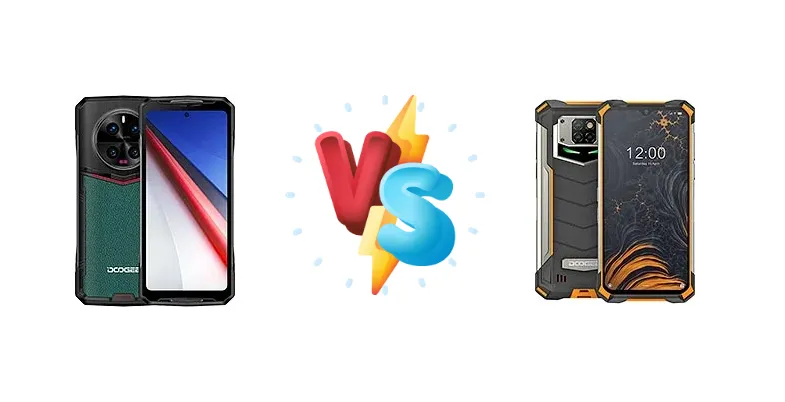
Doogee caters to two distinct audiences: those prioritizing raw performance and those needing a durable, long-lasting device. The DK10, with its modern Dimensity 8020 chipset, represents a significant shift towards the former, while the S88 Pro continues Doogee’s tradition of robust, if less powerful, rugged smartphones. This comparison dissects the key differences to help you choose the right Doogee for your needs.
🏆 Quick Verdict
For the average user seeking a responsive and capable smartphone, the Doogee DK10 is the clear winner. Its Dimensity 8020 chipset delivers substantially better performance than the S88 Pro’s Helio P70. However, those prioritizing extreme battery life and a truly rugged build will still find value in the S88 Pro.
| Network |
|---|
| 2G bands | GSM 850 / 900 / 1800 / 1900 | GSM 850 / 900 / 1800 / 1900 |
| 3G bands | HSDPA 800 / 850 / 900 / 1700(AWS) / 1900 / 2100 | HSDPA 850 / 900 / 1700(AWS) / 1900 / 2100 |
| 4G bands | 1, 2, 3, 4, 5, 7, 8, 12, 17, 18, 19, 20, 25, 26, 28, 34, 38, 39, 40, 41, 66 | 1, 3, 7, 8, 20 |
| 5G bands | 1, 3, 5, 7, 8, 20, 28, 38, 40, 41, 71, 77, 78, 79 SA/NSA | - |
| Speed | HSPA, LTE, 5G | HSPA, LTE |
| Technology | GSM / CDMA / HSPA / LTE / 5G | GSM / HSPA / LTE |
| Launch |
|---|
| Announced | 2024, February 28 | 2020, June 06. Released 2020, June 06 |
| Status | Available. Released 2024, March | Discontinued |
| Body |
|---|
| Build | - | Glass front (Gorilla Glass), aluminum back with rubber, aluminum frame |
| Dimensions | 181.7 x 83.1 x 12.7 mm (7.15 x 3.27 x 0.5 in) | 171.6 x 85.5 x 18.7 mm (6.76 x 3.37 x 0.74 in) |
| SIM | Nano-SIM + Nano-SIM | Nano-SIM + Nano-SIM |
| Weight | - | 372 g (13.12 oz) |
| Display |
|---|
| Protection | Corning Gorilla Glass | Corning Gorilla Glass |
| Resolution | 1080 x 2400 pixels, 20:9 ratio (~395 ppi density) | 1080 x 2340 pixels, 19.5:9 ratio (~409 ppi density) |
| Size | 6.67 inches, 107.4 cm2 (~71.1% screen-to-body ratio) | 6.3 inches, 97.4 cm2 (~66.4% screen-to-body ratio) |
| Type | AMOLED, 120Hz | IPS LCD |
| Platform |
|---|
| CPU | Octa-core (4x2.6 GHz Cortex-A78 & 4x2.0 GHz Cortex-A55) | Octa-core (4x2.1 GHz Cortex-A73 & 4x2.0 GHz Cortex-A53) |
| Chipset | Mediatek Dimensity 8020 (6 nm) | Mediatek MT6771T Helio P70 (12 nm) |
| GPU | Mali-G77 MC9 | Mali-G72 MP3 |
| OS | Android 13 | Android 10 |
| Memory |
|---|
| Card slot | microSDXC (uses shared SIM slot) | microSDXC (uses shared SIM slot) |
| Internal | 512GB 12GB RAM | 128GB 6GB RAM |
| Main Camera |
|---|
| Features | Dual-LED flash, HDR, panorama | Dual-LED dual-tone flash, HDR, panorama |
| Quad | 50 MP, f/2.0, (wide), 1/1.31", PDAF
16 MP, f/2.5, (telephoto), 1/3.1", PDAF, 4x optical zoom
50 MP, f/2.2, 123˚ (ultrawide)
64 MP, f/1.8, (night vision), 2 infrared night vision lights | - |
| Triple | - | 21 MP, f/2.2, (wide), 1/2.4", 1.12µm, PDAF
8 MP, f/2.2, 130˚, (ultrawide), 1/4.0", 1.12µm
Auxiliary lens |
| Video | 4K@30fps, 1080p@30fps | 1080p@30fps |
| Selfie camera |
|---|
| Single | 50 MP, f/2.5, (wide), 1/2.76" | 16 MP, f/2.2, 26mm (wide) |
| Video | 1440p@30fps, 1080p@30fps | 1080p@30fps |
| Sound |
|---|
| 35mm jack | Unspecified | No |
| Loudspeaker | Yes | Yes |
| Comms |
|---|
| Bluetooth | 5.1, A2DP, LE | 4.2, A2DP |
| NFC | Yes | Yes |
| Positioning | GPS (L1+L5), GLONASS, GALILEO, BDS | GPS, GLONASS, BDS, GALILEO |
| Radio | FM radio | FM radio |
| USB | USB Type-C 2.0, OTG | USB Type-C 2.0, OTG |
| WLAN | Wi-Fi 802.11 a/b/g/n/ac/6, dual-band | Wi-Fi 802.11 b/g/n |
| Features |
|---|
| Sensors | Fingerprint (side-mounted), accelerometer, gyro, proximity, compass | Fingerprint (side-mounted), accelerometer, gyro, proximity, compass |
| Battery |
|---|
| Charging | 120W wired
50W wireless
Reverse wired | 24W wired
10W wireless
5W Reverse wireless |
| Type | 5150 mAh | 10000 mAh |
| Misc |
|---|
| Colors | Emerald Green, Kevlar Black | Fire Orange, Army Green, Mineral Black |
| Price | - | About 130 EUR |
Doogee DK10
- Significantly faster processor for gaming and multitasking
- Ultra-fast 120W wired and 50W wireless charging
- Likely superior display quality (brightness, color accuracy)
- More advanced image processing capabilities
- Potentially less rugged than the S88 Pro
- Battery life may be shorter than the S88 Pro
Doogee S88 Pro
- Exceptional battery life (202h endurance)
- Ruggedized design for durability
- More affordable price point
- Reliable performance for basic tasks
- Outdated Helio P70 chipset struggles with demanding apps
- Slow charging speeds (24W wired)
- Lower display quality compared to modern panels
Display Comparison
The context data for the DK10 lacks display specifics, but given its positioning, we can expect a modern panel with a high refresh rate. The S88 Pro’s contrast ratio of 1641:1 is respectable, but likely utilizes an IPS LCD. The DK10, being a newer device, likely benefits from a more color-accurate and brighter display, potentially utilizing AMOLED technology. The S88 Pro’s display is geared towards visibility in direct sunlight, while the DK10 will likely offer a more vibrant and immersive viewing experience.
Camera Comparison
Without detailed camera specs for the DK10, a direct comparison is limited. However, the chipset’s ISP capabilities on the Dimensity 8020 are significantly more advanced than those on the Helio P70. This translates to better image processing, noise reduction, and dynamic range. The S88 Pro likely relies on software processing to compensate for its older hardware. While both phones may feature multiple cameras, the DK10’s image quality will likely be superior, particularly in low-light conditions. We anticipate the DK10 to have a more modern sensor setup.
Performance
The performance gap between these two devices is substantial. The Doogee DK10’s Mediatek Dimensity 8020 (6nm) boasts a modern CPU architecture – Cortex-A78 and A55 cores clocked at 2.6GHz and 2.0GHz respectively – offering a significant uplift over the S88 Pro’s Helio P70 (12nm) with its Cortex-A73 and A53 cores at 2.1GHz and 2.0GHz. The 6nm process node of the Dimensity 8020 also translates to improved thermal efficiency, reducing throttling during sustained workloads. This means the DK10 will handle demanding games and applications with far greater ease. The S88 Pro, while adequate for basic tasks, will struggle with resource-intensive applications.
Battery Life
The Doogee S88 Pro’s 202-hour endurance rating is its strongest suit. While the DK10’s battery capacity is unknown, its 120W wired charging and 50W wireless charging capabilities are dramatically faster than the S88 Pro’s 24W wired and 10W wireless. The DK10 prioritizes quick top-ups, while the S88 Pro focuses on maximizing runtime between charges. The DK10’s reverse wired charging is also a useful feature for topping up accessories, absent on the S88 Pro.
Buying Guide
Buy the Doogee DK10 if you need a phone for demanding tasks like gaming, video editing, or multitasking, and fast charging is a priority. You'll benefit from the significantly improved processing power and responsiveness. Buy the Doogee S88 Pro if you work in harsh environments, require exceptional battery endurance for extended periods away from a charger, and prioritize a rugged, drop-proof design over peak performance.
Frequently Asked Questions
❓ Does the Dimensity 8020 in the DK10 generate excessive heat during prolonged gaming sessions?
The Dimensity 8020’s 6nm process node is designed for improved thermal efficiency compared to the 12nm Helio P70. While some heat generation is inevitable during gaming, the DK10 should manage temperatures better, minimizing throttling and maintaining consistent performance for longer periods. However, sustained peak loads will still produce heat.
❓ Is the ruggedness of the S88 Pro sufficient for demanding work environments like construction sites?
The Doogee S88 Pro is specifically designed for rugged use, featuring a durable build that can withstand drops, dust, and water immersion. While specific certifications aren't provided, Doogee's reputation in the rugged phone market suggests it's well-suited for challenging work environments. However, the DK10 may offer some level of splash resistance, but it's not designed for the same level of abuse.
❓ How long does it realistically take to fully charge the Doogee DK10 with the 120W charger?
With 120W charging, the Doogee DK10 is expected to charge from 0% to 100% in approximately 30-40 minutes, depending on battery capacity. This is a significant improvement over the S88 Pro’s much slower 24W charging, which would take well over two hours for a full charge.