
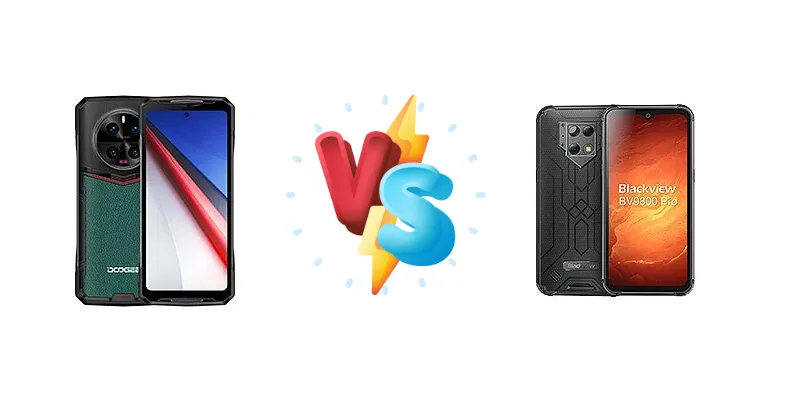
Doogee DK10 vs Blackview BV9800 Pro: Which Rugged Phone Reigns Supreme?
| Phones Images | |||||
|---|---|---|---|---|---|
|
🏆 Quick Verdict
For the average user prioritizing performance and future-proofing, the Doogee DK10 is the clear winner. Its Dimensity 8020 chipset delivers significantly faster processing speeds and improved efficiency compared to the Blackview BV9800 Pro’s Helio P70. While the BV9800 Pro remains a viable option for basic tasks, the DK10 offers a superior experience for gaming, multitasking, and demanding applications.
| PHONES | ||
|---|---|---|
| Phone Names | Doogee DK10 | Blackview BV9800 Pro |
| Network | ||
|---|---|---|
| 2G bands | GSM 850 / 900 / 1800 / 1900 | GSM 850 / 900 / 1800 / 1900 |
| 3G bands | HSDPA 800 / 850 / 900 / 1700(AWS) / 1900 / 2100 | HSDPA 800 / 850 / 900 / 1700(AWS) / 1900 / 2100 |
| 4G bands | 1, 2, 3, 4, 5, 7, 8, 12, 17, 18, 19, 20, 25, 26, 28, 34, 38, 39, 40, 41, 66 | 1, 2, 3, 4, 5, 6, 7, 8, 12, 13, 17, 18, 19, 20, 25, 26, 28, 34, 38, 39, 40, 41, 66 |
| 5G bands | 1, 3, 5, 7, 8, 20, 28, 38, 40, 41, 71, 77, 78, 79 SA/NSA | - |
| Speed | HSPA, LTE, 5G | HSPA, LTE |
| Technology | GSM / CDMA / HSPA / LTE / 5G | GSM / CDMA / HSPA / CDMA2000 / LTE |
| Launch | ||
|---|---|---|
| Announced | 2024, February 28 | 2019, October 28. Released 2019, November |
| Status | Available. Released 2024, March | Discontinued |
| Body | ||
|---|---|---|
| Dimensions | 181.7 x 83.1 x 12.7 mm (7.15 x 3.27 x 0.5 in) | 168.5 x 81 x 14.8 mm (6.63 x 3.19 x 0.58 in) |
| SIM | Nano-SIM + Nano-SIM | Nano-SIM + Nano-SIM |
| Weight | - | 322 g (11.36 oz) |
| Display | ||
|---|---|---|
| Protection | Corning Gorilla Glass | - |
| Resolution | 1080 x 2400 pixels, 20:9 ratio (~395 ppi density) | 1080 x 2340 pixels, 19.5:9 ratio (~409 ppi density) |
| Size | 6.67 inches, 107.4 cm2 (~71.1% screen-to-body ratio) | 6.3 inches, 97.4 cm2 (~71.4% screen-to-body ratio) |
| Type | AMOLED, 120Hz | IPS LCD |
| Platform | ||
|---|---|---|
| CPU | Octa-core (4x2.6 GHz Cortex-A78 & 4x2.0 GHz Cortex-A55) | Octa-core (4x2.1 GHz Cortex-A73 & 4x2.0 GHz Cortex-A53) |
| Chipset | Mediatek Dimensity 8020 (6 nm) | Mediatek MT6771V/CT Helio P70 (12 nm) |
| GPU | Mali-G77 MC9 | Mali-G72 MP3 |
| OS | Android 13 | Android 9.0 (Pie) |
| Memory | ||
|---|---|---|
| Card slot | microSDXC (uses shared SIM slot) | microSDXC |
| Internal | 512GB 12GB RAM | 128GB 6GB RAM |
| Main Camera | ||
|---|---|---|
| Features | Dual-LED flash, HDR, panorama | Thermal imaging, LED flash |
| Quad | 50 MP, f/2.0, (wide), 1/1.31", PDAF 16 MP, f/2.5, (telephoto), 1/3.1", PDAF, 4x optical zoom 50 MP, f/2.2, 123˚ (ultrawide) 64 MP, f/1.8, (night vision), 2 infrared night vision lights | - |
| Triple | - | 48 MP, (wide), PDAF 5 MP, thermal assisted camera FLIR thermal camera (Lepton module) |
| Video | 4K@30fps, 1080p@30fps | 1080p@30fps |
| Selfie camera | ||
|---|---|---|
| Single | 50 MP, f/2.5, (wide), 1/2.76" | 16 MP, f/2.0, (wide) |
| Video | 1440p@30fps, 1080p@30fps | 1080p@30fps |
| Sound | ||
|---|---|---|
| 35mm jack | Unspecified | Yes |
| Loudspeaker | Yes | Yes |
| Comms | ||
|---|---|---|
| Bluetooth | 5.1, A2DP, LE | 4.1, A2DP |
| NFC | Yes | Yes |
| Positioning | GPS (L1+L5), GLONASS, GALILEO, BDS | GPS, GLONASS, GALILEO |
| Radio | FM radio | FM radio |
| USB | USB Type-C 2.0, OTG | USB Type-C 2.0, OTG |
| WLAN | Wi-Fi 802.11 a/b/g/n/ac/6, dual-band | Wi-Fi 802.11 a/b/g/n/ac |
| Features | ||
|---|---|---|
| Sensors | Fingerprint (side-mounted), accelerometer, gyro, proximity, compass | Fingerprint (side-mounted), accelerometer, gyro, proximity, compass, barometer |
| Battery | ||
|---|---|---|
| Charging | 120W wired 50W wireless Reverse wired | 18W wired |
| Type | 5150 mAh | 6580 mAh |
| Misc | ||
|---|---|---|
| Colors | Emerald Green, Kevlar Black | Black, Orange |
| Price | - | About 340 EUR |
Doogee DK10
- Significantly faster processor (Dimensity 8020)
- Ultra-fast 120W wired charging
- 50W wireless charging and reverse wired charging
- Potentially better camera image processing
- Likely higher price point
- Potential for increased heat under extreme load (though 6nm helps)
Blackview BV9800 Pro
- More affordable price
- Rugged build quality
- Acceptable performance for basic tasks
- Established reputation in the rugged phone market
- Slow 18W charging
- Outdated Helio P70 chipset
- Limited performance for demanding applications
- Inferior image processing capabilities
Display Comparison
While both phones are likely to feature durable displays given their rugged nature, the provided specs focus on internal components. We can infer that the Blackview BV9800 Pro, being an older model, likely utilizes an IPS LCD panel, whereas the DK10 *could* incorporate a more modern AMOLED panel, though this isn't confirmed. The difference in processing power suggests the DK10 might support higher refresh rates, leading to smoother visuals. Bezels are likely comparable, prioritizing screen protection over minimal design.
Camera Comparison
Without specific camera sensor details, a direct comparison is limited. However, the processing power of the Dimensity 8020 in the DK10 suggests superior image processing capabilities, potentially resulting in better dynamic range, noise reduction, and overall image quality. The BV9800 Pro’s Helio P70 will likely produce acceptable images in good lighting conditions, but will fall behind in low-light scenarios. It's reasonable to assume the DK10 will support more advanced camera features like 4K video recording and potentially more sophisticated computational photography techniques.
Performance
The performance gap between these two devices is substantial. The Doogee DK10’s Mediatek Dimensity 8020 (6nm) utilizes Cortex-A78 cores clocked at 2.6 GHz, a significant upgrade over the Blackview BV9800 Pro’s Helio P70 (12nm) and its Cortex-A73 cores at 2.1 GHz. The 6nm process node of the Dimensity 8020 translates to better power efficiency and reduced thermal throttling under sustained load. This means the DK10 will handle graphically intensive games and multitasking with ease, while the BV9800 Pro will likely struggle with demanding applications. The newer chipset also benefits from advancements in AI processing and image signal processing.
Battery Life
The Doogee DK10’s charging capabilities are a standout feature. 120W wired charging will drastically reduce charging times, potentially going from 0-100% in under 30 minutes. The addition of 50W wireless charging and reverse wired charging adds further convenience. The Blackview BV9800 Pro’s 18W wired charging is comparatively slow, requiring significantly longer to fully charge. While battery capacity isn't specified, the Dimensity 8020’s improved power efficiency could offset a potentially smaller battery in the DK10, resulting in comparable real-world battery life despite the faster charging.
Buying Guide
Buy the Doogee DK10 if you need a rugged phone capable of handling demanding tasks like gaming, video editing, or running multiple apps simultaneously, and if fast charging is a priority. Buy the Blackview BV9800 Pro if you prioritize affordability and only require a phone for basic communication, navigation, and light media consumption, and are willing to accept significantly slower performance.