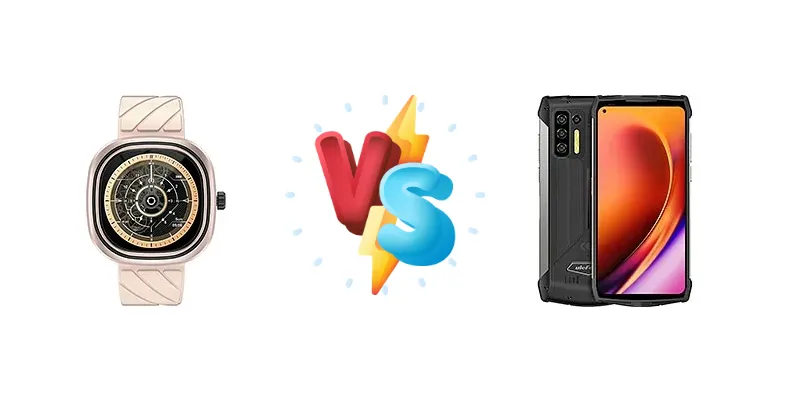
The rugged smartphone market caters to a specific user: those needing durability and extended battery life. The Doogee DG Ares and Ulefone Power Armor 13 both aim to deliver, but take drastically different approaches to performance. The Ares prioritizes affordability with a Realtek chipset, while the Power Armor 13 opts for a more powerful Mediatek Helio G95, creating a clear divergence in user experience.
🏆 Quick Verdict
For the average user prioritizing performance and responsiveness, the Ulefone Power Armor 13 is the clear winner. Its Helio G95 chipset provides a significantly smoother experience for demanding tasks. However, if budget is the primary concern and basic functionality is sufficient, the Doogee DG Ares offers a functional, albeit slower, rugged option.
| Network |
|---|
| 2G bands | N/A | GSM 850 / 900 / 1800 / 1900 |
| 3G bands | N/A | HSDPA 850 / 900 / 1700(AWS) / 1900 / 2100 |
| 4G bands | N/A | 1, 2, 3, 4, 5, 7, 8, 12, 13, 17, 18, 19, 20, 25, 26, 28, 38, 40, 66 |
| EDGE | No | - |
| GPRS | No | - |
| Speed | - | HSPA 42.2/11.5 Mbps, LTE Cat12 600/150 Mbps |
| Technology | No cellular connectivity | GSM / HSPA / LTE |
| Launch |
|---|
| Announced | 2021, September 27 | 2021, July 22 |
| Status | Available. Released 2021, September 27 | Available. Released 2021, July 26 |
| Body |
|---|
| Build | Plastic frame, plastic back | - |
| Dimensions | 45.9 x 45.9 x 10.3 mm (1.81 x 1.81 x 0.41 in) | 183.7 x 85.4 x 20.8 mm (7.23 x 3.36 x 0.82 in) |
| SIM | No | Nano-SIM + Nano-SIM |
| Weight | 47 g (1.66 oz) | 492 g (1.08 lb) |
| | - | IP68 dust/water resistant (up to 1.5m for 30 min)
Drop-to-concrete resistance from up to 1.2m
MIL-STD-810G compliant |
| Display |
|---|
| Protection | - | Corning Gorilla Glass 3 |
| Resolution | 360 x 360 pixels (~386 ppi density) | 1080 x 2400 pixels, 20:9 ratio (~386 ppi density) |
| Size | 1.32 inches | 6.81 inches, 112.0 cm2 (~71.4% screen-to-body ratio) |
| Type | IPS LCD | IPS LCD |
| Platform |
|---|
| CPU | - | Octa-core (2x2.05 GHz Cortex-A76 & 6x2.0 GHz Cortex-A55) |
| Chipset | Realtek 8762C | Mediatek MT6785V/CD Helio G95 (12 nm) |
| GPU | - | Mali-G76 MC4 |
| OS | Proprietary | Android 11 |
| Memory |
|---|
| Card slot | No | microSDXC (uses shared SIM slot) |
| Internal | - | 256GB 8GB RAM |
| Main Camera |
|---|
| Features | - | Quad-LED flash, HDR, panorama |
| Penta | - | 48 MP, f/1.8, 26mm (wide), 1/2.0", 0.8µm, PDAF
8 MP, f/2.2, (ultrawide)
2 MP (macro)
Auxiliary lens |
| Video | - | 4K@30fps, 1080p@30fps |
| Selfie camera |
|---|
| Features | - | HDR, panorama |
| Single | - | 16 MP, f/2.2 |
| Video | - | 1080p@30fps |
| Sound |
|---|
| 3.5mm jack | - | Yes |
| 35mm jack | No | Yes |
| Loudspeaker | No | Yes |
| Comms |
|---|
| Bluetooth | 5.0, A2DP, LE | 5.0, A2DP, LE |
| NFC | No | Yes |
| Positioning | No | GPS, GLONASS, GALILEO, BDS |
| Radio | No | FM radio, RDS, recording |
| USB | No | - |
| WLAN | No | Wi-Fi 802.11 a/b/g/n/ac, dual-band |
| Features |
|---|
| Sensors | Accelerometer, heart rate | Fingerprint (side-mounted), accelerometer, gyro, proximity, compass, baroceptor, coulombmeter |
| | - | Infrared distance measure (error range: 1~20m, ±10mm; 20~40m, ±25mm) |
| Battery |
|---|
| Charging | - | 33W wired
15W wireless
5W reverse wireless |
| Type | Li-Ion 300 mAh | Li-Po 13200 mAh |
| Misc |
|---|
| Colors | Green, Rose Gold, Black | Black |
| Price | About 40 EUR | About 300 EUR |
| Tests |
|---|
| Battery life | - |
Endurance rating 296h
|
| Camera | - |
Photo / Video |
| Display | - |
Contrast ratio: 1306:1 (nominal) |
| Loudspeaker | - |
-28.3 LUFS (Average)
|
| Performance | - |
AnTuTu: 294194 (v8), 351678 (v9)
GeekBench: 1610 (v5.1)
GFXBench: 18fps (ES 3.1 onscreen) |
Doogee DG Ares
- Highly affordable price point
- Rugged build quality
- Long battery endurance
- Weak processor performance
- Likely lower-quality display
- Limited charging options
Ulefone Power Armor 13
- Powerful Mediatek Helio G95 processor
- Faster 33W wired and 15W wireless charging
- Good display brightness and contrast
- Higher price compared to Doogee DG Ares
- Still a rugged phone, so may be bulky
- Camera details are limited
Display Comparison
The Ulefone Power Armor 13 boasts a measured peak brightness of 401 nits and a 1306:1 contrast ratio, providing a reasonably viewable experience outdoors. While the Doogee DG Ares’ display specifications are not provided, it’s likely to be a lower-resolution panel given its price point. The 1306:1 contrast ratio on the Ulefone suggests a decent level of color separation, though it’s not an AMOLED panel. Users who spend significant time outdoors will benefit from the Ulefone’s higher brightness.
Camera Comparison
Both phones list 'Photo / Video' capabilities, but lack specific details. Given the price difference, the Ulefone Power Armor 13 likely features a more capable camera system with a larger sensor and potentially optical image stabilization (OIS). The Ares will likely rely on software processing to compensate for a lower-quality sensor. The absence of sensor size information makes a direct comparison difficult, but the G95’s image signal processor (ISP) will offer superior image processing capabilities compared to the Ares’ chipset.
Performance
The core difference lies in the chipsets. The Ulefone Power Armor 13’s Mediatek Helio G95 (12nm) is an octa-core processor with a configuration of 2x2.05 GHz Cortex-A76 and 6x2.0 GHz Cortex-A55 cores, designed for gaming and multitasking. This is a substantial upgrade over the Doogee DG Ares’ Realtek 8762C. The Realtek chipset is geared towards power efficiency and basic functionality, making it suitable for calls, texts, and light app usage, but will struggle with graphically intensive games or demanding applications. The G95’s architecture allows for a far smoother user experience and better responsiveness.
Battery Life
Both devices achieve an impressive endurance rating of 296 hours, suggesting similar overall battery life despite the performance disparity. However, the Ulefone Power Armor 13 offers significantly faster charging options: 33W wired, 15W wireless, and 5W reverse wireless. The Doogee DG Ares’ charging specifications are not provided, but are likely to be slower. The Ulefone’s wireless charging is a significant convenience feature, and the faster wired charging reduces downtime.
Buying Guide
Buy the Doogee DG Ares if you need a highly affordable, extremely durable phone for basic communication and light tasks – think construction workers needing a reliable call device. Buy the Ulefone Power Armor 13 if you prefer a rugged phone capable of handling more demanding applications like navigation, photography, and occasional gaming, and value faster performance and wireless charging.
Frequently Asked Questions
❓ Does the Mediatek Helio G95 in the Ulefone Power Armor 13 generate excessive heat during prolonged use?
The Helio G95 is a relatively efficient chipset. While it will generate heat during demanding tasks like gaming, the Ulefone Power Armor 13’s rugged design likely incorporates heat dissipation features to mitigate throttling. It’s unlikely to overheat to the point of being unusable, but sustained peak performance may be limited.
❓ Is the lack of detailed camera specifications on both phones a cause for concern?
Yes, it is. However, given the price difference, the Ulefone Power Armor 13 likely has a more capable camera system. The G95’s ISP will contribute to better image quality, even if the sensor size isn’t significantly larger. Expect the Ares to perform adequately in good lighting conditions, but struggle in low light.
❓ How does the Realtek 8762C chipset in the Doogee DG Ares handle basic apps like WhatsApp and web browsing?
The Realtek 8762C is sufficient for basic tasks like WhatsApp, calls, and light web browsing. However, expect some lag and slowdown when multitasking or loading complex web pages. It’s not designed for demanding applications or smooth performance.
❓ What type of wireless charging is supported by the Ulefone Power Armor 13, and is it compatible with all Qi chargers?
The Ulefone Power Armor 13 supports 15W Qi wireless charging. It should be compatible with most standard Qi wireless chargers, but for optimal charging speeds, it’s recommended to use a charger that supports at least 15W output.