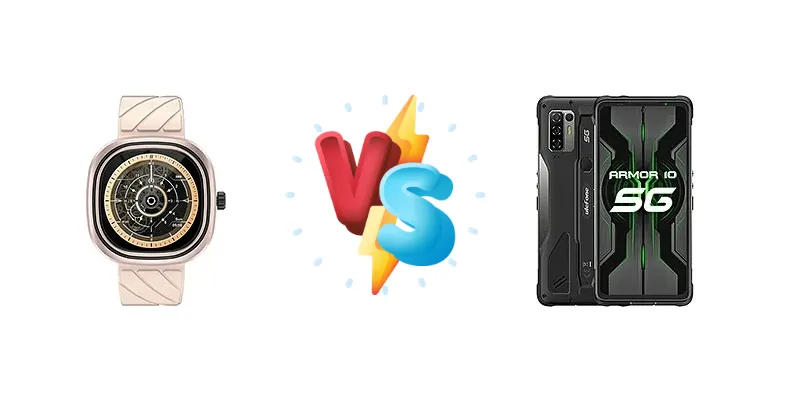
The rugged smartphone market caters to a specific user – those needing durability and reliability in challenging environments. The Doogee DG Ares and Ulefone Armor 10 5G both aim to deliver this, but they take drastically different approaches to performance and features. The Ares focuses on affordability, while the Armor 10 5G leverages a more powerful chipset for a smoother user experience.
🏆 Quick Verdict
For the average user prioritizing responsiveness and 5G connectivity, the Ulefone Armor 10 5G is the clear winner. Its Mediatek Dimensity 800 chipset provides a significantly more capable experience than the Doogee DG Ares’ Realtek 8762C. However, the Ares remains a viable option for those on a tight budget who prioritize basic functionality over speed.
| Network |
|---|
| 2G bands | N/A | GSM 850 / 900 / 1800 / 1900 |
| 3G bands | N/A | HSDPA 850 / 900 / 1700(AWS) / 1900 / 2100 |
| 4G bands | N/A | 1, 2, 3, 4, 5, 7, 8, 12, 13, 17, 18, 19, 20, 25, 26, 28, 34, 38, 39, 40, 41, 66 |
| 5G bands | - | 1, 3, 41, 77, 78, 79 SA/NSA |
| EDGE | No | - |
| GPRS | No | - |
| Speed | - | HSPA, LTE, 5G |
| Technology | No cellular connectivity | GSM / CDMA / HSPA / EVDO / LTE / 5G |
| | - | CDMA2000 1xEV-DO |
| Launch |
|---|
| Announced | 2021, September 27 | 2020, November 17. Released 2020, December 07 |
| Status | Available. Released 2021, September 27 | Discontinued |
| Body |
|---|
| Build | Plastic frame, plastic back | Front glass, aluminum back with rubber, aluminum frame |
| Dimensions | 45.9 x 45.9 x 10.3 mm (1.81 x 1.81 x 0.41 in) | 176.5 x 82.8 x 14.6 mm (6.95 x 3.26 x 0.57 in) |
| SIM | No | Nano-SIM + Nano-SIM |
| Weight | 47 g (1.66 oz) | 328 g (11.57 oz) |
| | - | IP68 dust/water resistant (up to 1.5m for 30 min)
Drop-to-concrete resistance from up to 1.2m
MIL-STD-810G compliant |
| Display |
|---|
| Protection | - | Scratch-resistant glass, oleophobic coating |
| Resolution | 360 x 360 pixels (~386 ppi density) | 1080 x 2400 pixels, 20:9 ratio (~395 ppi density) |
| Size | 1.32 inches | 6.67 inches, 107.4 cm2 (~73.5% screen-to-body ratio) |
| Type | IPS LCD | IPS LCD |
| Platform |
|---|
| CPU | - | Octa-core (4x2.0 GHz Cortex-A76 & 4x2.0 GHz Cortex-A55) |
| Chipset | Realtek 8762C | Mediatek Dimensity 800 (7 nm) |
| GPU | - | Mali-G57 MP4 |
| OS | Proprietary | Android 10, planned upgrade to Android 11 |
| Memory |
|---|
| Card slot | No | microSDXC (uses shared SIM slot) |
| Internal | - | 128GB 8GB RAM |
| Main Camera |
|---|
| Features | - | LED flash, Panorama, HDR |
| Quad | - | 64 MP, f/1.9, 26mm (wide), 1/1.72", 0.8µm, PDAF
8 MP, f/2.2, 119˚ (ultrawide)
5 MP (macro)
Auxiliary lens |
| Video | - | 4K@30fps, 1080p@30fps |
| Selfie camera |
|---|
| Single | - | 16 MP, f/2.2 |
| Video | - | 1080p@30fps |
| Sound |
|---|
| 3.5mm jack | - | Yes |
| 35mm jack | No | Yes |
| Loudspeaker | No | Yes |
| Comms |
|---|
| Bluetooth | 5.0, A2DP, LE | 5.2, A2DP, LE |
| NFC | No | Yes |
| Positioning | No | GPS, GLONASS, GALILEO, BDS |
| Radio | No | FM radio, RDS, recording |
| USB | No | USB Type-C 2.0, OTG |
| WLAN | No | Wi-Fi 802.11 a/b/g/n/ac, Wi-Fi Direct |
| Features |
|---|
| Sensors | Accelerometer, heart rate | Fingerprint (side-mounted), accelerometer, gyro, proximity, compass, baroceptor, coulombmeter |
| Battery |
|---|
| Charging | - | 15W wired
15W wireless |
| Type | Li-Ion 300 mAh | Li-Po 5800 mAh |
| Misc |
|---|
| Colors | Green, Rose Gold, Black | Black |
| Price | About 40 EUR | About 420 EUR |
Doogee DG Ares
- Highly affordable price point
- Rugged build quality for durability
- Suitable for basic communication tasks
- Significantly weaker processor performance
- Likely limited software support
- No 5G connectivity
Ulefone Armor 10 5G
- Powerful Mediatek Dimensity 800 chipset
- 5G connectivity for faster data speeds
- Wireless charging convenience
- Higher price compared to the Doogee DG Ares
- May experience some thermal throttling under heavy load
- Rugged design adds bulk
Display Comparison
Neither device's display specifications are provided, so a direct comparison is limited. However, given the Armor 10 5G's positioning, it likely features a higher resolution and potentially a higher refresh rate panel than the Ares. The Ares, aiming for cost-effectiveness, likely utilizes a standard 60Hz LCD. The Armor 10 5G's potential for a brighter panel would improve outdoor visibility, crucial for a rugged device.
Camera Comparison
Without detailed camera specifications, a precise comparison is difficult. However, the Armor 10 5G’s higher overall processing power suggests superior image processing capabilities. The Ares will likely rely on simpler algorithms, resulting in less detailed and dynamic range in photos. The presence of 5G on the Armor 10 5G also facilitates faster cloud uploads of photos and videos. The inclusion of Optical Image Stabilization (OIS) on the Armor 10 5G, if present, would further enhance image quality, particularly in low-light conditions.
Performance
The performance gap is substantial. The Ulefone Armor 10 5G’s Mediatek Dimensity 800 (7nm) is an octa-core processor built on a more advanced manufacturing process than the Doogee DG Ares’ Realtek 8762C. The Dimensity 800’s Cortex-A76 cores deliver significantly higher single-core performance, translating to snappier app launches and smoother multitasking. The Ares’ Realtek chipset is geared towards basic functionality and will struggle with resource-intensive tasks. This difference is critical for users who plan to use their rugged phone for anything beyond calls and messaging.
Battery Life
Battery capacity isn't specified for either device. However, the Ulefone Armor 10 5G offers both 15W wired and 15W wireless charging, providing greater convenience. The Ares’ charging capabilities are unknown, but likely slower and limited to wired charging. While a larger mAh capacity on the Ares could offset the slower charging, the Dimensity 800’s 7nm process is more power-efficient, potentially leading to comparable real-world battery life despite a potentially smaller battery size on the Armor 10 5G.
Buying Guide
Buy the Doogee DG Ares if you need a highly affordable, extremely durable phone for essential communication and light tasks, and aren't concerned with demanding applications or 5G speeds. Buy the Ulefone Armor 10 5G if you prefer a smoother, more responsive experience with 5G connectivity, faster charging, and the ability to handle more demanding apps and games, even if it comes at a higher price point.
Frequently Asked Questions
❓ Will the Ulefone Armor 10 5G's Dimensity 800 chip overheat during prolonged gaming sessions?
While the Dimensity 800 is a capable processor, it's not a flagship-level chip. Some thermal throttling is possible during extended gaming, but the Armor 10 5G's rugged design likely incorporates heat dissipation features to mitigate this. Expect performance to be sustained, but not consistently at peak levels.
❓ Is the Realtek 8762C in the Doogee DG Ares sufficient for running popular social media apps like Facebook and WhatsApp?
Yes, the Realtek 8762C is capable of running basic applications like Facebook and WhatsApp without significant issues. However, expect slower loading times and potential lag when switching between apps. It's best suited for light usage and isn't ideal for multitasking.
❓ Does the Ulefone Armor 10 5G support VoLTE and VoWiFi for improved call quality?
Given its 5G capabilities and market positioning, the Ulefone Armor 10 5G likely supports VoLTE (Voice over LTE) and VoWiFi (Voice over Wi-Fi) for enhanced call quality and network coverage. However, compatibility depends on your carrier, so it's best to verify with your provider.