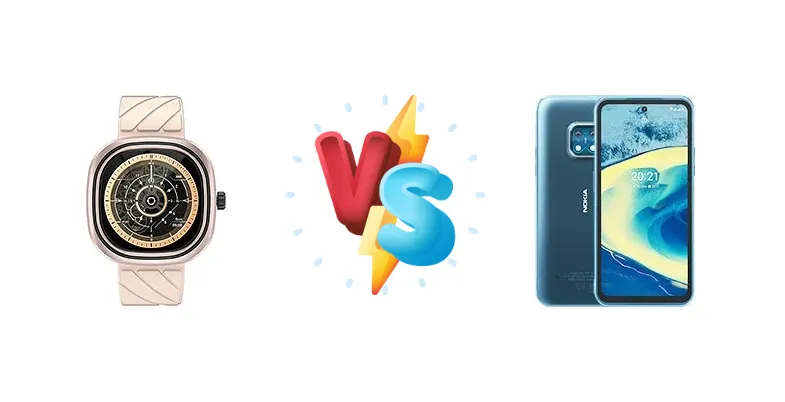
The rugged smartphone market caters to a specific need: durability. Both the Doogee DG Ares and Nokia XR20 promise resilience, but they approach this goal with vastly different internal hardware. The Ares prioritizes affordability with a Realtek chipset, while the XR20 opts for Qualcomm's Snapdragon 480 5G, bringing connectivity and a performance boost. This comparison dissects these choices to determine which phone delivers the best value for users demanding a tough device.
🏆 Quick Verdict
For the average user prioritizing 5G connectivity and smoother performance, the Nokia XR20 is the better choice. Its Snapdragon 480 chipset offers a significant advantage over the Doogee DG Ares’ Realtek 8762C, translating to a more responsive user experience and future-proofing. However, the Ares may appeal to budget-conscious buyers who prioritize basic functionality over speed.
| Network |
|---|
| 2G bands | N/A | GSM 850 / 900 / 1800 / 1900 |
| 3G bands | N/A | HSDPA 850 / 900 / 1700(AWS) / 1900 / 2100 |
| 4G bands | N/A | 1, 2, 3, 4, 5, 7, 8, 12, 13, 14, 20, 25, 26, 28, 30, 38, 40, 41, 48, 66, 71 |
| 5G bands | - | 2, 5, 25, 38, 41, 48, 66, 77, 78 SA/NSA |
| EDGE | No | - |
| GPRS | No | - |
| Speed | - | HSPA, LTE, 5G |
| Technology | No cellular connectivity | GSM / CDMA / HSPA / EVDO / LTE / 5G |
| | - | CDMA2000 1xEV-DO |
| Launch |
|---|
| Announced | 2021, September 27 | 2021, July 27 |
| Status | Available. Released 2021, September 27 | Available. Released 2021, August 04 |
| Body |
|---|
| Build | Plastic frame, plastic back | - |
| Dimensions | 45.9 x 45.9 x 10.3 mm (1.81 x 1.81 x 0.41 in) | 171.6 x 81.5 x 10.6 mm (6.76 x 3.21 x 0.42 in) |
| SIM | No | · Nano-SIM· Nano-SIM + Nano-SIM |
| Weight | 47 g (1.66 oz) | 248 g (8.75 oz) |
| | - | IP68 dust/water resistant (up to 1.5m for 60 min)
Drop-to-concrete resistance from up to 1.8m
MIL-STD-810H compliant |
| Display |
|---|
| Protection | - | Corning Gorilla Glass Victus |
| Resolution | 360 x 360 pixels (~386 ppi density) | 1080 x 2400 pixels, 20:9 ratio (~395 ppi density) |
| Size | 1.32 inches | 6.67 inches, 107.4 cm2 (~76.8% screen-to-body ratio) |
| Type | IPS LCD | IPS LCD, 550 nits |
| Platform |
|---|
| CPU | - | Octa-core (2x2.0 GHz Kryo 460 & 6x1.8 GHz Kryo 460) |
| Chipset | Realtek 8762C | Qualcomm SM4350 Snapdragon 480 5G (8 nm) |
| GPU | - | Adreno 619 |
| OS | Proprietary | Android 11, upgradable to Android 13 |
| Memory |
|---|
| Card slot | No | microSDXC (uses shared SIM slot) |
| Internal | - | 64GB 4GB RAM, 128GB 6GB RAM |
| Main Camera |
|---|
| Dual | - | 48 MP, f/1.8, (wide), 1/2.25", 0.8µm, PDAF
13 MP, f/2.4, 123˚ (ultrawide), 1/3.0", 1.12µm |
| Features | - | Zeiss optics, Dual-LED dual-tone flash, second LED flash, HDR, panorama |
| Single | - | 8 MP, f/2.0 (wide), 1/4.0", 1.12µm |
| Video | - | 1080p@30fps |
| Selfie camera |
|---|
| Single | - | 8 MP, f/2.0 (wide), 1/4.0", 1.12µm |
| Video | - | 1080p@30fps |
| Sound |
|---|
| 3.5mm jack | - | Yes |
| 35mm jack | No | Yes |
| Loudspeaker | No | Yes, with stereo speakers |
| Comms |
|---|
| Bluetooth | 5.0, A2DP, LE | 5.1, A2DP, LE, aptX Adaptive |
| NFC | No | Yes |
| Positioning | No | GPS (L1+L5), GLONASS, BDS, GALILEO, QZSS, NavIC |
| Radio | No | Unspecified |
| USB | No | USB Type-C 3.0 |
| WLAN | No | Wi-Fi 802.11 a/b/g/n/ac/6, dual-band, Wi-Fi Direct |
| Features |
|---|
| Sensors | Accelerometer, heart rate | Fingerprint (side-mounted), accelerometer, gyro, proximity, compass, barometer |
| Battery |
|---|
| Charging | - | 18W wired
15W wireless |
| Type | Li-Ion 300 mAh | Li-Po 4630 mAh |
| Misc |
|---|
| Colors | Green, Rose Gold, Black | Ultra Blue, Granite Gray |
| Models | - | TA-1368, TA-1362 |
| Price | About 40 EUR | About 270 EUR |
| SAR EU | - | 1.13 W/kg (head) 1.43 W/kg (body) |
Doogee DG Ares
- Extremely affordable price point
- Rugged design for durability
- Basic functionality for essential tasks
- Weak performance due to Realtek chipset
- No 5G connectivity
- Limited camera capabilities
Nokia XR20
- 5G connectivity for faster data speeds
- Smoother performance with Snapdragon 480
- Larger battery and faster charging options
- Higher price compared to Doogee DG Ares
- LCD display lacks vibrancy
- Not a flagship-level camera experience
Display Comparison
Neither device boasts a cutting-edge display. Details on the Doogee DG Ares’ panel are scarce, suggesting a standard LCD. The Nokia XR20 features a 6.67-inch FHD+ LCD, which is adequate for outdoor visibility, but lacks the vibrancy of OLED panels. The XR20’s 500 nits brightness is sufficient, but not exceptional. Both likely employ similar protective glass, prioritizing scratch resistance over peak visual fidelity. The absence of high refresh rates on either device suggests a focus on battery conservation rather than fluid animations.
Camera Comparison
Camera performance is likely to be a weak point on both devices, but the XR20 has a slight edge. While both likely feature a primary sensor, details on the Ares’ camera are limited. The XR20 features a 48MP main sensor, which, while not flagship-level, will capture more detailed images than the Ares’ likely lower-resolution sensor. The XR20 also includes an 8MP ultrawide lens, offering versatility. Both phones likely include basic macro and depth sensors, which are often of limited practical use. Image processing will likely be more refined on the XR20, thanks to Qualcomm’s ISP.
Performance
The core difference lies here. The Doogee DG Ares utilizes the Realtek 8762C, a chipset typically found in wearables and very low-end smartphones. This translates to limited processing power and potential struggles with multitasking. Conversely, the Nokia XR20’s Qualcomm Snapdragon 480 5G (8nm) is a significant step up. Its octa-core CPU (2x2.0 GHz Kryo 460 & 6x1.8 GHz Kryo 460) provides a much smoother experience, especially when running multiple apps or demanding tasks. The 8nm process node also contributes to better thermal efficiency, reducing the likelihood of throttling during sustained use. The XR20’s 5G capability is entirely absent in the Ares, making it a future-proofed choice for areas with 5G coverage.
Battery Life
The Doogee DG Ares’ battery capacity is unknown, but given its focus on affordability, it’s likely smaller than the Nokia XR20’s 5000mAh cell. The XR20 supports 18W wired charging and 15W wireless charging, offering convenient charging options. While 18W isn’t particularly fast by modern standards, it’s a reasonable compromise for a rugged device. The Ares’ charging speed is unknown, but likely slower. The XR20’s larger battery capacity, combined with the more efficient Snapdragon 480 chipset, should result in significantly longer battery life in real-world usage.
Buying Guide
Buy the Doogee DG Ares if you need an extremely affordable, basic rugged phone for essential communication and limited app usage. It’s ideal for construction workers or outdoor enthusiasts who primarily need a durable device for calls and texts. Buy the Nokia XR20 if you prefer a more modern smartphone experience with 5G connectivity, smoother multitasking, and the ability to run more demanding applications, all within a ruggedized package. This is the better option for users who want a phone that can keep up with their active lifestyle without sacrificing usability.
Frequently Asked Questions
❓ Will the Snapdragon 480 in the Nokia XR20 struggle with demanding games like PUBG Mobile?
While the Snapdragon 480 isn't a gaming powerhouse, it's capable of running PUBG Mobile at medium settings with reasonable frame rates. Expect some occasional stuttering during intense firefights, but it's a playable experience. The Doogee DG Ares’ Realtek 8762C would likely struggle significantly with even lower settings.
❓ How well does the Nokia XR20 hold up to drops and extreme temperatures?
The Nokia XR20 is IP68 rated for dust and water resistance and meets MIL-STD-810H standards for drop and shock resistance. This means it can withstand drops onto hard surfaces and operate in a wide range of temperatures. While the Doogee DG Ares is also ruggedized, Nokia’s certification provides a higher level of assurance regarding its durability.
❓ Is the lack of a high refresh rate screen noticeable on the Nokia XR20?
Yes, the 60Hz refresh rate on the Nokia XR20 is noticeable compared to phones with 90Hz or 120Hz displays. Scrolling and animations won't be as fluid. However, this is a common trade-off in rugged phones to prioritize battery life and durability.