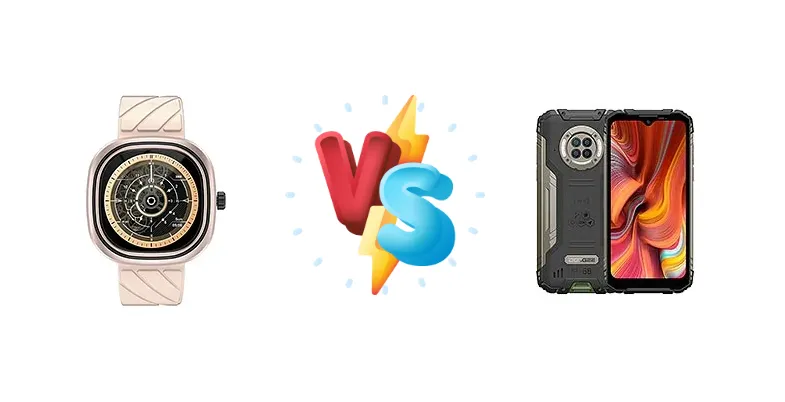
Doogee caters to the rugged phone market with a range of devices, but the DG Ares and S96 Pro represent distinct approaches. The Ares prioritizes affordability, while the S96 Pro aims for a more balanced experience with a significantly more powerful chipset. This comparison dissects the key differences to help you determine which device best suits your needs.
🏆 Quick Verdict
For the average user prioritizing performance and future-proofing, the Doogee S96 Pro is the clear winner. Its MediaTek Helio G90 chipset delivers a substantially better experience for gaming and demanding applications. However, the DG Ares remains a viable option for those on a strict budget who prioritize basic functionality and extreme durability.
| Network |
|---|
| 2G bands | N/A | GSM 850 / 900 / 1800 / 1900 |
| 3G bands | N/A | HSDPA 800 / 850 / 900 / 1700(AWS) / 1900 / 2100 |
| 4G bands | N/A | 1, 2, 3, 4, 5, 7, 8, 12, 13, 17, 18, 19, 20, 25, 26, 28, 38, 40, 66 |
| EDGE | No | - |
| GPRS | No | - |
| Speed | - | HSPA, LTE |
| Technology | No cellular connectivity | GSM / CDMA / HSPA / LTE |
| Launch |
|---|
| Announced | 2021, September 27 | 2020, October 26. Released 2020, November |
| Status | Available. Released 2021, September 27 | Discontinued |
| Body |
|---|
| Build | Plastic frame, plastic back | - |
| Dimensions | 45.9 x 45.9 x 10.3 mm (1.81 x 1.81 x 0.41 in) | 167 x 81.4 x 15.5 mm (6.57 x 3.20 x 0.61 in) |
| SIM | No | Nano-SIM + Nano-SIM |
| Weight | 47 g (1.66 oz) | 310 g (10.93 oz) |
| Display |
|---|
| Protection | - | Corning Gorilla Glass |
| Resolution | 360 x 360 pixels (~386 ppi density) | 720 x 1520 pixels, 19:9 ratio (~270 ppi density) |
| Size | 1.32 inches | 6.22 inches, 96.6 cm2 (~71.0% screen-to-body ratio) |
| Type | IPS LCD | IPS LCD |
| Platform |
|---|
| CPU | - | Octa-core (2x2.0 GHz Cortex-A76 & 6x2.0 GHz Cortex-A55) |
| Chipset | Realtek 8762C | Mediatek MT6785 Helio G90 (12 nm) |
| GPU | - | Mali-G76 MC4 |
| OS | Proprietary | Android 10 |
| Memory |
|---|
| Card slot | No | microSDXC (dedicated slot) |
| Internal | - | 128GB 8GB RAM |
| Main Camera |
|---|
| Features | - | Quad-LED flash, HDR, panorama |
| Quad | - | 48 MP, f/1.8, (wide), PDAF
8 MP, f/2.2, 130˚, (ultrawide)
20 MP, f/2.8, (night vision), 4 infrared night vision lights
2 MP (macro) |
| Video | - | 1080p |
| Selfie camera |
|---|
| Single | - | 16 MP, f/2.0, (wide) |
| Video | - | 1080p |
| Sound |
|---|
| 35mm jack | No | Yes |
| Loudspeaker | No | Yes |
| Comms |
|---|
| Bluetooth | 5.0, A2DP, LE | 5.0, A2DP, LE |
| NFC | No | Yes |
| Positioning | No | GPS, GLONASS, BDS, GALILEO |
| Radio | No | FM radio |
| USB | No | USB Type-C 2.0, OTG |
| WLAN | No | Wi-Fi 802.11 a/b/g/n/ac, dual-band |
| Features |
|---|
| Sensors | Accelerometer, heart rate | Fingerprint (side-mounted), accelerometer, gyro, proximity, compass |
| Battery |
|---|
| Charging | - | 24W wired
10W wireless |
| Type | Li-Ion 300 mAh | 6350 mAh |
| Misc |
|---|
| Colors | Green, Rose Gold, Black | Black, Orange, Green |
| Price | About 40 EUR | About 280 EUR |
Doogee DG Ares
- Extremely affordable price point
- Highly durable and rugged design
- Potentially longer battery life due to low-power chipset (depending on capacity)
- Significantly weaker performance
- Limited multitasking capabilities
- Inferior camera performance
Doogee S96 Pro
- Powerful MediaTek Helio G90 chipset
- Faster 24W wired and 10W wireless charging
- Improved camera image processing
- Higher price compared to the DG Ares
- May experience some thermal throttling under sustained load
- Rugged design may be less extreme than the Ares
Display Comparison
Detailed display specifications are unavailable for the DG Ares. The S96 Pro’s display benefits from the processing power of the Helio G90, potentially enabling smoother animations and faster response times. While both are likely LCD panels given the price points, the S96 Pro’s chipset allows for more sophisticated image processing, potentially improving color accuracy and contrast. The lack of detailed specs for the Ares makes a direct comparison impossible, but it's reasonable to assume a lower quality panel to meet the lower price.
Camera Comparison
Camera details beyond sensor counts are limited for both devices. However, the S96 Pro’s more powerful chipset allows for more advanced image signal processing (ISP) capabilities. This translates to better noise reduction, dynamic range, and overall image quality, even with similar sensor sizes. While both phones likely feature a primary camera, the S96 Pro’s ISP can extract more detail and clarity from the sensor. The Ares will likely rely on simpler algorithms, resulting in less refined images. The presence of a 2MP macro camera on both is largely a marketing tactic, offering limited practical benefit.
Performance
The core difference lies in the chipsets. The Doogee DG Ares utilizes the Realtek 8762C, a low-power chipset designed for basic smartphone functions. In contrast, the Doogee S96 Pro boasts the MediaTek Helio G90 (12nm). This G90 features an octa-core configuration with two Cortex-A76 cores clocked at 2.0 GHz and six Cortex-A55 cores, also at 2.0 GHz. This architecture provides a significant performance uplift over the 8762C, particularly in multi-threaded tasks and gaming. The 12nm process node of the G90 also offers better power efficiency compared to older, larger node chipsets, though thermal management will still be a consideration. Users intending to play graphically intensive games or run multiple apps simultaneously will find the S96 Pro far more capable.
Battery Life
Battery capacity is not specified for the DG Ares. The S96 Pro offers 24W wired charging and 10W wireless charging. The faster charging speed is a significant advantage, allowing for quicker top-ups. While the Ares may have a larger battery capacity, the S96 Pro’s more efficient chipset and faster charging mitigate the impact of a potentially smaller battery. The S96 Pro’s wireless charging capability is also a convenience feature absent on the Ares.
Buying Guide
Buy the Doogee DG Ares if you need an incredibly affordable, ultra-durable phone for essential communication and light tasks, and aren't concerned with demanding applications. Buy the Doogee S96 Pro if you prefer a more responsive user experience, enjoy mobile gaming, and value faster charging speeds, even at a higher price point.
Frequently Asked Questions
❓ Will the Helio G90 in the S96 Pro overheat during extended gaming sessions?
The Helio G90 is known to generate some heat under sustained load. While Doogee likely implements thermal management solutions, some throttling is possible during prolonged gaming. However, the chipset's performance still significantly exceeds the Ares's, even with some throttling.
❓ Is the DG Ares suitable for running apps like WhatsApp and Facebook without lag?
The Realtek 8762C in the DG Ares is sufficient for basic tasks like running WhatsApp and Facebook. However, expect slower app loading times and potential lag when switching between multiple apps. It's designed for essential communication, not demanding multitasking.
❓ Does the S96 Pro support fast charging with any standard charger, or do I need a Doogee-specific charger?
The S96 Pro supports 24W charging via USB-C Power Delivery (PD). While a Doogee-specific charger will provide optimal charging speeds, any USB-C PD charger capable of delivering 24W should work effectively.
❓ How does the ruggedness of the DG Ares compare to the S96 Pro in terms of drop and water resistance?
While both are rugged phones, the DG Ares is generally considered to have a more robust and extreme rugged design. It's likely to withstand harsher conditions and more significant drops. The S96 Pro offers good ruggedness, but prioritizes a more balanced design.