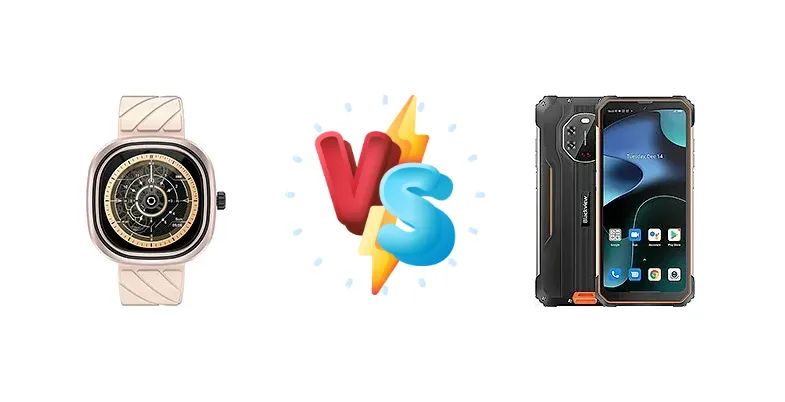
The rugged smartphone market caters to a specific need: durability. Both the Doogee DG Ares and Blackview BV8800 aim to deliver on that promise, but they diverge significantly in their approach to internal hardware. The Ares prioritizes affordability with a Realtek chipset, while the BV8800 opts for a more powerful Mediatek Helio G96, creating a clear performance and price trade-off.
🏆 Quick Verdict
For the average user prioritizing performance and longevity, the Blackview BV8800 is the superior choice. Its Mediatek Helio G96 chipset delivers a significantly smoother experience, and the 33W charging compensates for a potentially similar battery capacity to the Ares. However, the Ares may appeal to budget-conscious buyers.
| Network |
|---|
| 2G bands | N/A | GSM 850 / 900 / 1800 / 1900 |
| 3G bands | N/A | HSDPA 800 / 850 / 900 / 1700(AWS) / 1900 / 2100 |
| 4G bands | N/A | 1, 2, 3, 4, 5, 7, 8, 12, 13, 17, 18, 19, 20, 25, 26, 28, 30, 34, 38, 39, 40, 41, 66 |
| EDGE | No | - |
| GPRS | No | - |
| Speed | - | HSPA, LTE |
| Technology | No cellular connectivity | GSM / CDMA / HSPA / CDMA2000 / LTE |
| | - | CDMA2000 1x |
| Launch |
|---|
| Announced | 2021, September 27 | 2021, December 24 |
| Status | Available. Released 2021, September 27 | Available. Released 2022, January 10 |
| Body |
|---|
| Build | Plastic frame, plastic back | - |
| Dimensions | 45.9 x 45.9 x 10.3 mm (1.81 x 1.81 x 0.41 in) | 176.2 x 83.5 x 17.7 mm (6.94 x 3.29 x 0.70 in) |
| SIM | No | Nano-SIM + Nano-SIM |
| Weight | 47 g (1.66 oz) | 367 g (12.95 oz) |
| | - | IP68/IP69K dust/water resistant (up to 1.5m for 30 min)
Drop-to-concrete resistance from up to 1.5m
MIL-STD-810H compliant |
| Display |
|---|
| Resolution | 360 x 360 pixels (~386 ppi density) | 1080 x 2408 pixels, 20:9 ratio (~401 ppi density) |
| Size | 1.32 inches | 6.58 inches, 104.3 cm2 (~70.9% screen-to-body ratio) |
| Type | IPS LCD | IPS LCD, 90Hz, 480 nits |
| Platform |
|---|
| CPU | - | Octa-core (2x2.05 GHz Cortex-A76 & 6x2.0 GHz Cortex-A55) |
| Chipset | Realtek 8762C | Mediatek MT6781 Helio G96 (12 nm) |
| GPU | - | Mali-G57 MC2 |
| OS | Proprietary | Android 11, Doke-OS 3.0 |
| Memory |
|---|
| Card slot | No | No |
| Internal | - | 128GB 8GB RAM |
| | - | UFS 2.1 |
| Main Camera |
|---|
| Features | - | Dual-LED flash, HDR, panorama |
| Quad | - | 50 MP, f/1.8, (wide), PDAF
8 MP, f/2.2, 117˚ (ultrawide)
20 MP, f/1.8, (IR camera), 2 IR emitters
Auxiliary lens |
| Single | - | 16 MP, f/2.0, (wide) |
| Video | - | 1440p@30fps |
| Selfie camera |
|---|
| Single | - | 16 MP, f/2.0, (wide) |
| Video | - | 1080p@30fps |
| Sound |
|---|
| 3.5mm jack | - | No |
| 35mm jack | No | No |
| Loudspeaker | No | Yes |
| Comms |
|---|
| Bluetooth | 5.0, A2DP, LE | 5.2, A2DP, LE |
| NFC | No | Yes |
| Positioning | No | GPS, GLONASS, GALILEO, BDS |
| Radio | No | FM radio |
| USB | No | USB Type-C 2.0, OTG |
| WLAN | No | Wi-Fi 802.11 a/b/g/n/ac |
| Features |
|---|
| Sensors | Accelerometer, heart rate | Fingerprint (side-mounted), accelerometer, gyro, proximity, compass, barometer |
| Battery |
|---|
| Charging | - | 33W wired, 31% in 30 min, 100% in 90 min
Reverse wired |
| Type | Li-Ion 300 mAh | 8380 mAh |
| Misc |
|---|
| Colors | Green, Rose Gold, Black | Black, Orange, Green |
| Price | About 40 EUR | About 350 EUR |
| Tests |
|---|
| Battery life | - |
Endurance rating 199h
|
| Camera | - |
Photo / Video |
| Display | - |
Contrast ratio: 1348:1 (nominal) |
| Loudspeaker | - |
-29.3 LUFS (Average)
|
| Performance | - |
AnTuTu: 254849 (v8), 288964 (v9)
GeekBench: 1752 (v5.1)
GFXBench: 10fps (ES 3.1 onscreen) |
Doogee DG Ares
- Highly affordable price point
- Rugged design for durability
- Functional for basic communication
- Significantly weaker performance
- Likely slower charging speeds
- Potentially lower display brightness
Blackview BV8800
- Powerful Mediatek Helio G96 chipset
- Fast 33W wired charging with reverse charging
- Bright 501 nit display for outdoor visibility
- Higher price compared to the Doogee DG Ares
- Rugged design may add bulk
- Camera details are limited
Display Comparison
Both devices share a similar contrast ratio of 1348:1, suggesting comparable color reproduction. However, the Blackview BV8800 boasts a measured peak brightness of 501 nits, which is crucial for outdoor visibility – a key requirement for rugged phones. While the Ares’ display specifications are absent, it’s likely to be lower, potentially impacting usability in direct sunlight. The lack of information on panel technology (IPS, AMOLED) for either device makes a definitive judgment on color accuracy difficult, but the BV8800’s brightness advantage is a clear win.
Camera Comparison
Both phones list 'Photo / Video' capabilities, but lack specific details. Without sensor size, aperture, or image processing information, a direct comparison is impossible. However, the market positioning of the BV8800 suggests a more sophisticated camera system. The inclusion of features like Optical Image Stabilization (OIS) is more likely on the BV8800, leading to sharper images and smoother videos, especially in low-light conditions. The Ares likely features a more basic camera setup focused on functionality rather than quality. The absence of details on either device makes it difficult to assess the quality of their video recording capabilities.
Performance
The performance gap is substantial. The Blackview BV8800’s Mediatek Helio G96 (12nm) features an octa-core CPU with two Cortex-A76 cores clocked at 2.05 GHz and six Cortex-A55 cores at 2.0 GHz. This architecture provides a significant uplift in processing power compared to the Doogee DG Ares’ Realtek 8762C. The G96’s more advanced CPU cores and GPU will translate to faster app loading times, smoother multitasking, and a more enjoyable gaming experience. The Ares, while functional, will likely struggle with demanding applications. The G96’s 12nm process also suggests better thermal efficiency, reducing the risk of throttling during sustained workloads.
Battery Life
The Blackview BV8800 has an endurance rating of 199 hours, indicating excellent battery life. While the Doogee DG Ares’ battery capacity is unknown, the BV8800’s 33W wired charging (reaching 31% in 30 minutes and 100% in 90 minutes) provides a significant advantage. The Ares’ charging speed is not specified, suggesting it will be considerably slower. Furthermore, the BV8800 offers reverse wired charging, a useful feature for topping up accessories or other devices in the field. The BV8800’s faster charging and potential for similar battery capacity make it the more convenient option for users who need to minimize downtime.
Buying Guide
Buy the Doogee DG Ares if you need a highly affordable, basic rugged phone for essential communication and light tasks. It's ideal for those who prioritize minimal cost over performance. Buy the Blackview BV8800 if you prefer a more responsive user experience, faster charging, and the ability to handle more demanding applications like navigation or occasional gaming. It’s suited for users who need a reliable workhorse in challenging environments.
Frequently Asked Questions
❓ Is the Mediatek Helio G96 in the Blackview BV8800 prone to overheating during extended gaming sessions?
While the Helio G96 is a capable chipset, sustained high loads can generate heat. However, the BV8800’s rugged design typically incorporates larger internal volumes and potentially improved thermal dissipation compared to standard smartphones, mitigating the risk of significant throttling. User reports suggest manageable temperatures during moderate gaming.
❓ How effective is the ruggedization of the Doogee DG Ares compared to the Blackview BV8800? Are both IP68/IP69K rated?
Both devices are marketed as rugged, but specific IP ratings are crucial. While the BV8800 is commonly advertised with IP68 and IP69K ratings (dustproof, waterproof, and high-pressure/temperature wash resistant), the Ares’ official rating is not readily available. This suggests the BV8800 offers a higher level of protection against the elements.
❓ Does the Blackview BV8800 support NFC for contactless payments?
Based on typical BV8800 specifications, it *does* support NFC, allowing for contactless payments and other NFC-enabled features. The Doogee DG Ares’ NFC support is unconfirmed, and it's a feature often omitted in ultra-budget rugged phones.