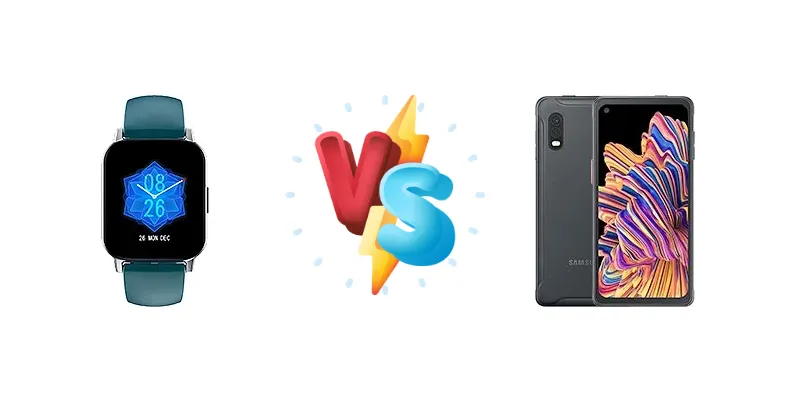
The rugged smartphone market caters to a specific need: durability. Both the Doogee CS2 and the Samsung Galaxy XCover Pro aim to deliver on that promise, but they approach it with vastly different internal hardware. The CS2 utilizes a Realtek chipset, prioritizing affordability, while the XCover Pro leverages Samsung’s Exynos 9611, aiming for a balance of power and resilience. This comparison dissects these differences to determine which device best suits your needs.
🏆 Quick Verdict
For the average user prioritizing a smoother, more responsive experience and established brand reliability, the Samsung Galaxy XCover Pro is the better choice. Its Exynos 9611 chipset offers significantly more processing power than the Doogee CS2’s Realtek 8762C, translating to better multitasking and app performance, despite the slower 15W charging.
| Network |
|---|
| 2G bands | N/A | GSM 850 / 900 / 1800 / 1900 |
| 3G bands | N/A | HSDPA 850 / 900 / 1900 / 2100 - International |
| 4G bands | N/A | 1, 2, 3, 5, 7, 8, 20, 28, 38, 40, 41 - International |
| EDGE | No | - |
| GPRS | No | - |
| Speed | - | HSPA 42.2/5.76 Mbps, LTE (3CA) Cat11 600/50 Mbps |
| Technology | No cellular connectivity | GSM / HSPA / LTE |
| | - | 1, 2, 3, 4, 5, 7, 12, 13, 14, 20, 29, 38, 40, 41, 66 - Canada |
| Launch |
|---|
| Announced | 2021, May | 2020, January |
| Status | Available. Released 2021, May | Available. Released 2020, January |
| Body |
|---|
| Build | Plastic frame, plastic back | - |
| Dimensions | 43.8 x 36.9 x 10.5 mm (1.72 x 1.45 x 0.41 in) | 159.9 x 76.7 x 10 mm (6.30 x 3.02 x 0.39 in) |
| SIM | No | · Nano-SIM· Nano-SIM + Nano-SIM |
| Weight | 35 g (1.23 oz) | 218 g (7.69 oz) |
| | - | IP68 dust/water resistant (up to 1.5m for 35 min)
Drop-to-concrete resistance from up to 1.5m
MIL-STD-810G compliant*
*does not guarantee ruggedness or use in extreme conditions |
| Display |
|---|
| Protection | - | Corning Gorilla Glass 5 |
| Resolution | 240 x 240 pixels (~201 ppi density) | 1080 x 2340 pixels, 19.5:9 ratio (~409 ppi density) |
| Size | 1.69 inches | 6.3 inches, 97.4 cm2 (~79.4% screen-to-body ratio) |
| Type | IPS LCD | IPS LCD |
| Platform |
|---|
| CPU | - | Octa-core (4x2.3 GHz Cortex-A73 & 4x1.7 GHz Cortex-A53) |
| Chipset | Realtek 8762C | Exynos 9611 (10 nm) |
| GPU | - | Mali-G72 MP3 |
| OS | Proprietary | Android 10, upgradable to Android 13, One UI 5 |
| Memory |
|---|
| Card slot | No | microSDXC (dedicated slot) |
| Internal | - | 64GB 4GB RAM |
| Main Camera |
|---|
| Dual | - | 25 MP, f/1.7, 26mm (wide), PDAF
8 MP, f/2.2, 123˚ (ultrawide), 1/4.0", 1.12µm |
| Features | - | Dual-LED flash, HDR, panorama |
| Video | - | 1080p@30fps |
| Selfie camera |
|---|
| Features | - | HDR |
| Single | - | 13 MP, f/2.0, (wide), 1/3.1", 1.12µm |
| Video | - | 1080p@30fps |
| Sound |
|---|
| 3.5mm jack | - | Yes |
| 35mm jack | No | Yes |
| Loudspeaker | No | Yes |
| Comms |
|---|
| Bluetooth | 5.0, A2DP, LE | 5.0, A2DP, LE |
| NFC | No | Yes |
| Positioning | No | GPS, GLONASS, GALILEO, BDS |
| Radio | No | FM radio (market/region dependent) |
| USB | No | USB Type-C 2.0 |
| WLAN | No | Wi-Fi 802.11 a/b/g/n/ac/k/v/r, dual-band, Wi-Fi Direct |
| Features |
|---|
| Sensors | Accelerometer, heart rate | Fingerprint (side-mounted), accelerometer, gyro, proximity, compass |
| | - | ANT+ |
| Battery |
|---|
| Charging | - | 15W wired |
| Type | Li-Ion 300 mAh | Li-Po 4050 mAh, removable |
| Misc |
|---|
| Colors | Black, Rose Gold, Silver | Black |
| Models | - | SM-G715FN/DS, SM-G715FN, SM-G715F, SM-G715W, SM-G715U, SM-G715U1 |
| Price | About 40 EUR | About 120 EUR |
| SAR EU | - | 0.47 W/kg (head) 1.23 W/kg (body) |
Doogee CS2
- Extremely affordable price point
- Potentially longer battery life due to efficient chipset
- Rugged design for durability
- Significantly lower performance compared to the XCover Pro
- Likely basic camera system
- Limited software support
Samsung Galaxy XCover Pro
- More powerful Exynos 9611 processor
- Better software experience and potential for longer updates
- More refined camera system
- Slower 15W charging
- Higher price compared to the Doogee CS2
- Potential for thermal throttling under heavy load
Display Comparison
Neither device’s display specifications are provided, so a direct comparison is limited. However, given the XCover Pro’s positioning, it likely features a higher quality panel with better color accuracy and viewing angles than the CS2. The XCover Pro’s market segment suggests a focus on usability in bright outdoor conditions, potentially incorporating a higher peak brightness. The CS2, aiming for cost savings, likely utilizes a more basic LCD panel.
Camera Comparison
Without detailed camera specifications, a precise comparison is difficult. However, the XCover Pro’s brand reputation suggests a more refined image processing pipeline and potentially better low-light performance. The CS2 likely relies on basic image processing algorithms to compensate for a potentially smaller sensor. The presence of a 2MP macro camera on the CS2 is likely a marketing feature with limited real-world utility, as image quality will be significantly constrained by the sensor size and lens quality. The XCover Pro’s camera system, while not flagship-level, is likely to deliver more consistent and usable results.
Performance
The performance gap is the most significant differentiator. The Doogee CS2’s Realtek 8762C is a low-power chipset typically found in wearables and basic feature phones. In contrast, the Samsung Galaxy XCover Pro’s Exynos 9611 (10nm) is an octa-core processor built on a more advanced manufacturing process. The Exynos 9611’s Cortex-A73 cores provide a substantial performance uplift for demanding applications and multitasking. The 10nm process also contributes to better thermal efficiency, reducing the likelihood of throttling under sustained load. Users who intend to run multiple apps simultaneously or engage in moderate gaming will find the XCover Pro far more capable.
Battery Life
Battery capacity is not specified for either device. However, the XCover Pro’s 15W wired charging is slower than what’s becoming standard in the market. The Realtek 8762C in the CS2 is extremely power efficient, potentially allowing for longer battery life despite a smaller capacity. However, the XCover Pro’s more efficient Exynos 9611, combined with optimized software, could mitigate the slower charging speed, providing comparable real-world battery endurance for typical usage patterns.
Buying Guide
Buy the Doogee CS2 if you need an extremely budget-friendly rugged phone for basic communication and light tasks, and are willing to accept compromises in performance. Buy the Samsung Galaxy XCover Pro if you prefer a more capable device for work or outdoor activities, demanding smoother performance, and appreciate the benefits of Samsung’s software ecosystem and potentially longer software support.
Frequently Asked Questions
❓ Does the Exynos 9611 in the Samsung Galaxy XCover Pro overheat during prolonged use, like gaming?
While the Exynos 9611 isn't a flagship processor, its 10nm manufacturing process and Samsung's thermal management solutions should prevent significant overheating during moderate gaming sessions. However, extended, graphically intensive games may lead to some throttling to maintain thermal stability. The Doogee CS2, with its less powerful chipset, is less likely to overheat but also offers a significantly less capable gaming experience.
❓ Is the 2MP macro camera on the Doogee CS2 actually useful for taking detailed close-up photos?
Unfortunately, a 2MP macro camera typically delivers limited detail and image quality. The small sensor size and basic lens severely restrict its capabilities. While it can capture close-up shots, expect soft images with limited clarity. It's primarily a marketing feature rather than a genuinely useful photographic tool.
❓ How does the Realtek 8762C chipset in the Doogee CS2 handle multitasking compared to the Exynos 9611?
The Realtek 8762C is designed for basic smartphone functions and will struggle with demanding multitasking. Switching between apps will be noticeably slower, and running multiple apps simultaneously may lead to lag and performance issues. The Exynos 9611, with its octa-core architecture and higher processing power, handles multitasking far more efficiently, allowing for a smoother and more responsive user experience.