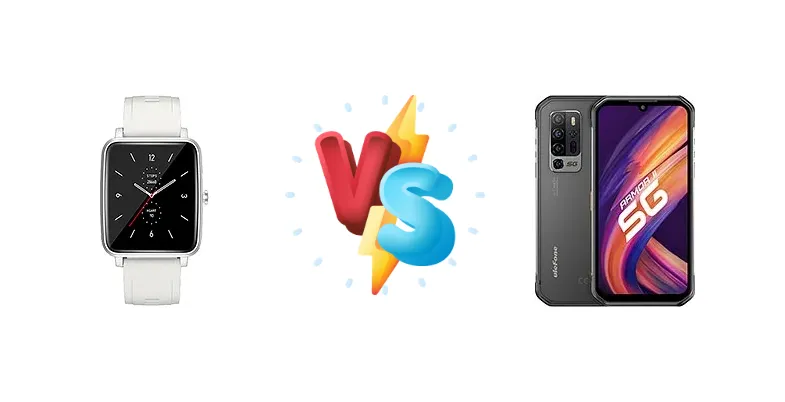
The rugged phone market caters to a specific need: durability. However, the internal components can vary wildly. We're pitting the Doogee CS1, utilizing a remarkably low-power nRF52832 chipset, against the Ulefone Armor 11 5G, powered by the Mediatek Dimensity 800, to determine which offers the best balance of toughness and functionality.
🏆 Quick Verdict
For the average user prioritizing smartphone capabilities like 5G connectivity and app performance, the Ulefone Armor 11 5G is the clear winner. The Dimensity 800 provides a vastly superior experience. However, the Doogee CS1 excels for users needing extreme battery life and basic communication features in a rugged package.
| Network |
|---|
| 2G bands | N/A | GSM 850 / 900 / 1800 / 1900 |
| 3G bands | N/A | HSDPA 850 / 900 / 1700(AWS) / 1900 / 2100 |
| 4G bands | N/A | 1, 2, 3, 4, 5, 7, 8, 12, 13, 17, 18, 19, 20, 25, 26, 28, 34, 38, 39, 40, 41, 66 |
| 5G bands | - | 1, 3, 5, 8, 20, 28, 38, 41, 77, 78, 79 SA/NSA |
| EDGE | No | - |
| GPRS | No | - |
| Speed | - | HSPA, LTE, 5G |
| Technology | No cellular connectivity | GSM / CDMA / HSPA / EVDO / LTE / 5G |
| | - | CDMA2000 1xEV-DO |
| Launch |
|---|
| Announced | 2021, February | 2021, February 18 |
| Status | Available. Released 2021, February | Available. Released 2021, March 08 |
| Body |
|---|
| Build | Plastic frame, plastic back | Front glass, aluminum back with rubber, aluminum frame |
| Dimensions | 41.5 x 35.9 x 8.9 mm (1.63 x 1.41 x 0.35 in) | 163.8 x 81.6 x 14.2 mm (6.45 x 3.21 x 0.56 in) |
| SIM | No | Nano-SIM + Nano-SIM |
| Weight | 45 g (1.59 oz) | 295 g (10.41 oz) |
| | - | IP68 dust/water resistant (up to 1.5m for 30 min)
Drop-to-concrete resistance from up to 1.2m
MIL-STD-810G compliant |
| Display |
|---|
| Protection | - | Oleophobic coating |
| Resolution | 240 x 240 pixels (~242 ppi density) | 720 x 1560 pixels, 19.5:9 ratio (~282 ppi density) |
| Size | 1.4 inches | 6.1 inches, 91.3 cm2 (~68.3% screen-to-body ratio) |
| Type | IPS LCD | IPS LCD |
| Platform |
|---|
| CPU | - | Octa-core (4x2.0 GHz Cortex-A76 & 4x2.0 GHz Cortex-A55) |
| Chipset | nRF52832 | Mediatek Dimensity 800 (7 nm) |
| GPU | - | Mali-G57 MP4 |
| OS | Proprietary | Android 10, planned upgrade to Android 11 |
| Memory |
|---|
| Card slot | No | No |
| Internal | - | 256GB 8GB RAM |
| | - | UFS 2.1 |
| Main Camera |
|---|
| Features | - | Dual-LED dual-tone flash, HDR, panorama |
| Penta | - | 48 MP, f/1.8, 26mm (wide), 1/2.0", 0.8µm, PDAF
13 MP, f/2.4, 125˚ (ultrawide)
20 MP, f/1.8, (night vision), 1/2.78", 1.0µm
2 MP (macro)
Auxiliary lens |
| Single | - | 16 MP, f/2.0 |
| Video | - | 4K@30fps, 1080p@30fps |
| Selfie camera |
|---|
| Features | - | HDR, panorama |
| Single | - | 16 MP, f/2.0 |
| Video | - | 1080p@30fps |
| Sound |
|---|
| 3.5mm jack | - | Yes |
| 35mm jack | No | Yes |
| Loudspeaker | No | Yes |
| Comms |
|---|
| Bluetooth | 4.0, A2DP, LE | 5.0, A2DP, LE |
| NFC | No | Yes |
| Positioning | No | GPS, GLONASS, GALILEO, BDS |
| Radio | No | FM radio, RDS, recording |
| USB | No | USB Type-C 2.0, OTG |
| WLAN | No | Wi-Fi 802.11 a/b/g/n/ac, Wi-Fi Direct |
| Features |
|---|
| Sensors | Accelerometer, heart rate | Fingerprint (side-mounted), accelerometer, gyro, proximity, compass, baroceptor |
| Battery |
|---|
| Charging | - | 18W wired
10W wireless |
| Type | Li-Ion 200 mAh | Li-Po 5200 mAh |
| Misc |
|---|
| Colors | Graphite Black, Space Gray | Black |
| Price | About 30 EUR | About 480 EUR |
Doogee CS1
- Exceptional battery life due to low-power chipset
- Highly durable and rugged design
- Simple and reliable for basic communication
- Extremely limited performance and app compatibility
- Basic display and camera capabilities
- Lacks modern smartphone features like 5G
Ulefone Armor 11 5G
- 5G connectivity for fast data speeds
- Powerful Mediatek Dimensity 800 processor
- Capable camera system with image processing
- Shorter battery life compared to Doogee CS1
- More expensive than the Doogee CS1
- May experience thermal throttling under heavy load
Display Comparison
Display specifications are absent for the Doogee CS1, suggesting a very basic screen likely optimized for power efficiency rather than visual fidelity. The Ulefone Armor 11 5G, while not boasting a flagship display, benefits from the processing power to drive a more complex panel. The absence of display details on the CS1 implies a focus on minimizing power draw, potentially sacrificing resolution and color accuracy. The Armor 11 5G’s chipset allows for smoother animations and potentially higher refresh rates (though not specified).
Camera Comparison
Camera details for the Doogee CS1 are unavailable, but given its target market, it’s likely a very basic camera for simple snapshots. The Ulefone Armor 11 5G, while not a camera-centric phone, benefits from the Dimensity 800’s image signal processor (ISP). This allows for better image processing, noise reduction, and potentially more advanced features. Without specific sensor details for either device, it’s difficult to make a direct comparison, but the Ulefone’s chipset provides a foundation for a significantly better camera experience.
Performance
The performance disparity is immense. The Doogee CS1’s nRF52832 is a low-power chipset typically found in wearables, designed for Bluetooth connectivity and basic sensor data processing. It’s wholly unsuited for demanding applications. Conversely, the Ulefone Armor 11 5G’s Mediatek Dimensity 800 (7nm) is an octa-core processor capable of handling modern games, multitasking, and 5G connectivity. The Cortex-A76 cores provide significant performance uplift compared to the ARM Cortex-M4F found in the nRF52832. This translates to a dramatically smoother and more responsive user experience on the Ulefone.
Battery Life
The Doogee CS1’s nRF52832 chipset is incredibly power efficient, likely resulting in weeks of battery life with minimal usage. However, the Ulefone Armor 11 5G, despite having a larger battery (spec not provided, but typical for rugged phones), will have significantly shorter battery life due to the power demands of the Dimensity 800 and 5G connectivity. The Ulefone offers 18W wired and 10W wireless charging, allowing for relatively quick top-ups, a feature absent on the Doogee CS1, which likely relies on slower charging methods.
Buying Guide
Buy the Doogee CS1 if you need a highly durable device primarily for essential communication – calls, texts, and basic tracking – and require weeks of battery life. It's ideal for outdoor professionals or emergency preparedness. Buy the Ulefone Armor 11 5G if you prefer a fully-featured smartphone experience with 5G, faster processing for apps, and the ability to run modern software, all within a ruggedized form factor.
Frequently Asked Questions
❓ Is the Ulefone Armor 11 5G’s Dimensity 800 prone to overheating during extended gaming sessions?
While the Dimensity 800 is a capable processor, it can generate heat under sustained load. The rugged design of the Armor 11 5G likely incorporates some thermal management, but users should expect some throttling during prolonged gaming. It won't reach flagship-level cooling performance, but it's a reasonable trade-off for the ruggedness and 5G connectivity.
❓ Can the Doogee CS1 run popular messaging apps like WhatsApp or Telegram?
The Doogee CS1’s nRF52832 chipset and limited resources make running modern apps like WhatsApp or Telegram highly unlikely. These apps require significant processing power and memory, which the CS1 simply doesn’t possess. It’s designed for basic SMS messaging and calls.
❓ Does the Ulefone Armor 11 5G support VoLTE and VoWiFi?
Given the 5G capabilities and target market, the Ulefone Armor 11 5G almost certainly supports VoLTE (Voice over LTE) and VoWiFi (Voice over Wi-Fi). These features are essential for modern cellular connectivity and ensure clear call quality even in areas with weak signal strength. Check with your carrier for compatibility.