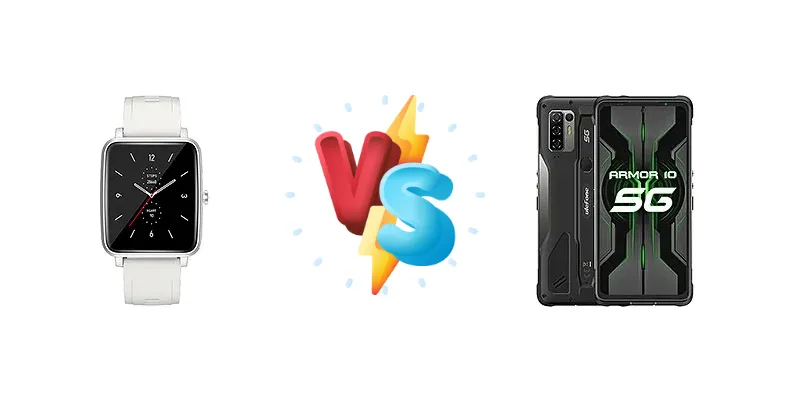
The rugged phone market caters to a specific need: durability. However, within that niche, priorities diverge. The Doogee CS1 appears to focus on basic functionality and extended standby, while the Ulefone Armor 10 5G aims for a more complete smartphone experience with 5G connectivity and a powerful processor. This comparison dissects these differences to determine which device delivers the best value.
🏆 Quick Verdict
For the average user needing a robust phone with modern features, the Ulefone Armor 10 5G is the clear winner. Its Mediatek Dimensity 800 chipset provides a substantial performance advantage over the Doogee CS1’s nRF52832, enabling smoother multitasking, faster app loading, and 5G connectivity. While the CS1 may excel in ultra-long standby, the Armor 10 5G offers a more versatile and capable experience.
| Network |
|---|
| 2G bands | N/A | GSM 850 / 900 / 1800 / 1900 |
| 3G bands | N/A | HSDPA 850 / 900 / 1700(AWS) / 1900 / 2100 |
| 4G bands | N/A | 1, 2, 3, 4, 5, 7, 8, 12, 13, 17, 18, 19, 20, 25, 26, 28, 34, 38, 39, 40, 41, 66 |
| 5G bands | - | 1, 3, 41, 77, 78, 79 SA/NSA |
| EDGE | No | - |
| GPRS | No | - |
| Speed | - | HSPA, LTE, 5G |
| Technology | No cellular connectivity | GSM / CDMA / HSPA / EVDO / LTE / 5G |
| | - | CDMA2000 1xEV-DO |
| Launch |
|---|
| Announced | 2021, February | 2020, November 17. Released 2020, December 07 |
| Status | Available. Released 2021, February | Discontinued |
| Body |
|---|
| Build | Plastic frame, plastic back | Front glass, aluminum back with rubber, aluminum frame |
| Dimensions | 41.5 x 35.9 x 8.9 mm (1.63 x 1.41 x 0.35 in) | 176.5 x 82.8 x 14.6 mm (6.95 x 3.26 x 0.57 in) |
| SIM | No | Nano-SIM + Nano-SIM |
| Weight | 45 g (1.59 oz) | 328 g (11.57 oz) |
| | - | IP68 dust/water resistant (up to 1.5m for 30 min)
Drop-to-concrete resistance from up to 1.2m
MIL-STD-810G compliant |
| Display |
|---|
| Protection | - | Scratch-resistant glass, oleophobic coating |
| Resolution | 240 x 240 pixels (~242 ppi density) | 1080 x 2400 pixels, 20:9 ratio (~395 ppi density) |
| Size | 1.4 inches | 6.67 inches, 107.4 cm2 (~73.5% screen-to-body ratio) |
| Type | IPS LCD | IPS LCD |
| Platform |
|---|
| CPU | - | Octa-core (4x2.0 GHz Cortex-A76 & 4x2.0 GHz Cortex-A55) |
| Chipset | nRF52832 | Mediatek Dimensity 800 (7 nm) |
| GPU | - | Mali-G57 MP4 |
| OS | Proprietary | Android 10, planned upgrade to Android 11 |
| Memory |
|---|
| Card slot | No | microSDXC (uses shared SIM slot) |
| Internal | - | 128GB 8GB RAM |
| Main Camera |
|---|
| Features | - | LED flash, Panorama, HDR |
| Quad | - | 64 MP, f/1.9, 26mm (wide), 1/1.72", 0.8µm, PDAF
8 MP, f/2.2, 119˚ (ultrawide)
5 MP (macro)
Auxiliary lens |
| Video | - | 4K@30fps, 1080p@30fps |
| Selfie camera |
|---|
| Single | - | 16 MP, f/2.2 |
| Video | - | 1080p@30fps |
| Sound |
|---|
| 3.5mm jack | - | Yes |
| 35mm jack | No | Yes |
| Loudspeaker | No | Yes |
| Comms |
|---|
| Bluetooth | 4.0, A2DP, LE | 5.2, A2DP, LE |
| NFC | No | Yes |
| Positioning | No | GPS, GLONASS, GALILEO, BDS |
| Radio | No | FM radio, RDS, recording |
| USB | No | USB Type-C 2.0, OTG |
| WLAN | No | Wi-Fi 802.11 a/b/g/n/ac, Wi-Fi Direct |
| Features |
|---|
| Sensors | Accelerometer, heart rate | Fingerprint (side-mounted), accelerometer, gyro, proximity, compass, baroceptor, coulombmeter |
| Battery |
|---|
| Charging | - | 15W wired
15W wireless |
| Type | Li-Ion 200 mAh | Li-Po 5800 mAh |
| Misc |
|---|
| Colors | Graphite Black, Space Gray | Black |
| Price | About 30 EUR | About 420 EUR |
Doogee CS1
- Potentially exceptional standby time due to low-power chipset.
- Likely very affordable price point.
- Simple and easy to use interface (assumed).
- Extremely limited processing power.
- Lack of modern features like 5G.
- Poor app performance and multitasking capabilities.
Ulefone Armor 10 5G
- Powerful Mediatek Dimensity 800 processor for smooth performance.
- 5G connectivity for fast data speeds.
- Wireless charging convenience.
- Battery life may be shorter than the Doogee CS1 under similar usage.
- Potentially higher price point.
- Rugged design may add bulk.
Display Comparison
Display specifications are absent for the Doogee CS1, suggesting a basic display focused on readability rather than visual fidelity. The Ulefone Armor 10 5G, while not boasting a cutting-edge panel, benefits from a more modern smartphone design. Without knowing the CS1’s resolution or panel type, it’s difficult to assess its color accuracy or viewing angles. The Armor 10 5G’s display, while likely 1080p, will offer a significantly more vibrant and detailed experience for media consumption.
Camera Comparison
Camera details for the Doogee CS1 are unavailable, making a direct comparison impossible. The Ulefone Armor 10 5G, while likely not competing with flagship camera phones, benefits from a more sophisticated image processing pipeline enabled by its powerful chipset. The Armor 10 5G’s camera system will likely offer better dynamic range and noise reduction compared to the CS1, assuming the CS1 even includes a comparable sensor. The absence of information regarding the CS1’s camera suggests it’s a basic feature, intended for simple snapshots.
Performance
The performance gap between these devices is immense. The Doogee CS1’s nRF52832 is a low-power chipset primarily designed for wearables and IoT devices, prioritizing battery life over processing speed. In contrast, the Ulefone Armor 10 5G’s Mediatek Dimensity 800 (7nm) is an octa-core processor built on a more advanced manufacturing process. The Dimensity 800’s Cortex-A76 cores deliver significantly higher single-core performance, crucial for responsive app launches, while the Cortex-A55 cores handle background tasks efficiently. This translates to a vastly superior user experience on the Armor 10 5G, especially for multitasking and gaming.
Battery Life
Battery capacity for the Doogee CS1 is unknown, but its nRF52832 chipset is designed for extreme power efficiency, suggesting potentially impressive standby times. The Ulefone Armor 10 5G offers both 15W wired and 15W wireless charging, providing convenient charging options. While the Armor 10 5G’s battery capacity is also unknown, the Dimensity 800’s power draw will be higher than the nRF52832. However, the Armor 10 5G’s more efficient power management features and potentially larger battery capacity will likely provide a full day of moderate use, while the CS1 may prioritize weeks of standby over intensive usage.
Buying Guide
Buy the Doogee CS1 if you need a secondary phone for emergencies, prioritize extremely long standby time over app performance, and require a minimal feature set. Buy the Ulefone Armor 10 5G if you prefer a fully-featured smartphone with 5G, a responsive user interface, and the ability to run demanding applications, even in challenging environments.
Frequently Asked Questions
❓ Is the Ulefone Armor 10 5G’s Dimensity 800 chipset prone to overheating during prolonged gaming sessions?
The Mediatek Dimensity 800 is generally well-regarded for its thermal efficiency. While it can get warm under heavy load, it’s unlikely to experience significant throttling due to its 7nm manufacturing process and the Ulefone Armor 10 5G’s rugged design, which typically incorporates heat dissipation features. However, sustained gaming at maximum settings will inevitably generate heat.
❓ How useful is the Doogee CS1 as a primary smartphone for everyday tasks like browsing and social media?
The Doogee CS1 is not well-suited as a primary smartphone for most users. Its nRF52832 chipset lacks the processing power to provide a smooth experience with modern apps and websites. Browsing will be slow, and social media apps may be unresponsive. It’s best suited as a secondary device for basic communication or emergency use.
❓ Does the Ulefone Armor 10 5G support VoLTE and VoWiFi for improved call quality?
The Ulefone Armor 10 5G, being a 5G-enabled smartphone, almost certainly supports VoLTE (Voice over LTE) for higher-quality calls on 4G networks. VoWiFi (Voice over Wi-Fi) support is likely, but depends on carrier compatibility. Check with your mobile provider to confirm VoWiFi functionality.