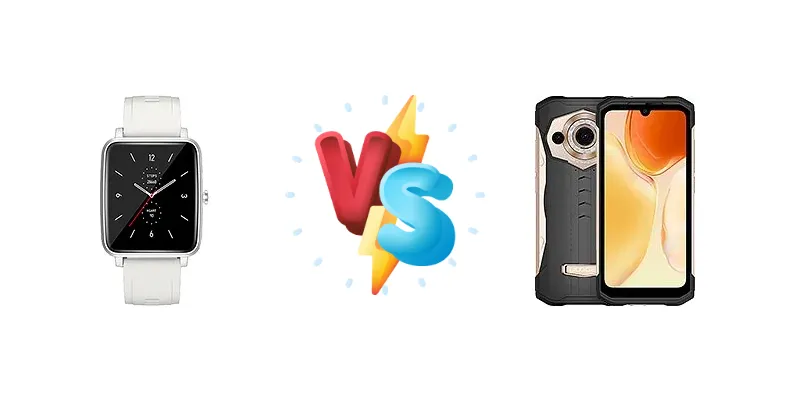
Doogee caters to distinct needs with the CS1 and S99. The CS1 represents a return to simplicity, focusing on core communication features and extreme durability. Conversely, the S99 is a fully-fledged Android smartphone, boasting a modern chipset and a broader feature set, all wrapped in a ruggedized package. This comparison dissects the key differences to help you determine which Doogee best suits your lifestyle.
🏆 Quick Verdict
For the average user seeking a smartphone experience, the Doogee S99 is the clear winner. Its Mediatek Helio G96 chipset provides significantly more processing power and versatility than the CS1’s nRF52832. However, the CS1 excels for those prioritizing extreme battery life and a distraction-free, minimalist device.
| Network |
|---|
| 2G bands | N/A | GSM 850 / 900 / 1800 / 1900 |
| 3G bands | N/A | HSDPA 800 / 850 / 900 / 1700(AWS) / 1900 / 2100 |
| 4G bands | N/A | 1, 2, 3, 4, 5, 7, 8, 12, 13, 17, 18, 19, 20, 25, 26, 28, 34, 38, 39, 40, 41, 66 |
| EDGE | No | - |
| GPRS | No | - |
| Speed | - | HSPA, LTE |
| Technology | No cellular connectivity | GSM / CDMA / HSPA / LTE |
| Launch |
|---|
| Announced | 2021, February | 2022, December 05 |
| Status | Available. Released 2021, February | Available. Released 2022, December 05 |
| Body |
|---|
| Build | Plastic frame, plastic back | - |
| Dimensions | 41.5 x 35.9 x 8.9 mm (1.63 x 1.41 x 0.35 in) | 172 x 82 x 15.5 mm (6.77 x 3.23 x 0.61 in) |
| SIM | No | Nano-SIM + Nano-SIM |
| Weight | 45 g (1.59 oz) | - |
| Display |
|---|
| Protection | - | Corning Gorilla Glass |
| Resolution | 240 x 240 pixels (~242 ppi density) | 1080 x 2340 pixels, 19.5:9 ratio (~409 ppi density) |
| Size | 1.4 inches | 6.3 inches, 97.4 cm2 (~69.1% screen-to-body ratio) |
| Type | IPS LCD | IPS LCD |
| Platform |
|---|
| CPU | - | Octa-core (2x2.05 GHz Cortex-A76 & 6x2.0 GHz Cortex-A55) |
| Chipset | nRF52832 | Mediatek MT6781 Helio G96 (12 nm) |
| GPU | - | Mali-G57 MC2 |
| OS | Proprietary | Android 12 |
| Memory |
|---|
| Card slot | No | microSDXC (dedicated slot) |
| Internal | - | 128GB 8GB RAM |
| Main Camera |
|---|
| Features | - | Dual-LED flash, HDR, panorama |
| Triple | - | 108 MP, f/1.9, (wide), 1/1.52", 0.7µm, PDAF
64 MP, f/1.8, (night vision), 2 infrared night vision lights
16 MP, f/1.8, 130˚ (ultrawide) |
| Video | - | 1440p@30fps, 1080p@30fps |
| Selfie camera |
|---|
| Single | - | 32 MP, f/2.0, (wide), 1/2.8", 0.8µm |
| Video | - | 1080p@30fps |
| Sound |
|---|
| 35mm jack | No | No |
| Loudspeaker | No | Yes |
| Comms |
|---|
| Bluetooth | 4.0, A2DP, LE | 5.1, A2DP, LE |
| NFC | No | Yes (market/region dependent) |
| Positioning | No | GPS, GLONASS, GALILEO, BDS |
| Radio | No | FM radio |
| USB | No | USB Type-C 2.0, OTG |
| WLAN | No | Wi-Fi 802.11 a/b/g/n/ac, dual-band |
| Features |
|---|
| Sensors | Accelerometer, heart rate | Fingerprint (side-mounted), accelerometer, gyro, proximity, compass |
| Battery |
|---|
| Charging | - | 33W wired, 45% in 30 min
15W wireless
Reverse wired |
| Type | Li-Ion 200 mAh | 6000 mAh |
| Misc |
|---|
| Colors | Graphite Black, Space Gray | Gold, Black |
| Price | About 30 EUR | About 250 EUR |
Doogee CS1
- Exceptional battery life due to low-power chipset
- Extreme durability and ruggedness
- Simple and distraction-free user experience
- Limited functionality – basic phone features only
- Poor performance for modern apps
- Low-resolution display (likely)
Doogee S99
- Full Android smartphone experience
- Powerful Mediatek Helio G96 processor
- Fast 33W wired and 15W wireless charging
- Shorter battery life compared to CS1
- More complex software experience
- Potentially higher price point
Display Comparison
The Doogee CS1’s display specifications are not provided, but given its positioning, it likely features a basic LCD panel focused on readability rather than visual fidelity. The S99, being a smartphone, benefits from a more advanced display, though specific details like panel type (IPS, AMOLED) and resolution are absent. The S99’s focus is on functionality, not high-end visuals, but it will offer a significantly more vibrant and detailed viewing experience than the CS1. Bezels on the CS1 are likely larger, prioritizing durability and simplicity, while the S99 will aim for a more modern, maximized screen-to-body ratio.
Camera Comparison
Camera details for the CS1 are unavailable, but it likely features a basic camera for simple snapshots. The S99, while not positioned as a camera flagship, will offer a more capable imaging system. Without specific sensor details, it’s difficult to assess image quality, but the S99’s processor allows for more advanced image processing algorithms. The absence of detailed camera specs on both devices suggests they aren’t primary selling points, but the S99 will undoubtedly provide a more versatile photographic experience.
Performance
The performance gap between these devices is substantial. The Doogee CS1 utilizes the nRF52832, a low-power chipset designed for Bluetooth connectivity and basic functions. It’s suitable for calls, texts, and limited feature phone tasks. The Doogee S99, however, is powered by the Mediatek MT6781 Helio G96 (12 nm). This octa-core processor, with its Cortex-A76 and A55 cores, delivers a far superior experience for multitasking, gaming, and running demanding applications. The G96’s 12nm process node also allows for more efficient power management under load compared to the CS1’s older architecture. The S99’s performance is geared towards a modern smartphone user, while the CS1 is deliberately limited.
Battery Life
Battery capacity for both devices is not specified. However, the CS1’s nRF52832 chipset is incredibly power-efficient, suggesting potentially weeks of standby time and days of usage on a single charge. The S99, with its more powerful processor and larger display, will have a shorter battery life, but compensates with 33W wired charging (45% in 30 minutes) and 15W wireless charging. The S99 also offers reverse wired charging, allowing it to charge other devices. The CS1 prioritizes longevity, while the S99 prioritizes convenience and faster replenishment.
Buying Guide
Buy the Doogee CS1 if you need a highly durable, long-lasting device primarily for calls and texts, and value simplicity above all else. It’s ideal for outdoor workers or those seeking a ‘digital detox’ phone. Buy the Doogee S99 if you prefer a full Android experience with app support, faster performance for multimedia, and features like wireless charging and reverse wired charging, all within a rugged build.
Frequently Asked Questions
❓ Is the Doogee S99’s Helio G96 chipset capable of handling demanding games like PUBG or Call of Duty?
The Mediatek Helio G96 is a capable mid-range processor. While it won’t deliver flagship-level performance, it should be able to run PUBG and Call of Duty at medium settings with reasonable frame rates. However, extended gaming sessions may lead to some thermal throttling.
❓ Can I use Google Pay or other NFC-based payment services on the Doogee S99?
While the context data doesn't explicitly state NFC support, the Doogee S99, being a modern smartphone, is *highly likely* to include NFC functionality. This would allow for contactless payments and other NFC-enabled features. However, it's best to confirm this with Doogee's official specifications.
❓ How durable is the Doogee CS1 compared to a standard smartphone?
The Doogee CS1 is built for extreme durability. While specific certifications (IP68, MIL-STD-810H) aren't mentioned, its design and chipset choice suggest it can withstand drops, dust, and water exposure far better than a typical smartphone. It's designed for harsh environments where a standard phone would fail.
❓ Does the Doogee CS1 support any apps like WhatsApp or Telegram?
The Doogee CS1 runs on a feature phone platform and does *not* support Android or iOS apps. It will likely have limited support for basic SMS and potentially some pre-installed apps, but it won't be able to run WhatsApp, Telegram, or other smartphone applications.