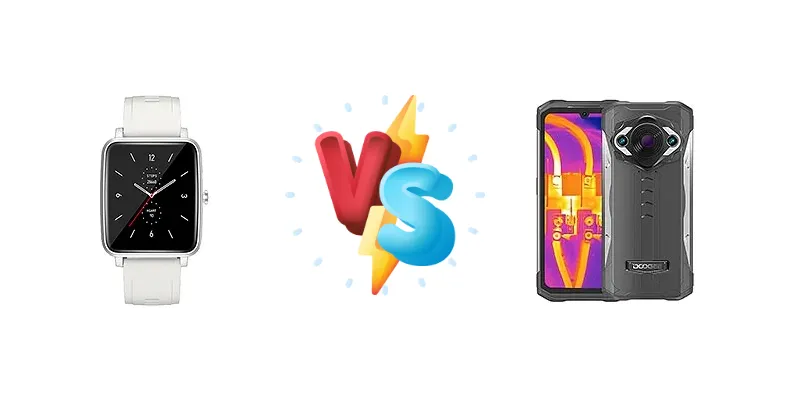
Doogee caters to distinct niches with the CS1 and S98 Pro. The CS1, leveraging a minimalist nRF52832 chipset, positions itself as a companion device focused on basic connectivity and potentially health tracking. Conversely, the S98 Pro, powered by the Mediatek Helio G96, aims for a full smartphone experience with gaming and multimedia capabilities, representing a significant leap in processing power.
🏆 Quick Verdict
For the average user seeking a capable smartphone experience, the Doogee S98 Pro is the clear winner. Its Mediatek Helio G96 chipset delivers substantially higher performance, enabling smoother multitasking, gaming, and app usage. The CS1 is best suited for niche applications where its limited functionality is sufficient.
| Network |
|---|
| 2G bands | N/A | GSM 850 / 900 / 1800 / 1900 |
| 3G bands | N/A | HSDPA 800 / 850 / 900 / 1700(AWS) / 1900 / 2100 |
| 4G bands | N/A | 1, 2, 3, 4, 5, 7, 8, 12, 13, 17, 18, 19, 20, 25, 26, 28, 34, 38, 39, 40, 41, 66 |
| EDGE | No | - |
| GPRS | No | - |
| Speed | - | HSPA, LTE |
| Technology | No cellular connectivity | GSM / CDMA / HSPA / LTE |
| Launch |
|---|
| Announced | 2021, February | 2022, May 27 |
| Status | Available. Released 2021, February | Available. Released 2022, June 06 |
| Body |
|---|
| Build | Plastic frame, plastic back | - |
| Dimensions | 41.5 x 35.9 x 8.9 mm (1.63 x 1.41 x 0.35 in) | 172 x 82 x 15.5 mm (6.77 x 3.23 x 0.61 in) |
| SIM | No | Nano-SIM + Nano-SIM |
| Weight | 45 g (1.59 oz) | 320 g (11.29 oz) |
| Display |
|---|
| Protection | - | Corning Gorilla Glass |
| Resolution | 240 x 240 pixels (~242 ppi density) | 1080 x 2340 pixels, 19.5:9 ratio (~409 ppi density) |
| Size | 1.4 inches | 6.3 inches, 97.4 cm2 (~69.1% screen-to-body ratio) |
| Type | IPS LCD | IPS LCD, 500 nits (peak) |
| Platform |
|---|
| CPU | - | Octa-core (2x2.05 GHz Cortex-A76 & 6x2.0 GHz Cortex-A55) |
| Chipset | nRF52832 | Mediatek MT6781 Helio G96 (12 nm) |
| GPU | - | Mali-G57 MC2 |
| OS | Proprietary | Android 12 |
| Memory |
|---|
| Card slot | No | microSDXC (dedicated slot) |
| Internal | - | 256GB 8GB RAM |
| Main Camera |
|---|
| Features | - | Dual-LED flash, HDR, panorama |
| Triple | - | 48 MP, f/1.8, (wide), PDAF
20 MP, f/1.8, (night vision), 2 infrared night vision lights
Thermal imaging camera |
| Video | - | 1440p, 1080p |
| Selfie camera |
|---|
| Single | - | 16 MP, f/2.0, (wide) |
| Video | - | 1080p |
| Sound |
|---|
| 35mm jack | No | Unspecified |
| Loudspeaker | No | Yes |
| Comms |
|---|
| Bluetooth | 4.0, A2DP, LE | 5.1, A2DP, LE |
| NFC | No | Yes |
| Positioning | No | GPS, GLONASS, BDS, GALILEO |
| Radio | No | FM radio |
| USB | No | USB Type-C 2.0, OTG |
| WLAN | No | Wi-Fi 802.11 a/b/g/n/ac, dual-band |
| Features |
|---|
| Sensors | Accelerometer, heart rate | Fingerprint (side-mounted), accelerometer, gyro, proximity, compass |
| Battery |
|---|
| Charging | - | 33W wired
15W wireless |
| Type | Li-Ion 200 mAh | 6000 mAh |
| Misc |
|---|
| Colors | Graphite Black, Space Gray | Black |
| Price | About 30 EUR | About 470 EUR |
Doogee CS1
- Extremely long battery life due to low-power chipset
- Compact and lightweight design
- Potentially ideal for niche applications (remote monitoring)
- Severely limited functionality
- Unable to run modern Android apps
- Poor user experience for general smartphone use
Doogee S98 Pro
- Powerful Mediatek Helio G96 processor
- Fast 33W wired and 15W wireless charging
- Full Android smartphone experience
- Shorter battery life compared to CS1
- Potentially higher price point
- Larger and heavier design
Display Comparison
Display specifications are not provided for the CS1, suggesting a very basic screen likely optimized for low power consumption. The S98 Pro, while details are missing, benefits from the processing power of the Helio G96 to drive a higher resolution and refresh rate display. The absence of LTPO technology on the S98 Pro, given the chipset, suggests a standard 60Hz or 90Hz panel, but the G96's GPU will handle graphics rendering effectively. The CS1's display is likely monochrome or a very low-resolution color screen.
Camera Comparison
Camera details for the CS1 are unavailable, but given its target use case, it likely lacks a dedicated camera. The S98 Pro, while lacking specific sensor details, benefits from the image signal processor (ISP) within the Helio G96, enabling features like HDR and image stabilization. Without knowing the sensor sizes and apertures, it’s difficult to assess image quality, but the S98 Pro will undoubtedly offer a far superior photography experience due to its processing capabilities. Any 2MP macro lens on the S98 Pro should be considered a marketing feature rather than a significant photographic asset.
Performance
The performance disparity is stark. The Doogee CS1’s nRF52832 is a low-power microcontroller primarily designed for Bluetooth Low Energy and simple sensor applications. It’s wholly inadequate for running a full Android OS or demanding applications. The Doogee S98 Pro’s Mediatek Helio G96 (12nm) is an octa-core processor featuring two Cortex-A76 cores clocked at 2.05 GHz and six Cortex-A55 cores at 2.0 GHz. This architecture provides a significant performance boost for gaming and multitasking. The 12nm process node, while not the most advanced, offers a good balance between performance and power efficiency. The S98 Pro will handle modern games and apps with relative ease, while the CS1 will struggle with even basic tasks.
Battery Life
Battery capacity is not specified for the CS1, but its low-power chipset suggests exceptional battery life, potentially lasting weeks on a single charge. The S98 Pro offers 33W wired and 15W wireless charging, indicating a focus on convenience and faster replenishment. While the S98 Pro’s battery capacity is unknown, the Helio G96’s power draw will result in significantly shorter battery life compared to the CS1. The S98 Pro’s charging capabilities allow for quick top-ups, mitigating the impact of its higher power consumption.
Buying Guide
Buy the Doogee CS1 if you need a simple, ultra-long-lasting device primarily for basic communication, potentially as a companion to a main smartphone, or for specialized applications like remote monitoring where minimal processing power is required. Buy the Doogee S98 Pro if you prefer a full-featured Android smartphone with gaming capabilities, faster performance, and the convenience of wireless charging, even within a ruggedized form factor.
Frequently Asked Questions
❓ Is the Doogee S98 Pro’s Helio G96 chipset capable of handling demanding games like Genshin Impact?
The Helio G96 is a capable mid-range chipset. While it won't deliver flagship-level performance, it can run Genshin Impact at medium settings with acceptable frame rates. Expect some frame drops during intense combat scenarios. Thermal management will be key to sustained performance.
❓ Can the Doogee CS1 be used as a standalone smartwatch replacement?
While the CS1 offers basic connectivity, its limited functionality and lack of a dedicated app ecosystem make it a poor smartwatch replacement. It lacks features like a high-resolution display, advanced health tracking, and app notifications. It's better suited as a simple communication device or companion to a smartphone.
❓ What type of SIM card does the Doogee S98 Pro support?
Based on typical Doogee S-series phone specifications, the S98 Pro likely supports dual Nano-SIM cards, allowing for separate work and personal lines or utilizing a local SIM while traveling.
❓ Is the Doogee CS1 waterproof or dustproof?
The context data does not specify the CS1's IP rating. However, given its minimalist design and focus on basic functionality, it likely offers limited or no ingress protection against water or dust. The S98 Pro, being part of Doogee's rugged line, will have a much higher IP rating.