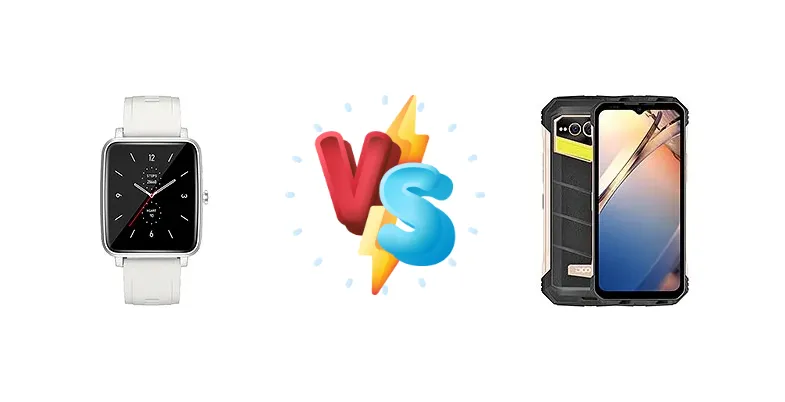
Doogee caters to distinct needs within the rugged phone market. The CS1 represents a minimalist, feature-focused approach, while the S100 Pro aims for a more mainstream experience with significantly enhanced processing power. This comparison dissects the core differences to help you determine which aligns with your priorities.
🏆 Quick Verdict
For the vast majority of users, the Doogee S100 Pro is the superior choice. Its Mediatek Helio G99 chipset delivers a dramatically improved performance profile compared to the CS1’s nRF52832, enabling smoother multitasking, gaming, and app responsiveness. While the CS1 offers simplicity, the S100 Pro provides a more versatile and future-proof experience.
| Network |
|---|
| 2G bands | N/A | GSM 850 / 900 / 1800 / 1900 |
| 3G bands | N/A | HSDPA 800 / 850 / 900 / 1700(AWS) / 1900 / 2100 |
| 4G bands | N/A | 1, 2, 3, 4, 5, 7, 8, 12, 13, 17, 18, 19, 20, 25, 26, 28, 34, 38, 39, 40, 41, 66, 71 |
| EDGE | No | - |
| GPRS | No | - |
| Speed | - | HSPA, LTE |
| Technology | No cellular connectivity | GSM / CDMA / HSPA / LTE |
| Launch |
|---|
| Announced | 2021, February | 2023, May 28 |
| Status | Available. Released 2021, February | Available. Released 2023, June 01 |
| Body |
|---|
| Build | Plastic frame, plastic back | - |
| Dimensions | 41.5 x 35.9 x 8.9 mm (1.63 x 1.41 x 0.35 in) | 178.5 x 83.1 x 27.3 mm (7.03 x 3.27 x 1.07 in) |
| SIM | No | Nano-SIM + Nano-SIM |
| Weight | 45 g (1.59 oz) | - |
| Display |
|---|
| Protection | - | Corning Gorilla Glass 5 |
| Resolution | 240 x 240 pixels (~242 ppi density) | 1080 x 2408 pixels, 20:9 ratio (~401 ppi density) |
| Size | 1.4 inches | 6.58 inches, 104.3 cm2 (~70.3% screen-to-body ratio) |
| Type | IPS LCD | IPS LCD |
| Platform |
|---|
| CPU | - | Octa-core (2x2.2 GHz Cortex-A76 & 6x2.0 GHz Cortex-A55) |
| Chipset | nRF52832 | Mediatek Helio G99 (6 nm) |
| GPU | - | Mali-G57 MC2 |
| OS | Proprietary | Android 12 |
| Memory |
|---|
| Card slot | No | microSDXC (uses shared SIM slot) |
| Internal | - | 256GB 12GB RAM |
| Main Camera |
|---|
| Features | - | Dual-LED flash, HDR, panorama |
| Triple | - | 108 MP, f/1.8, (wide), 1/1.52", 0.7µm, PDAF
20 MP, f/1.8, (night vision), 2 infrared night vision lights
16 MP, f/2.2, 130˚ (ultrawide) |
| Video | - | 1440p, 1080p |
| Selfie camera |
|---|
| Single | - | 32 MP, f/2.0, (wide), 1/2.8", 0.8µm |
| Video | - | 1440p, 1080p |
| Sound |
|---|
| 35mm jack | No | No |
| Loudspeaker | No | Yes, with stereo speakers |
| Comms |
|---|
| Bluetooth | 4.0, A2DP, LE | 5.0, A2DP, LE |
| NFC | No | Yes (market/region dependent) |
| Positioning | No | GPS (L1+L5), GLONASS, BDS, GALILEO |
| Radio | No | FM radio |
| USB | No | USB Type-C 2.0, OTG |
| WLAN | No | Wi-Fi 802.11 a/b/g/n/ac, dual-band |
| Features |
|---|
| Sensors | Accelerometer, heart rate | Fingerprint (side-mounted), accelerometer, gyro, proximity, compass |
| Battery |
|---|
| Charging | - | 33W wired |
| Type | Li-Ion 200 mAh | 22000 mAh |
| Misc |
|---|
| Colors | Graphite Black, Space Gray | Black, Black/Silver, Black/Gold |
| Price | About 30 EUR | About 300 EUR |
Doogee CS1
- Extremely long battery life (estimated)
- Simple and easy to use
- Potentially very affordable
- Very limited performance
- Poor app compatibility
- Basic camera capabilities
Doogee S100 Pro
- Significantly faster performance with Helio G99
- 33W fast charging
- More versatile for apps and media
- Shorter battery life than CS1 (estimated)
- Likely more expensive than CS1
- May still lack high-end camera features
Display Comparison
Display specifications are not provided for either device. However, given the CS1’s focus on simplicity, it likely features a basic LCD panel. The S100 Pro, positioned as a more capable device, likely utilizes an IPS LCD. The absence of details like refresh rate or resolution suggests neither phone prioritizes display quality as a key selling point. Bezels are likely substantial on both, typical of rugged designs prioritizing drop protection.
Camera Comparison
Camera details are absent for both devices. Given the CS1’s minimalist nature, its camera is likely a low-resolution sensor for basic snapshots. The S100 Pro, while not a camera-focused phone, likely features a more capable sensor. Without specific megapixel counts or aperture information, it’s difficult to assess image quality, but the Helio G99’s ISP (Image Signal Processor) will offer superior image processing capabilities compared to the nRF52832’s limited processing power.
Performance
The performance disparity is the most significant difference. The Doogee CS1’s nRF52832 chipset is designed for low-power wearables and IoT devices, not demanding smartphone tasks. It’s suitable for basic communication but will struggle with modern apps. Conversely, the Doogee S100 Pro’s Mediatek Helio G99 (6nm) is a capable mid-range processor featuring an octa-core configuration (2x2.2 GHz Cortex-A76 & 6x2.0 GHz Cortex-A55). The 6nm process node offers improved power efficiency compared to older 12nm or 14nm chips, translating to better sustained performance and reduced thermal throttling. This makes the S100 Pro suitable for gaming and multitasking.
Battery Life
Battery capacity is not specified for either device. However, the nRF52832’s low power consumption in the CS1 suggests excellent battery life, potentially lasting several days on a single charge with minimal use. The S100 Pro, with its more powerful processor, will have shorter battery life, but its 33W wired charging significantly reduces downtime. The CS1 likely charges via a slower, proprietary method. The S100 Pro’s faster charging is a crucial advantage for users who rely on their phone throughout the day.
Buying Guide
Buy the Doogee CS1 if you need a supremely simple, long-lasting device primarily for calls, texts, and basic tracking – think elderly relatives or those needing a reliable emergency phone. Buy the Doogee S100 Pro if you prefer a smartphone experience with app support, media consumption, occasional gaming, and faster charging, all within a ruggedized package.
Frequently Asked Questions
❓ Is the Mediatek Helio G99 in the S100 Pro powerful enough for demanding games like PUBG or Call of Duty?
The Helio G99 is a capable mid-range processor. While it won't deliver flagship-level performance, it should be able to run PUBG and Call of Duty at medium settings with reasonable frame rates. Expect some frame drops during intense action, but it's a far cry from the unplayable experience you'd have on the CS1.
❓ How does the limited processing power of the nRF52832 in the Doogee CS1 affect app usage?
The nRF52832 is not designed to run modern Android apps effectively. You'll likely encounter significant lag, crashes, and compatibility issues with most apps available on the Google Play Store. It's best suited for basic functions like calls, texts, and potentially simple GPS tracking.
❓ What type of charging does the Doogee CS1 use, and how long does it take to fully charge?
Details on the CS1's charging are scarce. Given its simplicity, it likely uses a proprietary charging cable and a slower charging rate. Expect a full charge to take several hours, potentially overnight. The S100 Pro's 33W charging is a significant advantage in this regard.
❓ Is the Doogee S100 Pro's ruggedness compromised by its more powerful processor and faster charging?
No. Doogee maintains its ruggedization standards across its product line. The S100 Pro is still built to withstand drops, dust, and water exposure, despite its more advanced internal components. The 6nm Helio G99 is also more power efficient, reducing heat generation and potentially improving long-term durability.