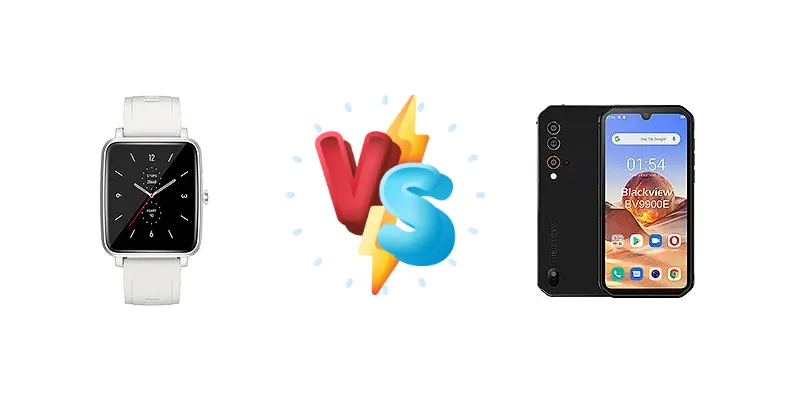
The rugged phone market caters to a specific need: durability. However, within that niche, priorities diverge. The Doogee CS1 represents a stripped-down, minimalist approach focused on core functionality, while the Blackview BV9900E aims for a more comprehensive experience with a significantly more powerful chipset. This comparison dissects these differing philosophies to determine which device best suits your needs.
🏆 Quick Verdict
For the average user prioritizing basic communication and long-term reliability in a rugged package, the Blackview BV9900E is the superior choice. Its Helio P90 chipset delivers a far more responsive experience and supports modern applications, while the CS1's nRF52832 is limited to essential functions.
| Network |
|---|
| 2G bands | N/A | GSM 850 / 900 / 1800 / 1900 |
| 3G bands | N/A | HSDPA 800 / 850 / 900 / 1700(AWS) / 1900 / 2100 |
| 4G bands | N/A | 1, 2, 3, 4, 5, 7, 8, 12, 13, 17, 18, 19, 20, 25, 26, 28, 34, 38, 39, 40, 41, 66 |
| EDGE | No | - |
| GPRS | No | - |
| Speed | - | HSPA, LTE |
| Technology | No cellular connectivity | GSM / CDMA / HSPA / CDMA2000 / LTE |
| Launch |
|---|
| Announced | 2021, February | 2020, September 10. Released 2020, September |
| Status | Available. Released 2021, February | Discontinued |
| Body |
|---|
| Build | Plastic frame, plastic back | - |
| Dimensions | 41.5 x 35.9 x 8.9 mm (1.63 x 1.41 x 0.35 in) | 156.5 x 78.3 x 14.2 mm (6.16 x 3.08 x 0.56 in) |
| SIM | No | Nano-SIM + Nano-SIM |
| Weight | 45 g (1.59 oz) | 273 g (9.63 oz) |
| Display |
|---|
| Protection | - | Corning Gorilla Glass 5 |
| Resolution | 240 x 240 pixels (~242 ppi density) | 1080 x 2280 pixels, 19:9 ratio (~432 ppi density) |
| Size | 1.4 inches | 5.84 inches, 85.1 cm2 (~69.5% screen-to-body ratio) |
| Type | IPS LCD | IPS LCD |
| Platform |
|---|
| CPU | - | Octa-core (2x2.2 GHz Cortex-A75 & 6x2.0 GHz Cortex-A55) |
| Chipset | nRF52832 | Mediatek MT6779V/CE Helio P90 (12 nm) |
| GPU | - | PowerVR GM9446 |
| OS | Proprietary | Android 10 |
| Memory |
|---|
| Card slot | No | microSDXC |
| Internal | - | 128GB 6GB RAM |
| Main Camera |
|---|
| Features | - | LED flash, HDR, panorama |
| Quad | - | 48 MP, f/1.8, (wide), PDAF
16 MP, 120˚ (ultrawide)
2 MP (macro)
Auxiliary lens |
| Video | - | 4K@30fps, 1080p@60fps |
| Selfie camera |
|---|
| Single | - | 16 MP, f/2.0, (wide) |
| Video | - | 1080p@30fps |
| Sound |
|---|
| 35mm jack | No | No |
| Loudspeaker | No | Yes |
| Comms |
|---|
| Bluetooth | 4.0, A2DP, LE | 5.0, A2DP, LE |
| NFC | No | Yes |
| Positioning | No | GPS, GLONASS, GALILEO, BDS |
| Radio | No | FM radio |
| USB | No | USB Type-C 2.0, OTG |
| WLAN | No | Wi-Fi 802.11 a/b/g/n/ac |
| Features |
|---|
| Sensors | Accelerometer, heart rate | Fingerprint (side-mounted), accelerometer, gyro, proximity, compass, barometer |
| Battery |
|---|
| Charging | - | 15W wired
18W wireless |
| Type | Li-Ion 200 mAh | 4380 mAh |
| Misc |
|---|
| Colors | Graphite Black, Space Gray | Black, Silver |
| Price | About 30 EUR | About 260 EUR |
Doogee CS1
- Extremely power-efficient chipset
- Minimalist design for simplicity
- Potentially very long battery life
- Limited functionality
- Poor performance for modern apps
- Basic display (likely)
Blackview BV9900E
- Powerful Helio P90 chipset
- Faster charging (wired and wireless)
- Full Android smartphone experience
- Less power-efficient than CS1
- May experience some thermal throttling
- Larger and heavier due to more features
Display Comparison
Display specifications are absent for the Doogee CS1, suggesting a very basic screen likely optimized for power efficiency rather than visual fidelity. The Blackview BV9900E, while not boasting a flagship display, benefits from a more modern panel capable of displaying richer colors and higher brightness. The lack of detailed display information for the CS1 implies a focus on minimizing power consumption over visual quality, making it suitable for users who prioritize battery life above all else.
Camera Comparison
Camera details for the Doogee CS1 are unavailable, reinforcing its focus on core functionality. The Blackview BV9900E, while not a camera powerhouse, likely features a more capable imaging system. While the specifics are unknown, the presence of a more powerful chipset suggests better image processing capabilities. It's reasonable to assume the BV9900E can capture more detailed photos and videos than the CS1, even if it doesn't compete with flagship smartphone cameras. The absence of camera information for the CS1 suggests it's not a primary selling point.
Performance
The performance gap is the most significant differentiator. The Doogee CS1’s nRF52832 chipset is designed for low-power wearable applications, not demanding smartphone tasks. It’s suitable for basic communication but will struggle with anything beyond simple apps. Conversely, the Blackview BV9900E’s MediaTek Helio P90 (12nm) is an octa-core processor featuring a combination of Cortex-A75 and A55 cores. This architecture provides a substantial performance boost, enabling smoother multitasking, faster app loading times, and the ability to run more complex applications. The 12nm process node also offers a degree of thermal efficiency, though not on par with newer fabrication processes.
Battery Life
Battery capacity is not specified for either device. However, the Doogee CS1’s nRF52832 chipset is inherently power-efficient, suggesting potentially excellent battery life despite a smaller capacity. The Blackview BV9900E offers both 15W wired and 18W wireless charging, providing convenient charging options. While the CS1 likely excels in longevity due to its low-power chipset, the BV9900E’s faster charging capabilities minimize downtime, making it more practical for users who rely on their phone throughout the day.
Buying Guide
Buy the Doogee CS1 if you need an extremely simple, long-lasting device primarily for calls, texts, and basic tracking – think a dedicated emergency phone or a device for those averse to smartphone complexity. Buy the Blackview BV9900E if you prefer a fully functional Android smartphone experience within a ruggedized body, capable of running apps, handling multimedia, and offering faster performance for everyday tasks.
Frequently Asked Questions
❓ Is the Blackview BV9900E's Helio P90 chipset prone to overheating during extended use?
The Helio P90 is a capable chip, but it's not known for exceptional thermal performance. While the 12nm process helps, demanding tasks like gaming or prolonged video recording may lead to some throttling to prevent overheating. However, it's unlikely to reach critical temperatures under normal usage scenarios.
❓ What kind of applications is the Doogee CS1 best suited for, given its limited chipset?
The Doogee CS1 excels as a dedicated communication device. It's ideal for users who primarily need a reliable phone for calls and texts, or as a backup device for emergencies. Its low power consumption makes it suitable for situations where battery life is paramount, and complex features are unnecessary.
❓ Does the Blackview BV9900E support NFC for contactless payments?
While not explicitly stated in the provided data, Blackview typically includes NFC in their mid-range and rugged devices. It's highly probable the BV9900E supports NFC, but verifying this through official specifications or reviews is recommended before purchase.