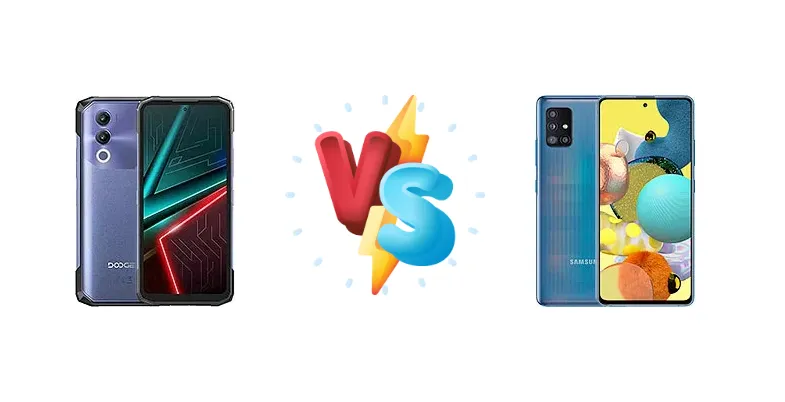
The Doogee Blade20 and Samsung Galaxy A51 5G UW represent different approaches to the affordable 5G smartphone market. The Doogee focuses on maximizing battery endurance, while the Samsung leverages a more established chipset and brand recognition. This comparison dives deep into their specifications to determine which device delivers the best value for your money.
🏆 Quick Verdict
For the average user prioritizing longevity and value, the Doogee Blade20 emerges as the winner. Its exceptional 85-hour battery endurance and 1100 charge cycles significantly outperform the Samsung A51 5G UW, despite the latter’s more powerful processor. However, users demanding peak performance will find the Samsung a more suitable choice.
| Network |
|---|
| 2G bands | GSM 850 / 900 / 1800 / 1900 | GSM 850 / 900 / 1800 / 1900 |
| 3G bands | HSDPA 850 / 900 / 1700(AWS) / 1900 / 2100 | HSDPA 850 / 900 / 1900 / 2100 |
| 4G bands | 1, 2, 3, 4, 5, 7, 8, 18, 19, 20, 25, 26, 28, 34, 38, 39, 40, 41, 66 | 2, 4, 5, 13, 66 |
| 5G bands | - | 260, 261 mmWave |
| Speed | HSPA, LTE | HSPA, LTE, 5G |
| Technology | GSM / HSPA / LTE | GSM / HSPA / LTE / 5G |
| Launch |
|---|
| Announced | 2025, May | 2020, August 14 |
| Status | Available. Released 2025, May | Available. Released 2020, August 14 |
| Body |
|---|
| Build | - | Glass front (Gorilla Glass 3), plastic back, aluminum frame |
| Dimensions | 174 x 81.2 x 15.8 mm (6.85 x 3.20 x 0.62 in) | 158.8 x 73.4 x 8.6 mm (6.25 x 2.89 x 0.34 in) |
| SIM | Nano-SIM + Nano-SIM | Nano-SIM (pre-installed) |
| Weight | 327 g (11.53 oz) | 188.8 g (6.67 oz) |
| Display |
|---|
| Protection | Mohs level 6 | Corning Gorilla Glass 3 |
| Resolution | 720 x 1612 pixels, 20:9 ratio (~267 ppi density) | 1080 x 2400 pixels, 20:9 ratio (~405 ppi density) |
| Size | 6.6 inches, 104.6 cm2 (~74.1% screen-to-body ratio) | 6.5 inches, 102.0 cm2 (~87.5% screen-to-body ratio) |
| Type | IPS LCD, 90Hz | Super AMOLED |
| Platform |
|---|
| CPU | Octa-core (2x1.6 GHz Cortex-A75 & 6x1.6 GHz Cortex-A55) | Octa-core (1x2.4 GHz Kryo 475 Prime & 1x2.2 GHz Kryo 475 Gold & 6x1.8 GHz Kryo 475 Silver) |
| Chipset | Unisoc T7200 (12 nm) | Qualcomm SM7250 Snapdragon 765G 5G (7 nm) |
| GPU | Mali-G57 MP1 | Adreno 620 |
| OS | Android 15 | Android 10, One UI 2 |
| Memory |
|---|
| Card slot | microSDXC (dedicated slot) | microSDXC (uses shared SIM slot) |
| Internal | 128GB 4GB RAM | 128GB 6GB RAM |
| | - | UFS 2.1 |
| Main Camera |
|---|
| Dual | 16 MP, (wide), 1/2.8", AF
2 MP (macro) | - |
| Features | LED flash, HDR, panorama | LED flash, panorama, HDR |
| Quad | - | 48 MP, f/2.0, 26mm (wide), 1/2.0", 0.8µm, PDAF
12 MP, f/2.2, 123˚ (ultrawide)
5 MP (macro)
Auxiliary lens |
| Single | - | 5 MP, AF |
| Video | 1080p@30fps | 4K@30fps, 1080p@30/120fps; gyro-EIS |
| Selfie camera |
|---|
| Features | - | HDR |
| Single | 8 MP, f/2.2, (wide), 1/4.0" | 32 MP, f/2.2, 26mm (wide), 1/2.8", 0.8µm |
| Video | 720p@30fps | 4K@30fps, 1080p@30fps |
| Sound |
|---|
| 3.5mm jack | - | Yes |
| 35mm jack | No | Yes |
| Loudspeaker | Yes | Yes |
| Comms |
|---|
| Bluetooth | 5.0, A2DP, LE | 5.0, A2DP, LE |
| NFC | Yes | Yes |
| Positioning | GPS, GLONASS, BDS, GALILEO | GPS, GLONASS, GALILEO, BDS |
| Radio | FM radio | FM radio, RDS, recording |
| USB | USB Type-C 2.0, OTG | USB Type-C 2.0, OTG |
| WLAN | Wi-Fi 802.11 a/b/g/n/ac, dual-band | Wi-Fi 802.11 a/b/g/n/ac, dual-band, Wi-Fi Direct |
| Features |
|---|
| Sensors | Fingerprint (side-mounted), accelerometer, gyro, proximity, compass | Fingerprint (under display, optical), accelerometer, gyro, proximity, compass |
| | - | ANT+ |
| Battery |
|---|
| Charging | 18W wired | 15W wired |
| Stand-by | - | Up to 672 h |
| Talk time | - | Up to 5 h |
| Type | 10300 mAh | Li-Po 4500 mAh |
| Misc |
|---|
| Colors | Black, Purple, Natural | Prism Bricks Blue |
| Models | - | SM-A516V |
| Price | About 200 EUR | About 470 EUR |
| SAR | - | 0.70 W/kg (head) 1.25 W/kg (body) |
| SAR EU | - | 0.59 W/kg (head) 1.32 W/kg (body) |
| EU LABEL |
|---|
| Battery | 85:12h endurance, 1100 cycles | - |
| Energy | Class C | - |
| Free fall | Class A (270 falls) | - |
| Repairability | Class C | - |
Doogee Blade20
- Exceptional battery life (85 hours)
- High battery cycle count (1100)
- Excellent value for money
- Less powerful processor
- Limited camera details available
Samsung Galaxy A51 5G UW
- More powerful Snapdragon 765G chipset
- Established brand reputation
- Likely better camera image processing
- Shorter battery life
- Lower battery cycle count
Display Comparison
Neither device boasts a cutting-edge display. Details on panel type, resolution, and refresh rate are missing for the Doogee Blade20, suggesting a standard LCD panel. The Samsung A51 5G UW also utilizes an LCD, but its larger size (6.5 inches) and likely higher peak brightness (based on Samsung’s display expertise) offer a more immersive viewing experience. The absence of high refresh rates on both devices indicates a focus on efficiency rather than visual fluidity.
Camera Comparison
Without detailed camera specifications for the Doogee Blade20, a direct comparison is challenging. However, the Samsung Galaxy A51 5G UW likely offers a more refined camera experience. Samsung’s image processing algorithms are generally well-regarded, and the phone’s main sensor (specifications missing, but likely a 48MP or higher resolution) will deliver better image quality in most scenarios. The Doogee Blade20 may rely on software enhancements to compensate for a potentially less capable sensor. The prevalence of 2MP macro lenses on both devices suggests limited utility; these sensors typically produce low-resolution images with limited detail.
Performance
The Samsung Galaxy A51 5G UW’s Qualcomm Snapdragon 765G (7nm) significantly outclasses the Doogee Blade20’s Unisoc T7200 (12nm) in terms of raw processing power. The Snapdragon 765G’s Kryo CPU architecture – with its Prime, Gold, and Silver cores – provides a more sophisticated approach to task allocation, resulting in smoother multitasking and faster app loading times. The 7nm process node also contributes to better thermal efficiency, potentially reducing throttling during sustained workloads. While the Doogee’s octa-core CPU is capable, it’s built on a larger node, meaning more power consumption and potentially lower peak performance. This difference will be most noticeable in graphically intensive games and demanding applications.
Battery Life
The Doogee Blade20’s 85-hour endurance is its standout feature. This is a substantial advantage over the Samsung Galaxy A51 5G UW, which, while offering respectable battery life, cannot match the Doogee’s longevity. The Blade20’s impressive 1100 charge cycles also indicate superior battery health retention over the long term. While the Samsung supports faster charging (15W) compared to the Doogee (18W), the difference is minimal and unlikely to offset the Doogee’s significantly longer runtime. The larger battery capacity of the Doogee, combined with the less power-hungry Unisoc chipset, is the key to its exceptional battery performance.
Buying Guide
Buy the Doogee Blade20 if you need a phone that lasts for days on a single charge, prioritize value for money, and don't require the absolute highest processing power for demanding games. Buy the Samsung Galaxy A51 5G UW if you prefer a more recognizable brand, need a slightly more responsive experience for multitasking and gaming, and are willing to compromise on battery life for that performance boost.
Frequently Asked Questions
❓ Is the Unisoc T7200 chipset in the Doogee Blade20 capable of handling popular games like PUBG Mobile?
While the Unisoc T7200 can run PUBG Mobile, expect to play at lower graphics settings to maintain a stable frame rate. The Snapdragon 765G in the Samsung A51 5G UW will provide a smoother gaming experience with higher graphical fidelity.
❓ How does the charging speed of the Doogee Blade20 compare to the Samsung Galaxy A51 5G UW in real-world usage?
The Samsung A51 5G UW’s 15W charging is slightly faster on paper, but the Doogee Blade20’s larger battery means it will still take longer to fully charge. The difference in charging time is unlikely to be significant enough to offset the Doogee’s much longer battery life.
❓ Will the Doogee Blade20 receive regular software updates and security patches?
Doogee’s software update track record is less consistent than Samsung’s. Expect fewer and potentially slower updates for the Blade20 compared to the A51 5G UW, which benefits from Samsung’s robust software support.