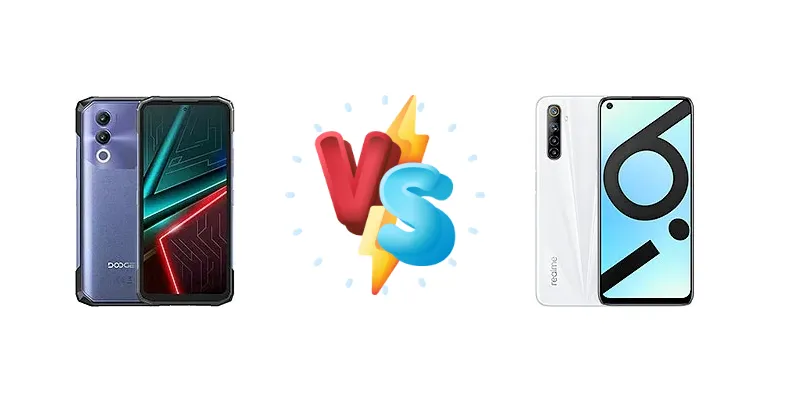
The budget smartphone market is fiercely competitive, and the Doogee Blade20 and Realme 6i (India variant) represent compelling options for users prioritizing value. While both aim for affordability, they take different approaches: the Doogee Blade20 emphasizes long-term battery endurance, while the Realme 6i focuses on quicker charging and a more powerful gaming chipset. This comparison dissects their key specifications to determine which device best suits your needs.
🏆 Quick Verdict
For the average user, the Realme 6i (India) emerges as the stronger choice. Its Helio G90T chipset delivers noticeably better gaming performance, and the 30W charging significantly reduces downtime. While the Doogee Blade20 boasts impressive battery endurance, the performance trade-off isn't ideal for demanding users.
| Network |
|---|
| 2G bands | GSM 850 / 900 / 1800 / 1900 | GSM 850 / 900 / 1800 / 1900 |
| 3G bands | HSDPA 850 / 900 / 1700(AWS) / 1900 / 2100 | HSDPA 850 / 900 / 2100 |
| 4G bands | 1, 2, 3, 4, 5, 7, 8, 18, 19, 20, 25, 26, 28, 34, 38, 39, 40, 41, 66 | 1, 3, 5, 8, 38, 40, 41 |
| Speed | HSPA, LTE | HSPA 42.2/11.5 Mbps, LTE (2CA) Cat6 300/75 Mbps |
| Technology | GSM / HSPA / LTE | GSM / HSPA / LTE |
| Launch |
|---|
| Announced | 2025, May | 2020, July 24. Released 2020, July 31 |
| Status | Available. Released 2025, May | Discontinued |
| Body |
|---|
| Build | - | Glass front (Gorilla Glass 3), plastic back, plastic frame |
| Dimensions | 174 x 81.2 x 15.8 mm (6.85 x 3.20 x 0.62 in) | 162.1 x 74.8 x 8.9 mm (6.38 x 2.94 x 0.35 in) |
| SIM | Nano-SIM + Nano-SIM | Nano-SIM + Nano-SIM |
| Weight | 327 g (11.53 oz) | 191 g (6.74 oz) |
| | - | Weather-sealed ports & loudspeaker |
| Display |
|---|
| Protection | Mohs level 6 | Corning Gorilla Glass 3 |
| Resolution | 720 x 1612 pixels, 20:9 ratio (~267 ppi density) | 1080 x 2400 pixels, 20:9 ratio (~405 ppi density) |
| Size | 6.6 inches, 104.6 cm2 (~74.1% screen-to-body ratio) | 6.5 inches, 102.0 cm2 (~84.1% screen-to-body ratio) |
| Type | IPS LCD, 90Hz | IPS LCD, 90Hz, 480 nits (typ) |
| Platform |
|---|
| CPU | Octa-core (2x1.6 GHz Cortex-A75 & 6x1.6 GHz Cortex-A55) | Octa-core (2x2.05 GHz Cortex-A76 & 6x2.0 GHz Cortex-A55) |
| Chipset | Unisoc T7200 (12 nm) | Mediatek MT6785 Helio G90T (12 nm) |
| GPU | Mali-G57 MP1 | Mali-G76 MC4 |
| OS | Android 15 | Android 10, Realme UI |
| Memory |
|---|
| Card slot | microSDXC (dedicated slot) | microSDXC (dedicated slot) |
| Internal | 128GB 4GB RAM | 64GB 4GB RAM, 64GB 6GB RAM |
| | - | UFS 2.1 |
| Main Camera |
|---|
| Dual | 16 MP, (wide), 1/2.8", AF
2 MP (macro) | - |
| Features | LED flash, HDR, panorama | LED flash, HDR, panorama |
| Quad | - | 48 MP, f/1.8, 26mm (wide), 1/2.0", 0.8µm, PDAF
8 MP, f/2.3, 119˚ (ultrawide), 1/4.0", 1.12µm
2 MP (macro)
Auxiliary lens |
| Video | 1080p@30fps | 4K@30fps, 1080p@30/60/120fps, gyro-EIS |
| Selfie camera |
|---|
| Features | - | HDR, panorama |
| Single | 8 MP, f/2.2, (wide), 1/4.0" | 16 MP, f/2.0, 26mm (wide), 1/3.06", 1.0µm |
| Video | 720p@30fps | 1080p@30fps |
| Sound |
|---|
| 3.5mm jack | - | Yes |
| 35mm jack | No | Yes |
| Loudspeaker | Yes | Yes |
| Comms |
|---|
| Bluetooth | 5.0, A2DP, LE | 5.0, A2DP, LE |
| NFC | Yes | No |
| Positioning | GPS, GLONASS, BDS, GALILEO | GPS, GLONASS, BDS |
| Radio | FM radio | FM radio |
| USB | USB Type-C 2.0, OTG | USB Type-C 2.0, OTG |
| WLAN | Wi-Fi 802.11 a/b/g/n/ac, dual-band | Wi-Fi 802.11 a/b/g/n/ac, dual-band, Wi-Fi Direct |
| Features |
|---|
| Sensors | Fingerprint (side-mounted), accelerometer, gyro, proximity, compass | Fingerprint (side-mounted), accelerometer, gyro, proximity, compass |
| Battery |
|---|
| Charging | 18W wired | 30W wired, PD, 100% in 55 min |
| Type | 10300 mAh | 4300 mAh |
| Misc |
|---|
| Colors | Black, Purple, Natural | Eclipse Black, Lunar White |
| Models | - | RMX2002 |
| Price | About 200 EUR | About 150 EUR |
| EU LABEL |
|---|
| Battery | 85:12h endurance, 1100 cycles | - |
| Energy | Class C | - |
| Free fall | Class A (270 falls) | - |
| Repairability | Class C | - |
Doogee Blade20
- Exceptional battery life (85:12h endurance)
- High battery cycle count (1100 cycles)
- Competitive price point
- Less powerful processor for gaming
- Slower charging speed (18W)
Realme 6i (India)
- Superior gaming performance (Helio G90T)
- Fast charging (30W, 55 min to 100%)
- More responsive user experience
- Likely shorter battery life compared to Doogee
- Potentially faster battery degradation (fewer charge cycles)
Display Comparison
Neither device boasts a standout display. Both utilize 12nm chipsets, suggesting similar power demands and therefore comparable display capabilities. While specific display specs (resolution, panel type) are missing, the focus here is on performance and battery, not display fidelity. We can assume both are LCD panels typical of this price point, prioritizing efficiency over premium features like OLED or high refresh rates.
Camera Comparison
Without detailed camera specifications, a direct comparison is difficult. However, given the market positioning of both devices, it’s likely both feature a primary camera alongside supporting lenses (ultrawide, depth, macro). The Realme 6i, benefiting from its gaming-focused chipset, likely has more sophisticated image processing capabilities. The Doogee Blade20 may prioritize computational photography to compensate for potentially less capable hardware. The absence of information on sensor size and aperture makes a definitive judgment impossible, but the Realme 6i’s overall processing power suggests a slight advantage.
Performance
The Realme 6i’s Mediatek Helio G90T chipset is the clear winner in terms of raw processing power. Its octa-core configuration, featuring 2x2.05 GHz Cortex-A76 cores, outperforms the Doogee Blade20’s Unisoc T7200 (2x1.6 GHz Cortex-A75 & 6x1.6 GHz Cortex-A55). The Cortex-A76 cores in the G90T are architecturally superior, offering better single-core performance crucial for app responsiveness and smoother multitasking. This translates to a more fluid user experience and significantly improved gaming capabilities. The Unisoc T7200 is adequate for basic tasks, but will struggle with graphically intensive games.
Battery Life
The Doogee Blade20 shines in battery endurance, offering a remarkable 85:12h of usage on a single charge, backed by an impressive 1100 charge cycles. This indicates a focus on long-term battery health and minimizing degradation. The Realme 6i, while likely having a smaller battery capacity (spec not provided), compensates with its 30W wired charging, achieving a full charge in just 55 minutes. This is a significant advantage for users who prioritize convenience and minimal downtime. The Doogee Blade20’s 18W charging is comparatively slow, requiring considerably longer to replenish the battery.
Buying Guide
Buy the Doogee Blade20 if you absolutely prioritize maximizing battery life and are a light user who primarily browses, communicates, and consumes media. Its 85:12h endurance and 1100 charge cycles are unmatched in this price bracket. Buy the Realme 6i (India) if you're a mobile gamer, frequently stream videos, or simply value faster charging and a more responsive overall experience. The Helio G90T provides a tangible performance boost, and the 30W charging is a significant convenience.
Frequently Asked Questions
❓ Will the Unisoc T7200 in the Doogee Blade20 struggle with demanding games like PUBG or Call of Duty?
Yes, the Unisoc T7200 is a budget-focused chipset. While it can handle less intensive games, you'll likely experience noticeable frame drops and lag in graphically demanding titles like PUBG or Call of Duty, even on lower settings. The Realme 6i’s Helio G90T is far better suited for mobile gaming.
❓ How much faster is the 30W charging on the Realme 6i compared to the 18W charging on the Doogee Blade20 in real-world use?
The Realme 6i’s 30W charging can fully charge the device in approximately 55 minutes. The Doogee Blade20’s 18W charging will take significantly longer – likely exceeding 2 hours, depending on battery capacity. This difference is substantial for users who frequently need to top up their battery quickly.
❓ Does the Doogee Blade20's 1100 charge cycle rating guarantee the battery will still hold a significant charge after a year of use?
The 1100 charge cycle rating is a strong indicator of long-term battery health. It suggests the battery is designed to withstand a considerable amount of charging and discharging before significant degradation occurs. However, battery life is also affected by usage patterns and environmental factors (heat). While 1100 cycles is excellent, it doesn't guarantee a specific capacity retention percentage after a year.