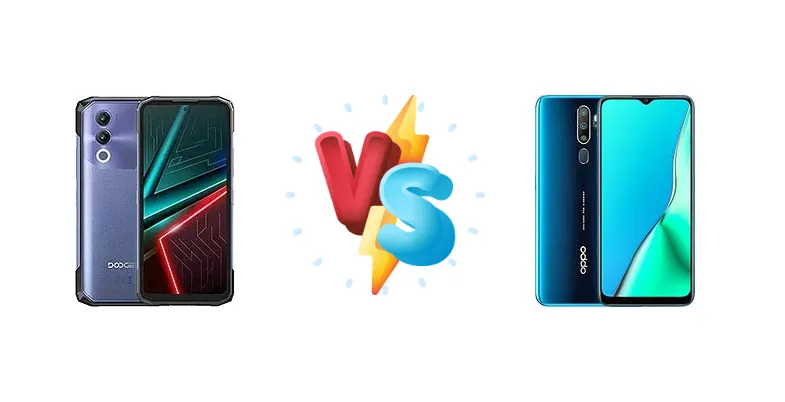
The Doogee Blade20 and Oppo A9 (2020) represent distinct approaches to the budget smartphone market. The Blade20 prioritizes exceptional battery life, while the A9 (2020) leverages Qualcomm’s Snapdragon platform for a balance of performance and features. This comparison dissects their key differences to determine which device best suits your needs.
🏆 Quick Verdict
For users prioritizing longevity, the Doogee Blade20 is the clear winner, boasting an 85-hour endurance rating and 1100 charge cycles. While the Oppo A9 (2020) offers a more recognizable chipset, its 69-hour endurance and slower 10W charging make it less appealing for heavy users.
| Network |
|---|
| 2G bands | GSM 850 / 900 / 1800 / 1900 | GSM 850 / 900 / 1800 / 1900 |
| 3G bands | HSDPA 850 / 900 / 1700(AWS) / 1900 / 2100 | HSDPA 850 / 900 / 2100 |
| 4G bands | 1, 2, 3, 4, 5, 7, 8, 18, 19, 20, 25, 26, 28, 34, 38, 39, 40, 41, 66 | 1, 3, 5, 8, 38, 40, 41 |
| Speed | HSPA, LTE | HSPA, LTE |
| Technology | GSM / HSPA / LTE | GSM / HSPA / LTE |
| Launch |
|---|
| Announced | 2025, May | 2019, September 10. Released 2019, September |
| Status | Available. Released 2025, May | Discontinued |
| Body |
|---|
| Build | - | Glass front (Gorilla Glass 3), plastic back, plastic frame |
| Dimensions | 174 x 81.2 x 15.8 mm (6.85 x 3.20 x 0.62 in) | 163.6 x 75.6 x 9.1 mm (6.44 x 2.98 x 0.36 in) |
| SIM | Nano-SIM + Nano-SIM | Nano-SIM + Nano-SIM |
| Weight | 327 g (11.53 oz) | 195 g (6.88 oz) |
| Display |
|---|
| Protection | Mohs level 6 | Corning Gorilla Glass 3 |
| Resolution | 720 x 1612 pixels, 20:9 ratio (~267 ppi density) | 720 x 1600 pixels, 20:9 ratio (~270 ppi density) |
| Size | 6.6 inches, 104.6 cm2 (~74.1% screen-to-body ratio) | 6.5 inches, 102.0 cm2 (~82.5% screen-to-body ratio) |
| Type | IPS LCD, 90Hz | IPS LCD, 480 nits (typ) |
| Platform |
|---|
| CPU | Octa-core (2x1.6 GHz Cortex-A75 & 6x1.6 GHz Cortex-A55) | Octa-core (4x2.0 GHz Kryo 260 Gold & 4x1.8 GHz Kryo 260 Silver) |
| Chipset | Unisoc T7200 (12 nm) | Qualcomm SDM665 Snapdragon 665 (11 nm) |
| GPU | Mali-G57 MP1 | Adreno 610 |
| OS | Android 15 | Android 9.0 (Pie), upgradable to Android 10, ColorOS 7.1 |
| Memory |
|---|
| Card slot | microSDXC (dedicated slot) | microSDXC (dedicated slot) |
| Internal | 128GB 4GB RAM | 128GB 4GB RAM, 128GB 8GB RAM |
| | - | UFS 2.1 |
| Main Camera |
|---|
| Dual | 16 MP, (wide), 1/2.8", AF
2 MP (macro) | - |
| Features | LED flash, HDR, panorama | Dual-LED dual-tone flash, panorama, HDR |
| Quad | - | 48 MP, f/1.8, (wide), 1/2.25", 0.8µm, PDAF
8 MP, f/2.3, 119˚ (ultrawide), 1/4.0", 1.12µm, AF
2 MP, f/2.4, 1/5.0", 1.75µm
Auxiliary lens |
| Single | - | 12 MP, f/2.0, 1/2.8", 1.25µm, PDAF, Laser AF
12 MP B/W, f/2.0, 1/2.9", 1.25µm, PDAF, Laser AF |
| Video | 1080p@30fps | 4K@30fps, 1080p@30fps, gyro-EIS |
| Selfie camera |
|---|
| Features | - | HDR |
| Single | 8 MP, f/2.2, (wide), 1/4.0" | 16 MP, f/2.0, 26mm (wide), 1/3.06", 1.0µm |
| Video | 720p@30fps | 1080p@30fps |
| Sound |
|---|
| 3.5mm jack | - | Yes |
| 35mm jack | No | Yes |
| Loudspeaker | Yes | Yes, with stereo speakers |
| | - | 24-bit/192kHz audio |
| Comms |
|---|
| Bluetooth | 5.0, A2DP, LE | 5.0, A2DP, LE |
| NFC | Yes | Yes (market/region dependent) |
| Positioning | GPS, GLONASS, BDS, GALILEO | GPS, GLONASS, GALILEO, BDS |
| Radio | FM radio | FM radio |
| USB | USB Type-C 2.0, OTG | USB Type-C 2.0, OTG |
| WLAN | Wi-Fi 802.11 a/b/g/n/ac, dual-band | Wi-Fi 802.11 a/b/g/n/ac, dual-band, Wi-Fi Direct |
| Features |
|---|
| Sensors | Fingerprint (side-mounted), accelerometer, gyro, proximity, compass | Fingerprint (rear-mounted), accelerometer, gyro, proximity, compass |
| Battery |
|---|
| Charging | 18W wired | 10W wired
Reverse wired |
| Type | 10300 mAh | Li-Po 5000 mAh, non-removable |
| Misc |
|---|
| Colors | Black, Purple, Natural | Marine Green, Space Purple, Vanilla Mint |
| Models | - | CPH1937, CPH1939, CPH1941 |
| Price | About 200 EUR | About 150 EUR |
| SAR | - | 0.87 W/kg (head) 1.10 W/kg (body) |
| SAR EU | - | 0.41 W/kg (head) 1.45 W/kg (body) |
| Tests |
|---|
| Battery life | - |
Endurance rating 69h
|
| Camera | - |
Photo / Video |
| Loudspeaker | - |
Voice 68dB / Noise 70dB / Ring 86dB
|
| Performance | - |
AnTuTu: 209779 (v7)
GeekBench: 6629 (v4.4)
GFXBench: 15fps (ES 3.1 onscreen) |
| EU LABEL |
|---|
| Battery | 85:12h endurance, 1100 cycles | - |
| Energy | Class C | - |
| Free fall | Class A (270 falls) | - |
| Repairability | Class C | - |
Doogee Blade20
- Exceptional battery life (85h endurance)
- High charge cycle count (1100 cycles)
- Potentially better multi-core performance with Unisoc T7200
- Lacks reverse wired charging
- Camera specifications unknown
Oppo A9 (2020)
- Qualcomm Snapdragon 665 chipset for app compatibility
- Reverse wired charging for accessory power
- Potentially better display calibration
- Significantly lower battery endurance (69h)
- Slower 10W charging
- Older chipset architecture
Display Comparison
Neither device’s display specifications are provided, so a direct comparison is limited. However, given the price points, both likely utilize LCD panels. The Oppo A9 (2020) likely benefits from Oppo’s established display calibration expertise, potentially offering slightly more accurate colors. Bezels are expected to be comparable, reflecting the budget nature of both devices.
Camera Comparison
The context data for the Oppo A9 (2020) mentions a camera, but provides no specifics. Given Oppo’s marketing history, it likely features a multi-camera setup with a primary sensor, ultra-wide, and depth sensor. The Doogee Blade20’s camera specifications are also absent. Without sensor size or aperture information, a meaningful comparison is impossible. It’s reasonable to assume both phones will perform adequately in good lighting conditions, but struggle in low light.
Performance
The Doogee Blade20’s Unisoc T7200 (12nm) and the Oppo A9 (2020)’s Snapdragon 665 (11nm) represent different architectural approaches. While the Snapdragon 665’s Kryo 260 Gold cores clock higher at 2.0 GHz versus the T7200’s 1.6 GHz Cortex-A75 cores, the Unisoc chip benefits from a more modern architecture. The T7200’s Cortex-A75 cores offer a performance uplift over the older Cortex-A53 cores found in the Snapdragon 665. Real-world performance will likely be similar for everyday tasks, but the T7200 may exhibit slightly better multi-core performance. The 12nm process node of the Unisoc T7200 is slightly less efficient than the 11nm of the Snapdragon 665, but this difference is unlikely to be significant.
Battery Life
The Doogee Blade20’s 85-hour endurance rating is a significant advantage over the Oppo A9 (2020)’s 69-hour rating. This translates to nearly a full day of additional usage. Furthermore, the Blade20’s stated 1100 charge cycles suggest superior long-term battery health. The Oppo A9 (2020) offers 10W wired charging and reverse wired charging, a feature absent on the Blade20. However, the slower charging speed means a full charge will take considerably longer than the Blade20’s 18W charging, even if the Blade20’s battery capacity is unknown.
Buying Guide
Buy the Doogee Blade20 if you need a phone that can reliably last through two full days of moderate use, or if you frequently find yourself away from a power outlet. It’s ideal for travelers, field workers, or anyone who dislikes daily charging. Buy the Oppo A9 (2020) if you prefer the Qualcomm ecosystem and potentially better app compatibility, and if you value the convenience of reverse wired charging, even at the cost of battery endurance.
Frequently Asked Questions
❓ Is the Unisoc T7200 chipset in the Doogee Blade20 capable of handling demanding games like PUBG?
While the Unisoc T7200 isn't a flagship chipset, its Cortex-A75 cores should allow for playable performance in PUBG at medium settings. However, expect some frame drops and potential thermal throttling during extended gaming sessions. The Snapdragon 665 in the Oppo A9 (2020) will likely offer similar gaming performance.
❓ How much faster is the 18W charging on the Doogee Blade20 compared to the 10W charging on the Oppo A9 (2020)?
18W charging is significantly faster than 10W. While exact 0-100% times are unavailable, the Doogee Blade20 will likely charge from 0% to full in approximately 2-3 hours, while the Oppo A9 (2020) could take 4-5 hours. This difference is substantial for users who need a quick power boost.
❓ Does the Oppo A9 (2020)'s reverse wired charging work with all devices?
The Oppo A9 (2020)'s reverse wired charging is compatible with most devices that charge via USB, including smartphones, Bluetooth headphones, and smartwatches. However, charging speeds will be limited by the Oppo A9 (2020)'s 10W output and the receiving device's charging capabilities.