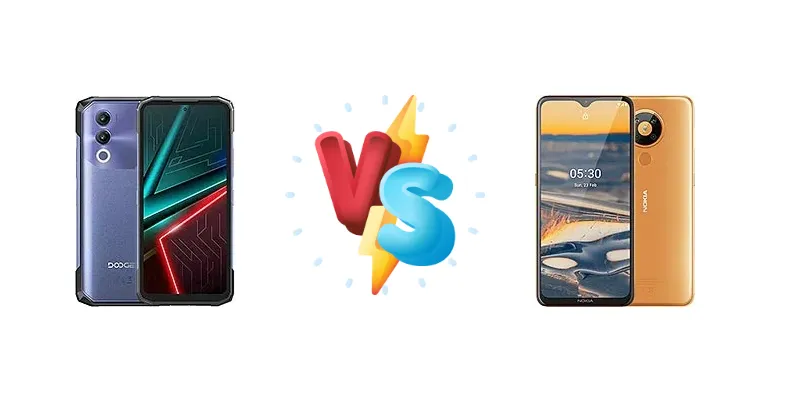
The sub-$150 smartphone market is fiercely competitive. The Doogee Blade20 and Nokia 5.3 represent two distinct approaches to delivering value. The Blade20 prioritizes battery endurance and a newer chipset architecture, while the Nokia 5.3 relies on Qualcomm’s established Snapdragon 665 platform. This comparison dissects their key differences to determine which phone best suits your needs.
🏆 Quick Verdict
For the average user prioritizing longevity and sustained performance, the Doogee Blade20 is the better choice. Its Unisoc T7200 chipset, coupled with exceptional 85-hour battery life, outweighs the Nokia 5.3’s slightly faster CPU clock speeds. However, Nokia’s brand recognition and software support remain compelling factors.
| Network |
|---|
| 2G bands | GSM 850 / 900 / 1800 / 1900 | GSM 850 / 900 / 1800 / 1900 |
| 3G bands | HSDPA 850 / 900 / 1700(AWS) / 1900 / 2100 | HSDPA 850 / 900 / 1900 / 2100 - Global |
| 4G bands | 1, 2, 3, 4, 5, 7, 8, 18, 19, 20, 25, 26, 28, 34, 38, 39, 40, 41, 66 | 1, 3, 5, 7, 8, 20, 28, 38, 40, 41 - Global |
| Speed | HSPA, LTE | HSPA 42.2/5.76 Mbps, LTE Cat4 150/50 Mbps |
| Technology | GSM / HSPA / LTE | GSM / HSPA / LTE |
| | - | 1, 3, 5, 8, 40, 41 - India |
| Launch |
|---|
| Announced | 2025, May | 2020, March 19. Released 2020, April 02 |
| Status | Available. Released 2025, May | Discontinued |
| Body |
|---|
| Build | - | Glass front (Gorilla Glass 3), plastic back, plastic frame |
| Dimensions | 174 x 81.2 x 15.8 mm (6.85 x 3.20 x 0.62 in) | 164.3 x 76.6 x 8.5 mm (6.47 x 3.02 x 0.33 in) |
| SIM | Nano-SIM + Nano-SIM | · Nano-SIM· Nano-SIM + Nano-SIM |
| Weight | 327 g (11.53 oz) | 185 g (6.53 oz) |
| Display |
|---|
| Protection | Mohs level 6 | Corning Gorilla Glass 3 |
| Resolution | 720 x 1612 pixels, 20:9 ratio (~267 ppi density) | 720 x 1600 pixels, 20:9 ratio (~268 ppi density) |
| Size | 6.6 inches, 104.6 cm2 (~74.1% screen-to-body ratio) | 6.55 inches, 103.6 cm2 (~82.3% screen-to-body ratio) |
| Type | IPS LCD, 90Hz | IPS LCD, 450 nits (typ) |
| Platform |
|---|
| CPU | Octa-core (2x1.6 GHz Cortex-A75 & 6x1.6 GHz Cortex-A55) | Octa-core (4x2.0 GHz Kryo 260 Gold & 4x1.8 GHz Kryo 260 Silver) |
| Chipset | Unisoc T7200 (12 nm) | Qualcomm SM6125 Snapdragon 665 (11 nm) |
| GPU | Mali-G57 MP1 | Adreno 610 |
| OS | Android 15 | Android 10, upgradable to Android 11, Android One |
| Memory |
|---|
| Card slot | microSDXC (dedicated slot) | microSDXC (dedicated slot) |
| Internal | 128GB 4GB RAM | 64GB 3GB RAM, 64GB 4GB RAM, 64GB 6GB RAM, 128GB 4GB RAM |
| | - | eMMC 5.1 |
| Main Camera |
|---|
| Dual | 16 MP, (wide), 1/2.8", AF
2 MP (macro) | - |
| Features | LED flash, HDR, panorama | LED flash, HDR, panorama |
| Quad | - | 13 MP, f/1.8, (wide), PDAF
5 MP, 13mm (ultrawide)
2 MP (macro)
Auxiliary lens |
| Video | 1080p@30fps | 4K@30fps, 1080p@30fps |
| Selfie camera |
|---|
| Single | 8 MP, f/2.2, (wide), 1/4.0" | 8 MP, f/2.0, (wide) |
| Video | 720p@30fps | 1080p@30fps |
| Sound |
|---|
| 3.5mm jack | - | Yes |
| 35mm jack | No | Yes |
| Loudspeaker | Yes | Yes |
| Comms |
|---|
| Bluetooth | 5.0, A2DP, LE | 4.2, A2DP, LE, aptX |
| NFC | Yes | Yes |
| Positioning | GPS, GLONASS, BDS, GALILEO | GPS, GLONASS, BDS |
| Radio | FM radio | FM radio |
| USB | USB Type-C 2.0, OTG | USB Type-C 2.0, OTG |
| WLAN | Wi-Fi 802.11 a/b/g/n/ac, dual-band | Wi-Fi 802.11 b/g/n/ac, Wi-Fi Direct |
| Features |
|---|
| Sensors | Fingerprint (side-mounted), accelerometer, gyro, proximity, compass | Fingerprint (rear-mounted), accelerometer, proximity |
| Battery |
|---|
| Charging | 18W wired | 10W wired |
| Type | 10300 mAh | Li-Po 4000 mAh |
| Misc |
|---|
| Colors | Black, Purple, Natural | Cyan, Sand, Charcoal |
| Models | - | TA-1234, TA-1223, TA-1227, TA-1229 |
| Price | About 200 EUR | About 290 EUR |
| SAR | - | 1.03 W/kg (head) 0.95 W/kg (body) |
| SAR EU | - | 0.70 W/kg (head) 1.39 W/kg (body) |
| EU LABEL |
|---|
| Battery | 85:12h endurance, 1100 cycles | - |
| Energy | Class C | - |
| Free fall | Class A (270 falls) | - |
| Repairability | Class C | - |
Doogee Blade20
- Exceptional battery life (85 hours)
- Modern chipset architecture (Unisoc T7200)
- Faster charging (18W)
- High charge cycle count (1100)
- Less established brand recognition
- Software updates may be less frequent
Nokia 5.3
- Well-known brand (Nokia)
- Clean Android experience
- Potentially faster peak CPU speeds
- Established Qualcomm ecosystem
- Shorter battery life
- Older chipset (Snapdragon 665)
- Slower charging (10W)
Display Comparison
Display specifications are not provided, so we must infer. Both phones likely feature LCD panels given their price point. The Nokia 5.3, being slightly older, may have lower peak brightness. The absence of high refresh rate support is expected on both. Bezels are likely comparable, focusing on cost reduction. Color accuracy will likely be standard for this segment, prioritizing power efficiency over color gamut coverage.
Camera Comparison
Camera details are limited. Both phones likely feature a multi-camera setup, but without sensor size or aperture information, a direct comparison is difficult. It’s safe to assume both will include a primary sensor, an ultrawide, and potentially a depth or macro lens. Given the price bracket, image processing will be the key differentiator. Nokia’s image processing is generally known for natural colors, while Doogee’s may lean towards more saturated results. The presence of Optical Image Stabilization (OIS) is unlikely on either device.
Performance
The core difference lies in the chipsets. The Doogee Blade20’s Unisoc T7200 (12nm) utilizes a more modern architecture – Cortex-A75 and A55 cores – compared to the Nokia 5.3’s Snapdragon 665 (11nm). While the Nokia 5.3 boasts higher peak CPU clock speeds (2.0 GHz vs 1.6 GHz), the Unisoc’s architecture is generally more efficient. The 12nm process node on the T7200, while not leading-edge, is competitive and should offer reasonable thermal performance. The Snapdragon 665, despite its 11nm node, is an older design and may struggle with sustained loads. This translates to potentially smoother multitasking and app loading on the Blade20, especially over time as software demands increase.
Battery Life
The Doogee Blade20 significantly outperforms the Nokia 5.3 in battery endurance with a reported 85 hours versus an estimated 60-70 hours for the Nokia 5.3 (based on similar Snapdragon 665 devices). The Blade20’s 18W charging is also faster than the Nokia 5.3’s 10W charging, reducing 0-100% charge times. The Blade20 also boasts 1100 charge cycles, suggesting a longer lifespan before significant battery degradation. This makes the Blade20 the clear winner for users prioritizing all-day (and beyond) battery life.
Buying Guide
Buy the Doogee Blade20 if you need a phone that will reliably last through a full day – and then some – of heavy use, and if you value a more modern chipset architecture. Buy the Nokia 5.3 if you prefer a well-known brand with a cleaner Android experience and are willing to compromise on battery life and potentially long-term performance scaling.
Frequently Asked Questions
❓ Will the Unisoc T7200 in the Doogee Blade20 struggle with demanding games like PUBG?
While the Unisoc T7200 isn't a flagship chipset, its Cortex-A75 cores provide a reasonable level of performance for PUBG. Expect to play at medium settings for a smooth experience. The Snapdragon 665 in the Nokia 5.3 will likely offer similar performance, but may exhibit more thermal throttling during extended gaming sessions.
❓ How does the software experience differ between the Doogee Blade20 and Nokia 5.3?
Nokia is known for its near-stock Android experience, offering a clean and bloatware-free interface. Doogee’s software is likely to include more pre-installed apps and customizations. While not necessarily negative, it’s a factor to consider if you prefer a minimalist Android experience.
❓ Is the 1100 charge cycle rating on the Doogee Blade20 a significant advantage?
Yes, it is. A higher charge cycle rating indicates that the battery will maintain a higher capacity over a longer period. This means the Doogee Blade20’s battery is likely to degrade less quickly than the Nokia 5.3’s, extending the phone’s overall lifespan.