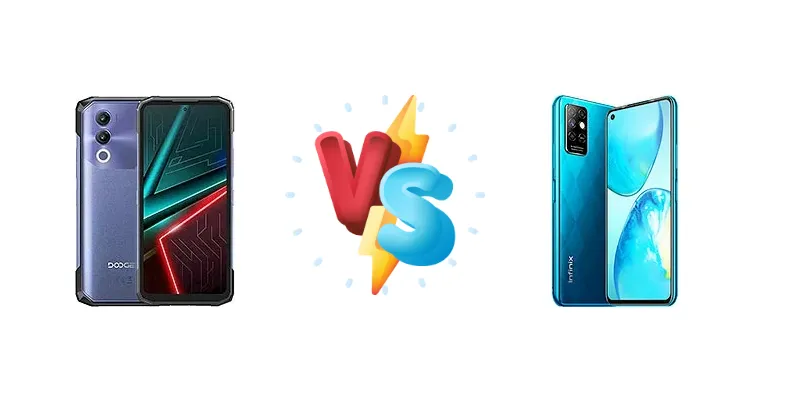
The sub-$150 smartphone market is fiercely competitive. Both the Doogee Blade20 and the Infinix Note 8i aim to deliver a compelling experience without breaking the bank. This comparison dissects their core components – from processing power to battery stamina – to determine which device offers the best value for budget-conscious consumers.
🏆 Quick Verdict
For the average user prioritizing longevity, the Doogee Blade20 is the better choice. Its Unisoc T7200 chipset, coupled with an impressive 85-hour endurance rating and 1100 charge cycles, provides a more reliable long-term experience. While the Infinix Note 8i boasts a slightly faster CPU clock speed, the Blade20’s battery performance is a significant advantage.
| Network |
|---|
| 2G bands | GSM 850 / 900 / 1800 / 1900 | GSM 850 / 900 / 1800 / 1900 |
| 3G bands | HSDPA 850 / 900 / 1700(AWS) / 1900 / 2100 | HSDPA 850 / 900 / 2100 |
| 4G bands | 1, 2, 3, 4, 5, 7, 8, 18, 19, 20, 25, 26, 28, 34, 38, 39, 40, 41, 66 | 1, 3, 5, 7, 8, 20, 38, 40, 41 |
| Speed | HSPA, LTE | HSPA 42.2/5.76 Mbps, LTE Cat4 150/50 Mbps |
| Technology | GSM / HSPA / LTE | GSM / HSPA / LTE |
| | - | 1, 3, 7, 8, 20, 28 |
| Launch |
|---|
| Announced | 2025, May | 2020, October 15. Released 2020, November 15 |
| Status | Available. Released 2025, May | Discontinued |
| Body |
|---|
| Dimensions | 174 x 81.2 x 15.8 mm (6.85 x 3.20 x 0.62 in) | 171.4 x 77.7 x 8.9 mm (6.75 x 3.06 x 0.35 in) |
| SIM | Nano-SIM + Nano-SIM | Nano-SIM + Nano-SIM |
| Weight | 327 g (11.53 oz) | - |
| Display |
|---|
| Protection | Mohs level 6 | Corning Gorilla Glass |
| Resolution | 720 x 1612 pixels, 20:9 ratio (~267 ppi density) | 720 x 1640 pixels (~264 ppi density) |
| Size | 6.6 inches, 104.6 cm2 (~74.1% screen-to-body ratio) | 6.78 inches, 109.2 cm2 (~82.0% screen-to-body ratio) |
| Type | IPS LCD, 90Hz | IPS LCD, 480 nits (peak) |
| Platform |
|---|
| CPU | Octa-core (2x1.6 GHz Cortex-A75 & 6x1.6 GHz Cortex-A55) | Octa-core (2x2.0 GHz Cortex-A75 & 6x1.8 GHz Cortex-A55) |
| Chipset | Unisoc T7200 (12 nm) | Mediatek MT6769V/CU Helio G80 (12 nm) |
| GPU | Mali-G57 MP1 | Mali-G52 MC2 |
| OS | Android 15 | Android 10, XOS 7.1 |
| Memory |
|---|
| Card slot | microSDXC (dedicated slot) | microSDXC (dedicated slot) |
| Internal | 128GB 4GB RAM | 64GB 4GB RAM, 128GB 4GB RAM, 128GB 6GB RAM |
| Main Camera |
|---|
| Dual | 16 MP, (wide), 1/2.8", AF
2 MP (macro) | - |
| Features | LED flash, HDR, panorama | Quad-LED flash, HDR, panorama |
| Quad | - | 48 MP, (wide), 1/2.0", 0.8µm, PDAF
2 MP (macro)
Auxiliary lenses |
| Video | 1080p@30fps | 1440p@30fps |
| Selfie camera |
|---|
| Features | - | Dual-LED flash |
| Single | 8 MP, f/2.2, (wide), 1/4.0" | 8 MP |
| Video | 720p@30fps | 1080p@30fps |
| Sound |
|---|
| 3.5mm jack | - | Yes |
| 35mm jack | No | Yes |
| Loudspeaker | Yes | Yes |
| Comms |
|---|
| Bluetooth | 5.0, A2DP, LE | 5.0, A2DP, LE |
| NFC | Yes | No |
| Positioning | GPS, GLONASS, BDS, GALILEO | GPS |
| Radio | FM radio | FM radio |
| USB | USB Type-C 2.0, OTG | USB Type-C 2.0, OTG |
| WLAN | Wi-Fi 802.11 a/b/g/n/ac, dual-band | Wi-Fi 802.11 a/b/g/n/ac, dual-band, Wi-Fi Direct |
| Features |
|---|
| Sensors | Fingerprint (side-mounted), accelerometer, gyro, proximity, compass | Fingerprint (side-mounted), accelerometer, proximity, compass |
| Battery |
|---|
| Charging | 18W wired | 18W wired |
| Type | 10300 mAh | 5200 mAh |
| Misc |
|---|
| Colors | Black, Purple, Natural | Gray, Blue, Green |
| Models | - | X683, X683B |
| Price | About 200 EUR | About 150 EUR |
| EU LABEL |
|---|
| Battery | 85:12h endurance, 1100 cycles | - |
| Energy | Class C | - |
| Free fall | Class A (270 falls) | - |
| Repairability | Class C | - |
Doogee Blade20
- Exceptional battery life (85h endurance)
- Long-term battery health (1100 cycles)
- Efficient Unisoc T7200 chipset
- Slightly slower CPU clock speed
- Likely basic camera performance
Infinix Note 8i
- Faster CPU clock speed (Helio G80)
- 18W fast charging
- Potentially more responsive interface
- Lower battery endurance
- Potentially faster battery degradation
Display Comparison
Neither device boasts a standout display. Both likely utilize LCD panels, common in this price bracket. Detailed specs like resolution and brightness are missing, but the focus here is on internal components. Bezels are expected to be noticeable on both, and color accuracy will likely be standard for the segment. The absence of high refresh rates or advanced panel technologies like LTPO is typical for these devices.
Camera Comparison
Camera performance is likely to be similar, with both devices relying on budget sensors and image processing. Without specific sensor details, it’s difficult to make a definitive judgment. The inclusion of a 2MP macro lens on the Infinix Note 8i is a common, but often underwhelming, feature in this price range. Users shouldn’t expect professional-grade photography from either device; the focus is on capturing acceptable images in good lighting conditions. Image processing will likely prioritize sharpening and contrast to compensate for sensor limitations.
Performance
The core difference lies in the chipsets. The Infinix Note 8i’s MediaTek Helio G80 (2x2.0 GHz Cortex-A75 & 6x1.8 GHz Cortex-A55) offers a slightly higher peak CPU clock speed compared to the Doogee Blade20’s Unisoc T7200 (2x1.6 GHz Cortex-A75 & 6x1.6 GHz Cortex-A55). However, clock speed isn’t everything. Both are 12nm chips, suggesting similar power efficiency. The Unisoc T7200’s architecture, while slightly slower on paper, is optimized for efficiency, potentially leading to more consistent performance under sustained loads. The real-world difference will likely be noticeable in demanding tasks, but for everyday use, both should handle basic apps and multitasking adequately. RAM configurations are unknown, but will heavily influence multitasking performance.
Battery Life
This is where the Doogee Blade20 truly shines. Its 85-hour endurance rating is significantly better than what’s typically seen in this segment. The 1100 charge cycles suggest a focus on long-term battery health, meaning the battery will retain its capacity for a longer period. The Infinix Note 8i, while equipped with an 18W charger (matching the Blade20), lacks the same level of endurance. While 18W charging is adequate, it won’t dramatically reduce charging times given the likely battery capacity of both devices. The Blade20’s superior endurance translates to fewer charging cycles and a more reliable experience over the phone’s lifespan.
Buying Guide
Buy the Doogee Blade20 if you need a phone that will reliably last through a full day (and then some) of moderate use, and if you value long-term battery health. Its focus on endurance makes it ideal for travelers, field workers, or anyone who dislikes frequent charging. Buy the Infinix Note 8i if you prioritize slightly quicker app loading times and a marginally more responsive interface, and are willing to accept potentially shorter battery life and more frequent charging cycles.
Frequently Asked Questions
❓ Will the Unisoc T7200 in the Doogee Blade20 struggle with demanding games like PUBG?
While the Unisoc T7200 isn't a gaming powerhouse, it should be capable of running PUBG Mobile at medium settings with acceptable frame rates. However, expect some frame drops during intense action. The Helio G80 in the Infinix Note 8i might offer a slightly smoother experience, but neither phone is designed for high-end gaming.
❓ How long will it take to fully charge the Doogee Blade20 with the 18W charger?
While the Blade20 supports 18W charging, the actual 0-100% time will depend on the battery capacity (which is unknown). Expect it to take around 2.5 to 3.5 hours for a full charge. However, the exceptional battery endurance means you won't need to charge it as frequently as the Infinix Note 8i.
❓ Is the Infinix Note 8i a good choice for streaming videos or browsing social media?
Yes, the Infinix Note 8i is perfectly adequate for everyday tasks like streaming videos and browsing social media. The Helio G80 chipset provides sufficient power for these activities. However, the Doogee Blade20 will allow you to do so for a significantly longer period on a single charge.