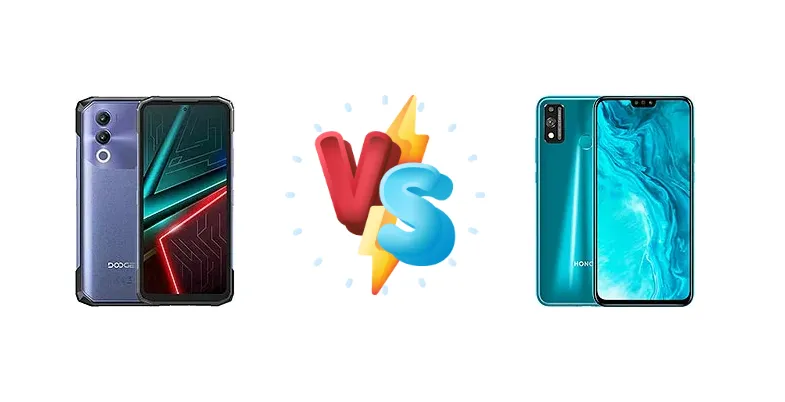
The Doogee Blade20 and Honor 9X Lite represent compelling options in the crowded budget smartphone market. While both aim to deliver essential features at an accessible price point, they diverge significantly in their core hardware. This comparison dissects the key differences – particularly in processing power and battery endurance – to determine which device offers the best value for your money.
🏆 Quick Verdict
For the average user prioritizing longevity and consistent performance, the Doogee Blade20 emerges as the stronger contender. Its Unisoc T7200 chipset, coupled with a remarkable 85-hour battery endurance, outweighs the Honor 9X Lite’s slightly faster CPU clock speeds, especially considering the Honor’s slower 10W charging.
| Network |
|---|
| 2G bands | GSM 850 / 900 / 1800 / 1900 | GSM 850 / 900 / 1800 / 1900 |
| 3G bands | HSDPA 850 / 900 / 1700(AWS) / 1900 / 2100 | HSDPA 850 / 900 / 1900 / 2100 |
| 4G bands | 1, 2, 3, 4, 5, 7, 8, 18, 19, 20, 25, 26, 28, 34, 38, 39, 40, 41, 66 | 1, 3, 7, 8, 20 |
| Speed | HSPA, LTE | HSPA 42.2/5.76 Mbps, LTE (2CA) Cat6 300/50 Mbps |
| Technology | GSM / HSPA / LTE | GSM / HSPA / LTE |
| Launch |
|---|
| Announced | 2025, May | 2020, April 17. Released 2020, May 14 |
| Status | Available. Released 2025, May | Discontinued |
| Body |
|---|
| Dimensions | 174 x 81.2 x 15.8 mm (6.85 x 3.20 x 0.62 in) | 160.4 x 76.6 x 7.8 mm (6.31 x 3.02 x 0.31 in) |
| SIM | Nano-SIM + Nano-SIM | Nano-SIM + Nano-SIM |
| Weight | 327 g (11.53 oz) | 188 g (6.63 oz) |
| Display |
|---|
| Protection | Mohs level 6 | - |
| Resolution | 720 x 1612 pixels, 20:9 ratio (~267 ppi density) | 1080 x 2340 pixels, 19.5:9 ratio (~397 ppi density) |
| Size | 6.6 inches, 104.6 cm2 (~74.1% screen-to-body ratio) | 6.5 inches, 103.2 cm2 (~84.0% screen-to-body ratio) |
| Type | IPS LCD, 90Hz | IPS LCD |
| Platform |
|---|
| CPU | Octa-core (2x1.6 GHz Cortex-A75 & 6x1.6 GHz Cortex-A55) | Octa-core (4x2.2 GHz Cortex-A73 & 4x1.7 GHz Cortex-A53) |
| Chipset | Unisoc T7200 (12 nm) | Kirin 710F (12 nm) |
| GPU | Mali-G57 MP1 | Mali-G51 MP4 |
| OS | Android 15 | Android 9.0 (Pie), EMUI 9.1, Google Play Services |
| Memory |
|---|
| Card slot | microSDXC (dedicated slot) | microSDXC (dedicated slot) |
| Internal | 128GB 4GB RAM | 128GB 4GB RAM |
| Main Camera |
|---|
| Dual | 16 MP, (wide), 1/2.8", AF
2 MP (macro) | 48 MP, f/1.8, (wide), 1/2.0", 0.8µm, PDAF
Auxiliary lens |
| Features | LED flash, HDR, panorama | LED flash, HDR, panorama |
| Video | 1080p@30fps | 1080p@30fps |
| Selfie camera |
|---|
| Single | 8 MP, f/2.2, (wide), 1/4.0" | 8 MP, f/2.0, (wide) |
| Video | 720p@30fps | 1080p@30fps |
| Sound |
|---|
| 3.5mm jack | - | Yes |
| 35mm jack | No | Yes |
| Loudspeaker | Yes | Yes |
| Comms |
|---|
| Bluetooth | 5.0, A2DP, LE | 4.2, A2DP, LE |
| NFC | Yes | Yes (market/region dependent) |
| Positioning | GPS, GLONASS, BDS, GALILEO | GPS, GLONASS, BDS |
| Radio | FM radio | FM radio |
| USB | USB Type-C 2.0, OTG | microUSB 2.0 |
| WLAN | Wi-Fi 802.11 a/b/g/n/ac, dual-band | Wi-Fi 802.11 a/b/g/n/ac, dual-band, Wi-Fi Direct |
| Features |
|---|
| Sensors | Fingerprint (side-mounted), accelerometer, gyro, proximity, compass | Fingerprint (rear-mounted), accelerometer, proximity, compass |
| Battery |
|---|
| Charging | 18W wired | 10W wired |
| Type | 10300 mAh | Li-Po 3750 mAh |
| Misc |
|---|
| Colors | Black, Purple, Natural | Emerald Green, Midnight Black |
| Models | - | JSN-L21, JSN-L22, JSN-L23 |
| Price | About 200 EUR | About 220 EUR |
| EU LABEL |
|---|
| Battery | 85:12h endurance, 1100 cycles | - |
| Energy | Class C | - |
| Free fall | Class A (270 falls) | - |
| Repairability | Class C | - |
Doogee Blade20
- Exceptional 85-hour battery endurance
- Faster 18W wired charging
- More modern CPU architecture (Cortex-A75)
- Potentially lower peak CPU performance
- Limited camera information
Honor 9X Lite
- Slightly higher CPU clock speeds
- Honor’s image processing experience
- Potentially better color calibration
- Significantly slower 10W charging
- Lower battery endurance (estimated)
- Older CPU architecture (Cortex-A73)
Display Comparison
Display specifications are not provided, so a direct comparison is impossible. However, given the price bracket, both devices likely utilize LCD panels with 720p+ resolution. The user experience will likely hinge on color calibration and viewing angles, areas where Honor historically performs slightly better. Bezels are expected to be noticeable on both devices, reflecting their budget positioning.
Camera Comparison
Camera details are limited. Both phones likely feature a multi-camera setup with a primary sensor and supporting lenses. Without sensor size or aperture information, it’s difficult to assess image quality. The inclusion of a 2MP macro lens on either device is largely a marketing tactic, offering minimal practical benefit. Image processing will be a key differentiator, and Honor’s experience in this area may give it a slight edge, but the lack of OIS on either device limits low-light performance.
Performance
The core difference lies in the chipsets. The Doogee Blade20’s Unisoc T7200 (12nm) employs a dual-cluster architecture with 2x 1.6 GHz Cortex-A75 cores and 6x 1.6 GHz Cortex-A55 cores. The Honor 9X Lite features the Kirin 710F (12nm) with 4x 2.2 GHz Cortex-A73 cores and 4x 1.7 GHz Cortex-A53 cores. While the Kirin 710F boasts higher peak clock speeds on its performance cores, the Cortex-A75 cores in the Unisoc T7200 are architecturally more efficient, potentially leading to better sustained performance under load. The Kirin 710F’s older Cortex-A73 cores may struggle more with demanding multitasking. Neither chipset is a gaming powerhouse, but the Unisoc T7200’s architecture suggests a more balanced experience.
Battery Life
The Doogee Blade20’s 85-hour endurance is a standout feature, significantly exceeding what’s typically found in this price range. This is further bolstered by the stated 1100 charge cycles, indicating long-term battery health. The Honor 9X Lite, lacking specific endurance data, will likely offer considerably less runtime. The 18W charging on the Doogee Blade20 is also a significant advantage over the Honor 9X Lite’s 10W charging, reducing the time needed to replenish the battery.
Buying Guide
Buy the Doogee Blade20 if you need a phone that will reliably last through a full day (and then some) of moderate to heavy use, and if you value consistent performance over peak bursts of speed. Buy the Honor 9X Lite if you prioritize a slightly more responsive interface for basic tasks and are willing to compromise on battery life and charging speed to achieve it.
Frequently Asked Questions
❓ Will the Unisoc T7200 in the Doogee Blade20 struggle with demanding games like PUBG Mobile?
While the Unisoc T7200 isn't a high-end gaming chip, its Cortex-A75 cores offer a reasonable level of performance. PUBG Mobile will likely be playable at medium settings with moderate frame rates. Expect some frame drops during intense action, but the sustained performance should be better than the Kirin 710F due to its more efficient architecture.
❓ How long will it take to fully charge the Doogee Blade20 with the 18W charger?
While a precise 0-100% charge time isn't specified, the 18W charging should significantly reduce charging times compared to the Honor 9X Lite’s 10W charging. Expect a full charge to take approximately 2.5 to 3 hours, depending on usage during charging.
❓ Is the Honor 9X Lite a good choice for users who primarily use their phone for social media and basic communication?
Yes, the Honor 9X Lite is suitable for basic tasks like social media browsing, messaging, and calls. The Kirin 710F is capable of handling these workloads without issue. However, users who frequently multitask or engage in more demanding activities will likely experience slower performance compared to the Doogee Blade20.
❓ Does the Doogee Blade20 support fast charging protocols beyond standard 18W PD?
Information regarding support for proprietary fast charging protocols (like Quick Charge) is unavailable. It's likely the 18W charging relies on Power Delivery (PD) standard. Using a compatible PD charger will ensure optimal charging speeds.