
Doogee Blade20 Ultra vs Xiaomi Redmi Note 12 Pro+: A Deep Dive Comparison
| Phones Images | |||||
|---|---|---|---|---|---|
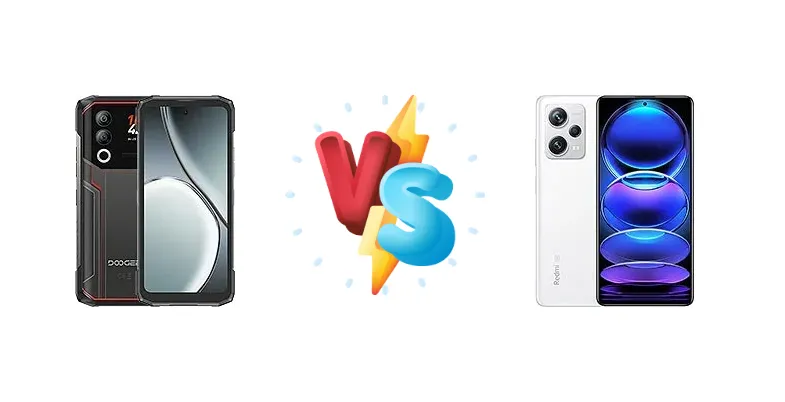
|
🏆 Quick Verdict
For the average user prioritizing sustained performance and longevity, the Xiaomi Redmi Note 12 Pro+ is the superior choice. Its Dimensity 1080 chipset offers a significant performance uplift, and the 120W charging dramatically reduces downtime. However, users who absolutely need maximum battery life and are willing to trade performance will find the Doogee Blade20 Ultra appealing.
| PHONES | ||
|---|---|---|
| Phone Names | Doogee Blade20 Ultra | Xiaomi Redmi Note 12 Pro+ |
| Network | ||
|---|---|---|
| 2G bands | GSM 850 / 900 / 1800 / 1900 | GSM 850 / 900 / 1800 / 1900 - SIM 1 & SIM 2 |
| 3G bands | HSDPA 850 / 900 / 1700(AWS) / 1900 / 2100 | HSDPA 800 / 850 / 900 / 1900 / 2100 |
| 4G bands | 1, 2, 3, 4, 5, 7, 8, 18, 19, 20, 25, 26, 28, 34, 38, 39, 40, 41, 66 | 1, 3, 5, 8, 19, 34, 38, 39, 40, 41 - International, China |
| 5G bands | - | 1, 3, 5, 8, 28, 38, 40, 41, 77, 78 SA/NSA - International |
| Speed | HSPA, LTE | HSPA, LTE-A (CA), 5G |
| Technology | GSM / HSPA / LTE | GSM / CDMA / HSPA / EVDO / LTE / 5G |
| - | 1, 3, 5, 8, 28, 38, 41, 77, 78 SA/NSA - China | |
| Launch | ||
|---|---|---|
| Announced | 2025, May | 2022, October 27 |
| Status | Available. Released 2025, May | Available. Released 2022, November 01 |
| Body | ||
|---|---|---|
| Build | - | Glass front (Gorilla Glass 5), glass back |
| Dimensions | 174 x 81.2 x 15.8 mm (6.85 x 3.20 x 0.62 in) | 162.9 x 76 x 8.9 mm (6.41 x 2.99 x 0.35 in) |
| SIM | Nano-SIM + Nano-SIM | Dual SIM (Nano-SIM, dual stand-by) |
| Weight | 326 g (11.50 oz) | 208.4 g (7.34 oz) |
| - | IP53, dust and splash resistant | |
| Display | ||
|---|---|---|
| Protection | Mohs level 6 | Corning Gorilla Glass 5 |
| Resolution | 720 x 1612 pixels, 20:9 ratio (~267 ppi density) | 1080 x 2400 pixels, 20:9 ratio (~395 ppi density) |
| Size | 6.6 inches, 104.6 cm2 (~74.1% screen-to-body ratio) | 6.67 inches, 107.4 cm2 (~86.8% screen-to-body ratio) |
| Type | IPS LCD, 90Hz | OLED, 1B colors, 120Hz, Dolby Vision, HDR10+, 500 nits (typ), 900 nits (HBM) |
| Platform | ||
|---|---|---|
| CPU | Octa-core (2x1.8 GHz Cortex-A75 & 6x1.6 GHz Cortex-A55) | Octa-core (2x2.6 GHz Cortex-A78 & 6x2.0 GHz Cortex-A55) |
| Chipset | Unisoc T7250 (12 nm) | Mediatek MT6877V Dimensity 1080 (6 nm) |
| GPU | Mali-G57 MP1 | Mali-G68 MC4 |
| OS | Android 14 | Android 12, MIUI 13 |
| Memory | ||
|---|---|---|
| Card slot | microSDXC (dedicated slot) | No |
| Internal | 512GB 8GB RAM | 256GB 8GB RAM, 256GB 12GB RAM |
| - | UFS 2.2 | |
| Main Camera | ||
|---|---|---|
| Features | Dual-LED flash, HDR, panorama | Dual-LED dual-tone flash, HDR, panorama |
| Single | 50 MP, f/1.8, (wide), 1/2.5", AF | - |
| Triple | - | 200 MP, f/1.7, 24mm (wide), 1/1.4", 0.56µm, PDAF, OIS 8 MP, f/2.2, 120˚ (ultrawide), 1/4", 1.12µm 2 MP, f/2.4, (macro) |
| Video | 1080p@30fps | 4K@30fps, 1080p@30/60/120fps, 720p@960fps |
| Selfie camera | ||
|---|---|---|
| Features | - | HDR |
| Single | 8 MP, f/2.2, (wide), 1/4.0" | 16 MP, f/2.5, (wide), 1/3.06", 1.0µm |
| Video | 720p@30fps | 1080p@30/60fps |
| Sound | ||
|---|---|---|
| 3.5mm jack | - | Yes |
| 35mm jack | No | - |
| Loudspeaker | Yes | Yes, with stereo speakers |
| - | 24-bit/192kHz audio | |
| Comms | ||
|---|---|---|
| Bluetooth | 5.0, A2DP, LE | 5.2, A2DP, LE |
| Infrared port | - | Yes |
| NFC | Yes | Yes (market/region dependent) |
| Positioning | GPS, GLONASS, BDS, GALILEO | GPS (L1), GLONASS (G1), BDS (B1I+B1c), GALILEO (E1), QZSS (L1) |
| Radio | FM radio | No |
| USB | USB Type-C 2.0, OTG | USB Type-C 2.0, OTG |
| WLAN | Wi-Fi 802.11 a/b/g/n/ac, dual-band | Wi-Fi 802.11 a/b/g/n/ac/6, dual-band, Wi-Fi Direct |
| Features | ||
|---|---|---|
| Sensors | Fingerprint (side-mounted), accelerometer, gyro, proximity, compass | Fingerprint (side-mounted), accelerometer, proximity, gyro, compass |
| Battery | ||
|---|---|---|
| Charging | 18W wired Reverse wired | 120W wired, PD3.0, 100% in 19 min (advertised) |
| Type | 10300 mAh | Li-Po 5000 mAh, non-removable |
| Misc | ||
|---|---|---|
| Colors | Red, Silver | Arctic White, Iceberg Blue, Obsidian Black, Trend edition |
| Models | - | 22101316UCP, 22101316UG |
| Price | About 230 EUR | $ 348.00 / £ 439.00 / € 399.00 / ₹ 29,949 |
| Tests | ||
|---|---|---|
| Battery life | - | Endurance rating 88h |
| Camera | - | Photo / Video |
| Display | - | Contrast ratio: Infinite (nominal) |
| Loudspeaker | - | -26.7 LUFS (Good) |
| Performance | - | AnTuTu: 498710 (v9) GeekBench: 2208 (v5.1), 2372 (v6) GFXBench: 22fps (ES 3.1 onscreen) |
| EU LABEL | ||
|---|---|---|
| Battery | 84:26h endurance, 1100 cycles | - |
| Energy | Class C | - |
| Free fall | Class A (270 falls) | - |
| Repairability | Class C | - |
Doogee Blade20 Ultra
- Exceptional battery life (84:26h endurance)
- High battery cycle count (1100 cycles)
- Reverse wired charging capability
- Slower processor (Unisoc T7250)
- Slow charging speed (18W)
Xiaomi Redmi Note 12 Pro+
- Faster processor (Dimensity 1080)
- Ultra-fast 120W charging (19 minutes to 100%)
- Likely superior display quality
- Shorter battery life (88h endurance)
- Potentially lower battery cycle count
Display Comparison
The Redmi Note 12 Pro+ boasts an 'Infinite' (nominal) contrast ratio, suggesting a high-quality AMOLED panel, though specific brightness data is missing. The Doogee Blade20 Ultra’s display specifications are not provided, making a direct comparison difficult. However, given its price point, it likely utilizes an IPS LCD panel with lower contrast and potentially less vibrant colors. The Redmi Note 12 Pro+'s panel technology likely offers a superior viewing experience, particularly for media consumption.
Camera Comparison
While both phones feature camera systems, detailed specifications are limited for the Doogee. The Redmi Note 12 Pro+ likely features a more advanced camera system, potentially including a higher resolution main sensor and more sophisticated image processing algorithms. The absence of detailed camera specs for the Doogee suggests it may not compete with the Redmi Note 12 Pro+ in image quality, especially in low-light conditions. The Redmi Note 12 Pro+'s camera is likely to offer better dynamic range and detail.
Performance
The Xiaomi Redmi Note 12 Pro+’s Mediatek Dimensity 1080 (6nm) chipset significantly outperforms the Doogee Blade20 Ultra’s Unisoc T7250 (12nm). The Dimensity 1080 features faster Cortex-A78 cores (2.6 GHz vs 1.8 GHz) and a more efficient manufacturing process, resulting in superior CPU and GPU performance. This translates to smoother multitasking, faster gaming, and quicker app launches. The Unisoc T7250 is adequate for everyday tasks, but will struggle with demanding applications and graphically intensive games. The Redmi Note 12 Pro+'s LPDDR5x RAM (speculation based on market segment) further enhances performance compared to the likely LPDDR4X RAM in the Doogee.
Battery Life
The Doogee Blade20 Ultra claims an impressive 84:26h endurance rating and 1100 charge cycles, indicating exceptional battery life and longevity. However, its 18W charging is comparatively slow. The Redmi Note 12 Pro+ offers a shorter 88h endurance, but compensates with a groundbreaking 120W wired charging capability, advertised to reach 100% in just 19 minutes. This difference in charging speed is substantial, offering a significant convenience factor for users who frequently need to top up their battery. The Doogee prioritizes long-term battery health, while the Xiaomi prioritizes rapid replenishment.
Buying Guide
Buy the Doogee Blade20 Ultra if you need a phone that can reliably last through two full days of moderate use and value long-term battery health with its 1100 charge cycles. Buy the Xiaomi Redmi Note 12 Pro+ if you prioritize a smoother, more responsive user experience, faster app loading times, and the convenience of incredibly quick charging – even if it means charging more frequently.