
Doogee Blade20 Ultra vs. Infinix Note 30 Pro: A Deep Dive into Battery, Performance, and Value
| Phones Images | |||||
|---|---|---|---|---|---|
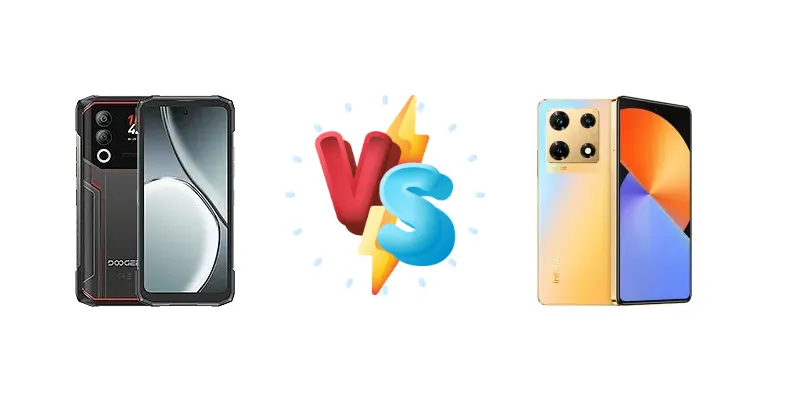
|
🏆 Quick Verdict
For users prioritizing longevity and minimizing charging frequency, the Doogee Blade20 Ultra is the clear winner thanks to its remarkable 84-hour battery endurance and 1100 charge cycles. However, the Infinix Note 30 Pro’s 68W charging and more powerful Helio G99 chipset make it a better choice for those who value speed and responsiveness.
| PHONES | ||
|---|---|---|
| Phone Names | Doogee Blade20 Ultra | Infinix Note 30 Pro |
| Network | ||
|---|---|---|
| 2G bands | GSM 850 / 900 / 1800 / 1900 | GSM 850 / 900 / 1800 / 1900 |
| 3G bands | HSDPA 850 / 900 / 1700(AWS) / 1900 / 2100 | HSDPA 850 / 900 / 1700(AWS) / 1900 / 2100 |
| 4G bands | 1, 2, 3, 4, 5, 7, 8, 18, 19, 20, 25, 26, 28, 34, 38, 39, 40, 41, 66 | 1, 2, 3, 4, 5, 7, 8, 12, 17, 20, 28, 38, 40, 41, 66 |
| Speed | HSPA, LTE | HSPA, LTE |
| Technology | GSM / HSPA / LTE | GSM / HSPA / LTE |
| Launch | ||
|---|---|---|
| Announced | 2025, May | 2023, May 22 |
| Status | Available. Released 2025, May | Available. Released 2023, May 22 |
| Body | ||
|---|---|---|
| Build | - | Glass front, plastic frame, glass back |
| Dimensions | 174 x 81.2 x 15.8 mm (6.85 x 3.20 x 0.62 in) | 162.7 x 76 x 8.2 mm (6.41 x 2.99 x 0.32 in) |
| SIM | Nano-SIM + Nano-SIM | Nano-SIM + Nano-SIM |
| Weight | 326 g (11.50 oz) | 203 g (7.16 oz) |
| - | IP53 | |
| Display | ||
|---|---|---|
| Protection | Mohs level 6 | - |
| Resolution | 720 x 1612 pixels, 20:9 ratio (~267 ppi density) | 1080 x 2400 pixels, 20:9 ratio (~395 ppi density) |
| Size | 6.6 inches, 104.6 cm2 (~74.1% screen-to-body ratio) | 6.67 inches, 107.4 cm2 (~86.9% screen-to-body ratio) |
| Type | IPS LCD, 90Hz | AMOLED, 1B colors, 120Hz, 900 nits (peak) |
| - | * the display diagonal size and resolution is unconfirmed | |
| Platform | ||
|---|---|---|
| CPU | Octa-core (2x1.8 GHz Cortex-A75 & 6x1.6 GHz Cortex-A55) | Octa-core (2x2.2 GHz Cortex-A76 & 6x2.0 GHz Cortex-A55) |
| Chipset | Unisoc T7250 (12 nm) | Mediatek Helio G99 (6 nm) |
| GPU | Mali-G57 MP1 | Mali-G57 MC2 |
| OS | Android 14 | Android 13, XOS 13 |
| Memory | ||
|---|---|---|
| Card slot | microSDXC (dedicated slot) | microSDXC (dedicated slot) |
| Internal | 512GB 8GB RAM | 256GB 8GB RAM |
| Main Camera | ||
|---|---|---|
| Features | Dual-LED flash, HDR, panorama | Quad-LED flash, HDR, panorama |
| Single | 50 MP, f/1.8, (wide), 1/2.5", AF | - |
| Triple | - | 108 MP, (wide), 1/1.67", PDAF 2 MP (macro) Auxiliary lens |
| Video | 1080p@30fps | 1440p@30fps, 1080p@30fps |
| Selfie camera | ||
|---|---|---|
| Features | - | LED flash, HDR |
| Single | 8 MP, f/2.2, (wide), 1/4.0" | 32 MP, f/2.0, (wide), 1/2.8" |
| Video | 720p@30fps | 1080p@30fps |
| Sound | ||
|---|---|---|
| 3.5mm jack | - | Yes |
| 35mm jack | No | Yes |
| Loudspeaker | Yes | Yes, with dual speakers |
| - | Sound by JBL 24-bit/192kHz audio | |
| Comms | ||
|---|---|---|
| Bluetooth | 5.0, A2DP, LE | Yes |
| NFC | Yes | Yes (market/region dependent) |
| Positioning | GPS, GLONASS, BDS, GALILEO | GPS |
| Radio | FM radio | FM radio |
| USB | USB Type-C 2.0, OTG | USB Type-C 2.0, OTG |
| WLAN | Wi-Fi 802.11 a/b/g/n/ac, dual-band | Wi-Fi 802.11 a/b/g/n/ac, dual-band, Wi-Fi Direct |
| Features | ||
|---|---|---|
| Sensors | Fingerprint (side-mounted), accelerometer, gyro, proximity, compass | Fingerprint (side-mounted), accelerometer, gyro, proximity, compass |
| Battery | ||
|---|---|---|
| Charging | 18W wired Reverse wired | 68W wired, PD3.0, 80% in 30 min 15W wireless Reverse wireless |
| Type | 10300 mAh | 5000 mAh |
| Misc | ||
|---|---|---|
| Colors | Red, Silver | Magic Black, Variable Gold |
| Models | - | X678B |
| Price | About 230 EUR | - |
| EU LABEL | ||
|---|---|---|
| Battery | 84:26h endurance, 1100 cycles | - |
| Energy | Class C | - |
| Free fall | Class A (270 falls) | - |
| Repairability | Class C | - |
Doogee Blade20 Ultra
- Exceptional 84-hour battery life
- High battery cycle count (1100)
- Reverse wired charging capability
- Slower 18W charging speed
- Less powerful Unisoc T7250 chipset
Infinix Note 30 Pro
- Faster and more efficient Mediatek Helio G99 chipset
- Ultra-fast 68W wired charging (80% in 30 min)
- Wireless and reverse wireless charging
- Shorter battery life compared to Doogee
- Potentially lower battery lifespan (fewer charge cycles - data unavailable)
Display Comparison
Display specifications are absent from the provided data, but considering the price points, both devices likely feature LCD panels. The key difference will likely be resolution and refresh rate. However, the focus here is on internal components. Without display data, we can assume both will offer adequate viewing experiences for their target market.
Camera Comparison
Camera details are unavailable, but given the market segment, both phones likely feature multi-camera setups with a primary sensor and supporting lenses. The absence of information prevents a detailed comparison. However, the focus on battery and charging suggests camera quality isn't a primary selling point for either device. We can expect adequate performance for social media and casual photography, but not flagship-level image quality.
Performance
The Infinix Note 30 Pro holds a significant advantage in raw processing power. Its Mediatek Helio G99, built on a more efficient 6nm process, features Cortex-A76 cores clocked at 2.2 GHz, compared to the Doogee’s Unisoc T7250’s Cortex-A75 cores at 1.8 GHz. This translates to noticeably faster app loading times, smoother multitasking, and improved gaming performance. The 6nm node also contributes to better thermal efficiency, potentially reducing throttling during sustained workloads. While the Unisoc T7250 is a capable chip, the Helio G99 offers a more modern architecture and superior performance.
Battery Life
This is where the Doogee Blade20 Ultra truly shines. Its 84-hour endurance is exceptional, far exceeding what most smartphones offer. The 1100 charge cycles also suggest a longer lifespan for the battery itself. However, the trade-off is a slower 18W charging speed. The Infinix Note 30 Pro, while offering less endurance, compensates with a blazing-fast 68W wired charging, capable of reaching 80% charge in just 30 minutes. The addition of 15W wireless charging and reverse wireless charging further enhances its convenience. The Infinix’s charging capabilities are a significant advantage for users who prioritize quick top-ups.
Buying Guide
Buy the Doogee Blade20 Ultra if you need a phone that can reliably last for multiple days on a single charge, and aren't heavily reliant on demanding applications. This is ideal for travelers, field workers, or anyone who simply dislikes frequent charging. Buy the Infinix Note 30 Pro if you prefer a phone that charges incredibly quickly, offers a smoother experience with more demanding apps and games, and appreciate the convenience of wireless charging.