
Doogee Blade20 Ultra vs Google Pixel 7a: A Deep Dive into Battery, Performance, and Camera
| Phones Images | |||||
|---|---|---|---|---|---|
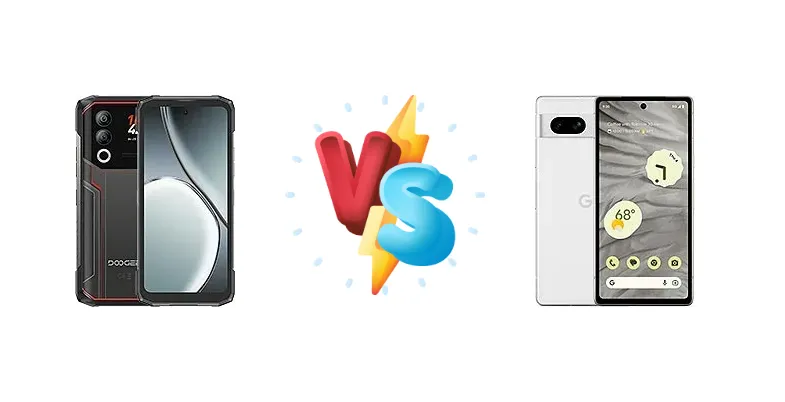
|
🏆 Quick Verdict
For the average user prioritizing camera quality and a smooth, responsive experience, the Google Pixel 7a is the clear winner. However, if battery life is paramount and you're willing to compromise on processing power, the Doogee Blade20 Ultra’s exceptional 84-hour endurance makes it a compelling choice.
| PHONES | ||
|---|---|---|
| Phone Names | Doogee Blade20 Ultra | Google Pixel 7a |
| Network | ||
|---|---|---|
| 2G bands | GSM 850 / 900 / 1800 / 1900 | GSM 850 / 900 / 1800 / 1900 |
| 3G bands | HSDPA 850 / 900 / 1700(AWS) / 1900 / 2100 | HSDPA 800 / 850 / 900 / 1700(AWS) / 1900 / 2100 |
| 4G bands | 1, 2, 3, 4, 5, 7, 8, 18, 19, 20, 25, 26, 28, 34, 38, 39, 40, 41, 66 | 1, 2, 3, 4, 5, 7, 8, 12, 13, 14, 17, 20, 25, 26, 28, 29, 30, 38, 40, 41, 48, 66, 71 - GWKK3, G0DZQ |
| 5G bands | - | 1, 2, 3, 5, 7, 8, 12, 14, 20, 25, 28, 30, 38, 41, 48, 66, 71, 77, 78 SA/NSA/Sub6 - GWKK3 |
| Speed | HSPA, LTE | HSPA, LTE, 5G |
| Technology | GSM / HSPA / LTE | GSM / HSPA / LTE / 5G |
| - | 1, 2, 3, 5, 7, 8, 12, 20, 25, 28, 38, 40, 41, 66, 75, 76, 77, 78, 79 SA/NSA/Sub6 - GHL1X, G82U8 | |
| Launch | ||
|---|---|---|
| Announced | 2025, May | 2023, May 10 |
| Status | Available. Released 2025, May | Available. Released 2023, May 10 |
| Body | ||
|---|---|---|
| Build | - | Glass front (Gorilla Glass 3), aluminum frame, plastic back |
| Dimensions | 174 x 81.2 x 15.8 mm (6.85 x 3.20 x 0.62 in) | 152 x 72.9 x 9 mm (5.98 x 2.87 x 0.35 in) |
| SIM | Nano-SIM + Nano-SIM | Nano-SIM + eSIM |
| Weight | 326 g (11.50 oz) | 193.5 g (6.84 oz) |
| - | IP67 dust/water resistant (up to 1m for 30 min) | |
| Display | ||
|---|---|---|
| Protection | Mohs level 6 | Corning Gorilla Glass 3 |
| Resolution | 720 x 1612 pixels, 20:9 ratio (~267 ppi density) | 1080 x 2400 pixels, 20:9 ratio (~429 ppi density) |
| Size | 6.6 inches, 104.6 cm2 (~74.1% screen-to-body ratio) | 6.1 inches, 90.7 cm2 (~81.8% screen-to-body ratio) |
| Type | IPS LCD, 90Hz | OLED, HDR, 90Hz |
| - | Always-on display | |
| Platform | ||
|---|---|---|
| CPU | Octa-core (2x1.8 GHz Cortex-A75 & 6x1.6 GHz Cortex-A55) | Octa-core (2x2.85 GHz Cortex-X1 & 2x2.35 GHz Cortex-A78 & 4x1.80 GHz Cortex-A55) |
| Chipset | Unisoc T7250 (12 nm) | Google Tensor G2 (5 nm) |
| GPU | Mali-G57 MP1 | Mali-G710 MP7 |
| OS | Android 14 | Android 13, upgradable to Android 15, up to 5 major Android upgrades |
| Memory | ||
|---|---|---|
| Card slot | microSDXC (dedicated slot) | No |
| Internal | 512GB 8GB RAM | 128GB 8GB RAM |
| - | UFS 3.1 | |
| Main Camera | ||
|---|---|---|
| Dual | - | 64 MP, f/1.9, 26mm (wide), 1/1.73", 0.8µm, dual pixel PDAF, OIS 13 MP, f/2.2, 120˚ (ultrawide), 1.12µm |
| Features | Dual-LED flash, HDR, panorama | Dual-LED flash, Pixel Shift, Auto-HDR, panorama |
| Single | 50 MP, f/1.8, (wide), 1/2.5", AF | - |
| Video | 1080p@30fps | 4K@30/60fps, 1080p@30/60/120/240fps, OIS |
| Selfie camera | ||
|---|---|---|
| Features | - | HDR, panorama |
| Single | 8 MP, f/2.2, (wide), 1/4.0" | 13 MP, f/2.2, 20mm (ultrawide), 1.12µm |
| Video | 720p@30fps | 4K@30fps, 1080p@30fps |
| Sound | ||
|---|---|---|
| 3.5mm jack | - | No |
| 35mm jack | No | No |
| Loudspeaker | Yes | Yes, with stereo speakers |
| Comms | ||
|---|---|---|
| Bluetooth | 5.0, A2DP, LE | 5.3, A2DP, LE |
| NFC | Yes | Yes |
| Positioning | GPS, GLONASS, BDS, GALILEO | GPS, GLONASS, GALILEO, BDS, QZSS, NavIC |
| Radio | FM radio | No |
| USB | USB Type-C 2.0, OTG | USB Type-C 3.2 |
| WLAN | Wi-Fi 802.11 a/b/g/n/ac, dual-band | Wi-Fi 802.11 a/b/g/n/ac/6e, tri-band |
| Features | ||
|---|---|---|
| Sensors | Fingerprint (side-mounted), accelerometer, gyro, proximity, compass | Fingerprint (under display, optical), accelerometer, gyro, proximity, compass, barometer |
| Battery | ||
|---|---|---|
| Charging | 18W wired Reverse wired | 18W wired, PD3.0 7.5W wireless |
| Type | 10300 mAh | Li-Po 4385 mAh |
| Misc | ||
|---|---|---|
| Colors | Red, Silver | Charcoal, Snow, Sea, Coral |
| Models | - | GWKK3, GHL1X, G0DZQ, G82U8 |
| Price | About 230 EUR | € 179.90 / $ 150.00 / £ 170.00 / ₹ 25,980 |
| EU LABEL | ||
|---|---|---|
| Battery | 84:26h endurance, 1100 cycles | - |
| Energy | Class C | - |
| Free fall | Class A (270 falls) | - |
| Repairability | Class C | - |
Doogee Blade20 Ultra
- Exceptional battery life (84h endurance)
- Long battery lifespan (1100 cycles)
- Reverse wired charging capability
- Less powerful processor (Unisoc T7250)
- Slower charging speed (18W)
- Camera performance likely inferior to Pixel 7a
Google Pixel 7a
- Powerful Google Tensor G2 chipset
- Excellent camera performance
- Bright and vibrant display (1070 nits)
- Shorter battery life (76h endurance)
- Slower charging than some competitors
- Wireless charging is relatively slow (7.5W)
Display Comparison
The Pixel 7a boasts a significantly brighter display, peaking at 1070 nits, which translates to excellent visibility outdoors. While the Blade20 Ultra’s display specs are not provided, it’s likely to be considerably dimmer. The Pixel 7a’s OLED panel also benefits from Google’s color calibration, offering more accurate and vibrant visuals. The absence of LTPO technology on either device means neither offers adaptive refresh rates for power saving.
Camera Comparison
The Pixel 7a’s camera system is a major strength, leveraging Google’s computational photography expertise. While specific sensor details aren’t provided, the Pixel 7a excels in both photo and video capture, particularly in challenging lighting conditions. The Doogee Blade20 Ultra’s camera specs are not detailed enough to make a meaningful comparison, but it’s unlikely to match the Pixel 7a’s image quality or feature set. The Pixel 7a’s image processing algorithms are a key differentiator, delivering consistently excellent results with minimal user effort.
Performance
The Google Tensor G2 (5nm) represents a substantial leap in processing power compared to the Unisoc T7250 (12nm) found in the Doogee Blade20 Ultra. The Tensor G2’s Cortex-X1 prime core, clocked at 2.85 GHz, delivers significantly faster single-core performance, crucial for app launch speeds and responsiveness. The Blade20 Ultra’s Cortex-A75 cores, while capable, are less efficient and slower. The Pixel 7a’s more advanced chipset also benefits from Google’s machine learning capabilities, enhancing features like voice recognition and image processing. The Doogee’s Unisoc chip is geared towards efficiency, prioritizing battery life over raw performance.
Battery Life
The Doogee Blade20 Ultra’s 84-hour endurance rating is its standout feature, dwarfing the Pixel 7a’s 76 hours. This translates to significantly longer usage between charges. However, the Blade20 Ultra is limited to 18W wired charging, while the Pixel 7a supports 18W wired charging with PD3.0 and 7.5W wireless charging. The slower charging speed on the Doogee means topping up the battery will take longer, despite the larger capacity. The 1100 charge cycles rating for the Doogee suggests a longer lifespan for the battery itself.
Buying Guide
Buy the Doogee Blade20 Ultra if you need a phone that can reliably last two full days on a single charge, and your usage primarily involves everyday tasks like calling, texting, and light social media. Buy the Google Pixel 7a if you prefer a phone with a superior camera system, faster performance for gaming and demanding apps, and benefit from Google’s software features and long-term support.