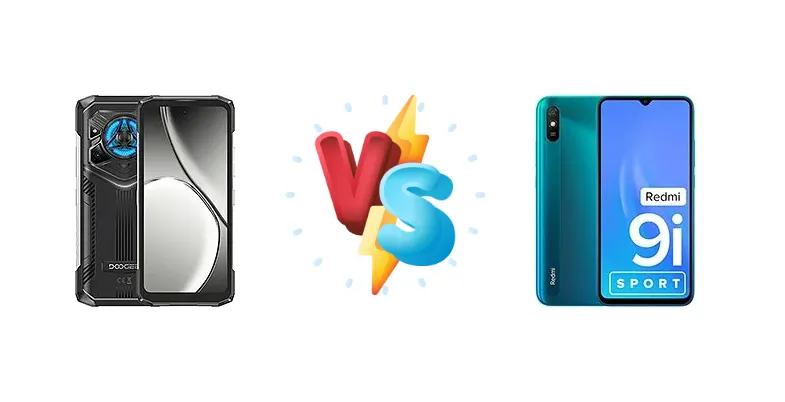
The Doogee Blade20 Play and Xiaomi Redmi 9i Sport represent opposite ends of the budget smartphone spectrum. The Redmi 9i Sport focuses on delivering essential functionality at an incredibly low price point, while the Blade20 Play aims to offer significantly more performance and features, leveraging a more modern chipset. This comparison dissects their key differences to help you determine which device best suits your needs.
🏆 Quick Verdict
For the average user prioritizing performance and future-proofing, the Doogee Blade20 Play is the clear winner. Its Mediatek Dimensity 7050 chipset delivers a substantial performance leap over the Redmi 9i Sport’s Helio G25, coupled with significantly faster 33W charging. However, the Redmi 9i Sport remains a viable option for those on the tightest of budgets.
| Network |
|---|
| 2G bands | GSM 850 / 900 / 1800 / 1900 | GSM 850 / 900 / 1800 / 1900 |
| 3G bands | HSDPA 850 / 900 / 1700(AWS) / 1900 / 2100 | HSDPA 850 / 900 / 2100 |
| 4G bands | 1, 2, 3, 4, 5, 7, 8, 18, 19, 20, 25, 26, 28, 34, 38, 39, 40, 41, 66 | 1, 3, 5, 8, 40, 41 |
| 5G bands | 1, 3, 7, 8, 28, 38, 41, 77, 78 SA/NSA | - |
| Speed | HSPA, LTE, 5G | HSPA, LTE |
| Technology | GSM / HSPA / LTE / 5G | GSM / HSPA / LTE |
| Launch |
|---|
| Announced | 2025, May | 2021, September 28 |
| Status | Available. Released 2025, May | Available. Released 2021, September 28 |
| Body |
|---|
| Dimensions | 174 x 81.2 x 15.8 mm (6.85 x 3.20 x 0.62 in) | 164.9 x 77.1 x 9 mm (6.49 x 3.04 x 0.35 in) |
| SIM | Nano-SIM + Nano-SIM | Nano-SIM + Nano-SIM |
| Weight | 362 g (12.77 oz) | 194 g (6.84 oz) |
| | - | Water-repellent coating |
| Display |
|---|
| Protection | Mohs level 6 | - |
| Resolution | 720 x 1612 pixels, 20:9 ratio (~267 ppi density) | 720 x 1600 pixels, 20:9 ratio (~269 ppi density) |
| Size | 6.6 inches, 104.6 cm2 (~74.1% screen-to-body ratio) | 6.53 inches, 102.9 cm2 (~81.0% screen-to-body ratio) |
| Type | IPS LCD, 90Hz | IPS LCD, 400 nits (typ) |
| Platform |
|---|
| CPU | Octa-core (2x2.6 GHz Cortex-A78 & 6x2.0 GHz Cortex-A55) | Octa-core (4x2.0 GHz Cortex-A53 & 4x1.5 GHz Cortex-A53) |
| Chipset | Mediatek Dimensity 7050 (6 nm) | Mediatek MT6762G Helio G25 (12 nm) |
| GPU | Mali-G68 MC4 | PowerVR GE8320 |
| OS | Android 15 | Android 10, MIUI 12 |
| Memory |
|---|
| Card slot | microSDXC (dedicated slot) | microSDXC (dedicated slot) |
| Internal | 256GB 8GB RAM | 64GB 4GB RAM, 128GB 4GB RAM |
| | - | eMMC 5.1 |
| Main Camera |
|---|
| Dual | 50 MP, f/1.8, (wide), 1/2.5", PDAF
20 MP, f/1.8, (night vision), infrared night vision light | - |
| Features | Dual-LED flash, HDR, panorama | LED flash, HDR |
| Single | - | 13 MP, f/2.2, 28mm (wide), 1.0µm, PDAF |
| Video | 4K@30fps, 1080p@30fps | 1080p@30fps |
| Selfie camera |
|---|
| Features | - | HDR |
| Single | 16 MP, f/2.5, (wide), 1/3.1" | 5 MP, f/2.2, (wide), 1.12µm |
| Video | 1080p@30fps | 1080p@30fps |
| Sound |
|---|
| 3.5mm jack | - | Yes |
| 35mm jack | No | Yes |
| Loudspeaker | Yes (125dB, 3.5W peak) | Yes |
| Comms |
|---|
| Bluetooth | 5.2, A2DP, LE | 5.0, A2DP, LE |
| NFC | Yes | No |
| Positioning | GPS, GLONASS, BDS, GALILEO | GPS, GLONASS, BDS |
| Radio | FM radio | FM radio |
| USB | USB Type-C 2.0, OTG | microUSB 2.0, OTG |
| WLAN | Wi-Fi 802.11 a/b/g/n/ac/6, dual-band | Wi-Fi 802.11 а/b/g/n, Wi-Fi Direct |
| Features |
|---|
| Sensors | Fingerprint (side-mounted), accelerometer, proximity, compass | Accelerometer, proximity, compass |
| Battery |
|---|
| Charging | 33W wired
Reverse wired | 10W wired |
| Type | 10300 mAh | Li-Po 5000 mAh |
| Misc |
|---|
| Colors | Red, Silver | Carbon Black, Coral Green, Metallic Blue |
| Price | € 274.99 / $ 221.42 / £ 227.99 | About 100 EUR |
| EU LABEL |
|---|
| Battery | 85:58h endurance, 1100 cycles | - |
| Energy | Class C | - |
| Free fall | Class A (270 falls) | - |
| Repairability | Class C | - |
Doogee Blade20 Play
- Significantly faster processor for smoother performance
- 33W fast charging for quick power-ups
- Longer battery endurance (85-58h)
- More future-proof chipset
- Likely higher price point
- May have a less refined software experience (depending on Doogee's UI)
Xiaomi Redmi 9i Sport
- Extremely affordable price
- Simple and easy-to-use interface
- Decent battery life for basic usage
- Reliable for essential smartphone tasks
- Slow 10W charging
- Outdated processor struggles with demanding apps
- Limited gaming capabilities
- May feel sluggish in everyday use
Display Comparison
While display specifications are absent, the focus here is on the processing power driving the user interface. A smoother experience is expected on the Blade20 Play due to its superior chipset. The Redmi 9i Sport, with its older Helio G25, will likely exhibit more noticeable lag when navigating menus or scrolling through content. The impact of the chipset on perceived display responsiveness is significant.
Camera Comparison
Without detailed camera specifications, it’s difficult to make a definitive judgment. However, the chipset’s image signal processor (ISP) plays a crucial role in image quality. The Dimensity 7050’s ISP is significantly more advanced than the Helio G25’s, enabling better noise reduction, dynamic range, and overall image processing capabilities. While both phones likely feature basic camera setups, the Blade20 Play will likely produce superior photos and videos, especially in challenging lighting conditions.
Performance
The performance disparity is the most significant difference between these two devices. The Doogee Blade20 Play’s Mediatek Dimensity 7050, built on a 6nm process, boasts a combination of Cortex-A78 and Cortex-A55 cores clocked up to 2.6 GHz. This architecture is a generation ahead of the Redmi 9i Sport’s Helio G25, which utilizes four Cortex-A53 cores at 2.0 GHz and another four at 1.5 GHz, fabricated on a less efficient 12nm node. The Dimensity 7050’s more advanced architecture and smaller fabrication process translate to significantly higher CPU and GPU performance, making the Blade20 Play far more capable of handling demanding tasks and games. The 6nm process also contributes to better thermal efficiency, reducing the likelihood of performance throttling during sustained use.
Battery Life
The Doogee Blade20 Play offers an impressive 85-58h endurance rating, suggesting excellent battery life. Coupled with its 33W wired charging, it can be rapidly replenished. The Redmi 9i Sport, lacking information on endurance, relies on a slower 10W charging solution. This means significantly longer charging times, making the Blade20 Play a more convenient option for users who frequently need to top up their battery. The 1100 charge cycles rating for the Blade20 Play also indicates a longer lifespan for the battery itself.
Buying Guide
Buy the Doogee Blade20 Play if you need a phone capable of handling demanding apps, moderate gaming, and appreciate faster charging speeds. It’s ideal for users who want a device that will remain responsive for years to come. Buy the Xiaomi Redmi 9i Sport if you prioritize extreme affordability and only require basic smartphone functionality like calls, texts, and light social media use. It’s a good choice for first-time smartphone owners or as a reliable backup device.
Frequently Asked Questions
❓ Will the Doogee Blade20 Play handle demanding games like PUBG or Call of Duty?
The Mediatek Dimensity 7050 chipset in the Blade20 Play is capable of running PUBG and Call of Duty, but likely at medium settings to maintain a stable frame rate. The Helio G25 in the Redmi 9i Sport will struggle with these titles, offering a significantly less enjoyable gaming experience.
❓ How long will it take to fully charge each phone?
The Doogee Blade20 Play’s 33W charging will fully charge the device in approximately 60-75 minutes. The Redmi 9i Sport’s 10W charging will take over 3 hours to reach 100%, making it considerably slower.
❓ Is the Doogee Blade20 Play a 5G phone?
The Mediatek Dimensity 7050 chipset supports 5G connectivity, meaning the Doogee Blade20 Play is capable of connecting to 5G networks, offering significantly faster data speeds where available. The Redmi 9i Sport is limited to 4G.
❓ How does the processor affect everyday tasks like browsing and social media?
The Blade20 Play’s Dimensity 7050 will provide a much smoother and more responsive experience when browsing the web, using social media apps, and multitasking. The Redmi 9i Sport’s Helio G25 may exhibit noticeable lag and slowdowns, especially with multiple apps open.