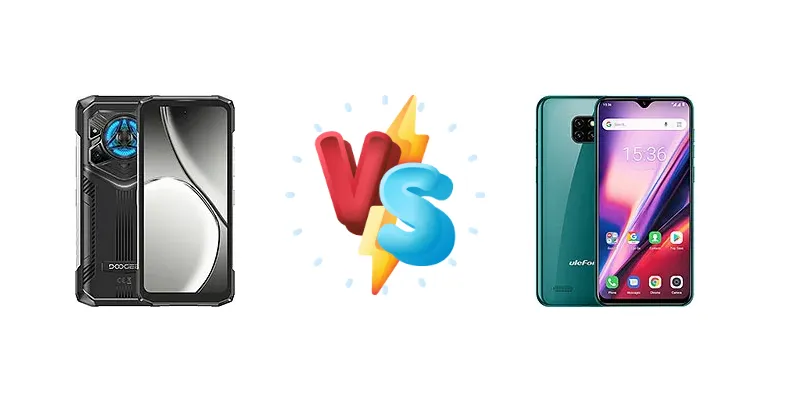
The smartphone market is flooded with budget options, but performance varies wildly. We pit the Doogee Blade20 Play, powered by the modern Mediatek Dimensity 7050, against the Ulefone Note 7T, utilizing the older Helio A22 chipset. This comparison isn't about incremental upgrades; it's about understanding the gulf between entry-level and genuinely capable budget devices.
🏆 Quick Verdict
For the average user prioritizing responsiveness and future-proofing, the Doogee Blade20 Play is the clear winner. Its Dimensity 7050 chipset delivers a vastly superior experience, justifying the likely price premium. However, the Ulefone Note 7T remains a viable option for those on the absolute tightest budget and with minimal performance demands.
| Network |
|---|
| 2G bands | GSM 850 / 900 / 1800 / 1900 | GSM 850 / 900 / 1800 / 1900 |
| 3G bands | HSDPA 850 / 900 / 1700(AWS) / 1900 / 2100 | HSDPA 850 / 900 / 2100 |
| 4G bands | 1, 2, 3, 4, 5, 7, 8, 18, 19, 20, 25, 26, 28, 34, 38, 39, 40, 41, 66 | 1, 3, 5, 7, 8, 20 |
| 5G bands | 1, 3, 7, 8, 28, 38, 41, 77, 78 SA/NSA | - |
| Speed | HSPA, LTE, 5G | HSPA 42.2/11.5 Mbps, LTE Cat7 300/150 Mbps |
| Technology | GSM / HSPA / LTE / 5G | GSM / HSPA / LTE |
| Launch |
|---|
| Announced | 2025, May | 2020, November 12. Released 2020, November 12 |
| Status | Available. Released 2025, May | Discontinued |
| Body |
|---|
| Dimensions | 174 x 81.2 x 15.8 mm (6.85 x 3.20 x 0.62 in) | 156.1 x 73.7 x 9.7 mm (6.15 x 2.90 x 0.38 in) |
| SIM | Nano-SIM + Nano-SIM | Dual SIM |
| Weight | 362 g (12.77 oz) | 177.5 g (6.28 oz) |
| Display |
|---|
| Protection | Mohs level 6 | - |
| Resolution | 720 x 1612 pixels, 20:9 ratio (~267 ppi density) | 600 x 1280 pixels (~232 ppi density) |
| Size | 6.6 inches, 104.6 cm2 (~74.1% screen-to-body ratio) | 6.1 inches, 92.3 cm2 (~80.2% screen-to-body ratio) |
| Type | IPS LCD, 90Hz | IPS LCD |
| Platform |
|---|
| CPU | Octa-core (2x2.6 GHz Cortex-A78 & 6x2.0 GHz Cortex-A55) | Octa-core 2.0 GHz Cortex-A53 |
| Chipset | Mediatek Dimensity 7050 (6 nm) | Mediatek MT6761 Helio A22 (12 nm) |
| GPU | Mali-G68 MC4 | PowerVR GE8320 |
| OS | Android 15 | Android 10 |
| Memory |
|---|
| Card slot | microSDXC (dedicated slot) | microSDXC (dedicated slot) |
| Internal | 256GB 8GB RAM | 16GB 2GB RAM |
| | - | eMMC 5.1 |
| Main Camera |
|---|
| Dual | 50 MP, f/1.8, (wide), 1/2.5", PDAF
20 MP, f/1.8, (night vision), infrared night vision light | - |
| Features | Dual-LED flash, HDR, panorama | LED flash |
| Triple | - | 8 MP, f/2.0, (wide)
2 MP
2 MP |
| Video | 4K@30fps, 1080p@30fps | 1080p@30fps |
| Selfie camera |
|---|
| Single | 16 MP, f/2.5, (wide), 1/3.1" | 5 MP, f/2.2 |
| Video | 1080p@30fps | - |
| Sound |
|---|
| 3.5mm jack | - | Yes |
| 35mm jack | No | Yes |
| Loudspeaker | Yes (125dB, 3.5W peak) | Yes |
| Comms |
|---|
| Bluetooth | 5.2, A2DP, LE | 5.0, A2DP, LE |
| NFC | Yes | No |
| Positioning | GPS, GLONASS, BDS, GALILEO | GPS, GLONASS |
| Radio | FM radio | Stereo FM radio, RDS, recording |
| USB | USB Type-C 2.0, OTG | microUSB 2.0 |
| WLAN | Wi-Fi 802.11 a/b/g/n/ac/6, dual-band | Wi-Fi 802.11 a/b/g/n/ac, dual-band |
| Features |
|---|
| Sensors | Fingerprint (side-mounted), accelerometer, proximity, compass | Accelerometer, proximity |
| Battery |
|---|
| Charging | 33W wired
Reverse wired | - |
| Type | 10300 mAh | Li-Ion 3500 mAh |
| Misc |
|---|
| Colors | Red, Silver | Twilight, Black, Midnight Green |
| Price | € 274.99 / $ 221.42 / £ 227.99 | - |
| SAR | - | 0.67 W/kg (head) 0.59 W/kg (body) |
| EU LABEL |
|---|
| Battery | 85:58h endurance, 1100 cycles | - |
| Energy | Class C | - |
| Free fall | Class A (270 falls) | - |
| Repairability | Class C | - |
Doogee Blade20 Play
- Significantly faster processor (Dimensity 7050)
- Longer battery life (85:58h endurance)
- Faster charging (33W)
- Potential for 5G connectivity
- Likely higher price
- May lack advanced features found on higher-end phones
Ulefone Note 7T
- Extremely affordable
- Simple and easy to use
- Acceptable for basic tasks
- Lightweight
- Slow processor (Helio A22)
- Shorter battery life
- Limited multitasking capabilities
- Poor gaming performance
Display Comparison
Display specifications are absent from the provided data, but given the price points, we can infer both devices likely utilize LCD panels. The Ulefone Note 7T, with its older chipset, likely features lower brightness and color accuracy. The Doogee Blade20 Play, positioned as a more modern device, may offer a slightly improved display experience, though likely still within the budget LCD category. Bezels are also expected to be larger on the Ulefone Note 7T due to its older design.
Camera Comparison
Camera details are limited. However, given the market segment, both devices likely feature basic camera setups. The absence of information suggests neither phone will excel in photography. The Doogee Blade20 Play, being a newer device, *may* have a slightly more advanced image processing pipeline, but the core sensor and lens quality are likely comparable. Any 2MP macro lenses on either device should be considered marketing features rather than genuinely useful cameras.
Performance
The performance disparity is the defining characteristic of this comparison. The Doogee Blade20 Play’s Mediatek Dimensity 7050 (6nm) is a significant leap forward from the Ulefone Note 7T’s Helio A22 (12nm). The Dimensity 7050’s octa-core configuration, featuring 2x2.6 GHz Cortex-A78 and 6x2.0 GHz Cortex-A55 cores, provides substantially more processing power than the Helio A22’s 2.0 GHz Cortex-A53 cores. The 6nm process node of the Dimensity 7050 also translates to better power efficiency and reduced thermal throttling, crucial for sustained performance. Users will experience dramatically faster app loading times, smoother multitasking, and the ability to run more demanding games on the Doogee.
Battery Life
The Doogee Blade20 Play boasts an impressive 85:58h endurance rating, coupled with 33W wired charging and reverse wired charging. This suggests a well-optimized battery system capable of lasting a full day with moderate use and recharging quickly. The Ulefone Note 7T’s battery capacity is unknown, but its older, less efficient chipset will likely result in shorter battery life. The 33W charging on the Doogee is a significant advantage, offering a much faster 0-100% charge time compared to the likely slower charging speeds of the Ulefone.
Buying Guide
Buy the Doogee Blade20 Play if you need a phone capable of handling demanding apps, moderate gaming, and benefit from 5G connectivity. It's ideal for users who want a device that will remain usable for several years. Buy the Ulefone Note 7T if you prioritize absolute affordability and only require basic functionality like calls, texts, and light social media use. It's a good choice for a first smartphone or a backup device.
Frequently Asked Questions
❓ Will the Doogee Blade20 Play handle demanding games like PUBG or Call of Duty?
The Mediatek Dimensity 7050 is capable of running PUBG and Call of Duty, but likely at medium settings to maintain a stable frame rate. The phone's thermal management will be a key factor in sustained performance during long gaming sessions.
❓ Is the Ulefone Note 7T suitable for someone who primarily uses their phone for calls, texts, and WhatsApp?
Yes, the Ulefone Note 7T is perfectly adequate for basic communication tasks. Its Helio A22 chipset is sufficient for these functions, and its lower price makes it a good option for users with minimal smartphone needs.
❓ Does the Doogee Blade20 Play support 5G connectivity?
While not explicitly stated, the Dimensity 7050 chipset *typically* includes 5G modem capabilities. However, it's crucial to verify the specific model and region to confirm 5G support.
❓ How many years of software updates can I expect from the Ulefone Note 7T?
Given Ulefone's track record and the Helio A22 chipset, software update support is likely to be limited. Expect at most one major Android update, and security patches may be infrequent.