
Doogee Blade20 Play vs Samsung Galaxy A11: A Deep Dive into Performance and Battery Life
| Phones Images | |||||
|---|---|---|---|---|---|
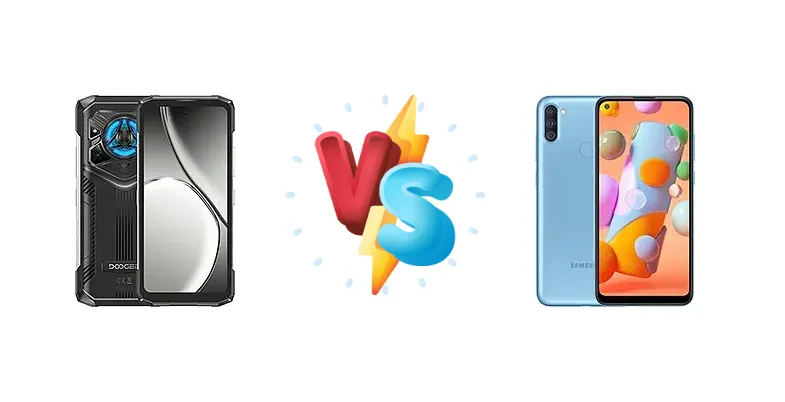
|
🏆 Quick Verdict
For the average user prioritizing performance and future-proofing, the Doogee Blade20 Play is the clear winner. Its Dimensity 7050 chipset offers a substantial leap in processing power and efficiency compared to the Galaxy A11's Snapdragon 450, coupled with significantly faster 33W charging. While the A11 benefits from Samsung's brand recognition, it falls behind in core capabilities.
| PHONES | ||
|---|---|---|
| Phone Names | Doogee Blade20 Play | Samsung Galaxy A11 |
| Network | ||
|---|---|---|
| 2G bands | GSM 850 / 900 / 1800 / 1900 | GSM 850 / 900 / 1800 / 1900 |
| 3G bands | HSDPA 850 / 900 / 1700(AWS) / 1900 / 2100 | HSDPA 850 / 900 / 1900 / 2100 |
| 4G bands | 1, 2, 3, 4, 5, 7, 8, 18, 19, 20, 25, 26, 28, 34, 38, 39, 40, 41, 66 | 1, 2, 3, 5, 7, 8, 20, 28, 38, 40, 41 |
| 5G bands | 1, 3, 7, 8, 28, 38, 41, 77, 78 SA/NSA | - |
| Speed | HSPA, LTE, 5G | HSPA 42.2/5.76 Mbps, LTE Cat4 150/50 Mbps |
| Technology | GSM / HSPA / LTE / 5G | GSM / HSPA / LTE |
| - | 1, 2, 3, 4, 5, 7, 8, 12, 13, 17, 20, 25, 26, 28, 38, 39, 40, 41, 66, 71 - SM-A115U | |
| Launch | ||
|---|---|---|
| Announced | 2025, May | 2020, March 13. Released 2020, May 01 |
| Status | Available. Released 2025, May | Discontinued |
| Body | ||
|---|---|---|
| Build | - | Glass front, plastic back, plastic frame |
| Dimensions | 174 x 81.2 x 15.8 mm (6.85 x 3.20 x 0.62 in) | 161.4 x 76.3 x 8 mm (6.35 x 3.00 x 0.31 in) |
| SIM | Nano-SIM + Nano-SIM | · Nano-SIM· Nano-SIM + Nano-SIM |
| Weight | 362 g (12.77 oz) | 177 g (6.24 oz) |
| Display | ||
|---|---|---|
| Protection | Mohs level 6 | - |
| Resolution | 720 x 1612 pixels, 20:9 ratio (~267 ppi density) | 720 x 1560 pixels, 19.5:9 ratio (~268 ppi density) |
| Size | 6.6 inches, 104.6 cm2 (~74.1% screen-to-body ratio) | 6.4 inches, 100.5 cm2 (~81.6% screen-to-body ratio) |
| Type | IPS LCD, 90Hz | PLS LCD |
| Platform | ||
|---|---|---|
| CPU | Octa-core (2x2.6 GHz Cortex-A78 & 6x2.0 GHz Cortex-A55) | Octa-core 1.8 GHz Cortex-A53 |
| Chipset | Mediatek Dimensity 7050 (6 nm) | Qualcomm SDM450 Snapdragon 450 (14 nm) |
| GPU | Mali-G68 MC4 | Adreno 506 |
| OS | Android 15 | Android 10, upgradable to Android 12, One UI Core 4.1 |
| Memory | ||
|---|---|---|
| Card slot | microSDXC (dedicated slot) | microSDXC (dedicated slot) |
| Internal | 256GB 8GB RAM | 32GB 2GB RAM, 32GB 3GB RAM, 64GB 3GB RAM, 64GB 4GB RAM |
| - | eMMC 5.1 | |
| Main Camera | ||
|---|---|---|
| Dual | 50 MP, f/1.8, (wide), 1/2.5", PDAF 20 MP, f/1.8, (night vision), infrared night vision light | - |
| Features | Dual-LED flash, HDR, panorama | LED flash, panorama, HDR |
| Triple | - | 13 MP, f/1.8, 27mm (wide), AF 5 MP, f/2.2, 115˚ (ultrawide) Auxiliary lens |
| Video | 4K@30fps, 1080p@30fps | 1080p@30fps |
| Selfie camera | ||
|---|---|---|
| Single | 16 MP, f/2.5, (wide), 1/3.1" | 8 MP, f/2.0 |
| Video | 1080p@30fps | 1080p@30fps |
| Sound | ||
|---|---|---|
| 3.5mm jack | - | Yes |
| 35mm jack | No | Yes |
| Loudspeaker | Yes (125dB, 3.5W peak) | Yes |
| Comms | ||
|---|---|---|
| Bluetooth | 5.2, A2DP, LE | 4.2, A2DP, LE |
| NFC | Yes | No |
| Positioning | GPS, GLONASS, BDS, GALILEO | GPS, GLONASS, GALILEO, BDS |
| Radio | FM radio | FM radio |
| USB | USB Type-C 2.0, OTG | USB Type-C 2.0 |
| WLAN | Wi-Fi 802.11 a/b/g/n/ac/6, dual-band | Wi-Fi 802.11 b/g/n, Wi-Fi Direct |
| Features | ||
|---|---|---|
| Sensors | Fingerprint (side-mounted), accelerometer, proximity, compass | Fingerprint (rear-mounted), accelerometer, proximity |
| Battery | ||
|---|---|---|
| Charging | 33W wired Reverse wired | 15W wired |
| Type | 10300 mAh | Li-Po 4000 mAh |
| Misc | ||
|---|---|---|
| Colors | Red, Silver | Black, White, Blue, Red |
| Models | - | SM-A115F/DS, SM-A115F, SM-A115M, SM-A115M/DS, SM-A115U, SM-A115A, SM-A115AZ, SM-A115U1, SM-A115W, SM-A115AP, SM-S115DL |
| Price | € 274.99 / $ 221.42 / £ 227.99 | About 160 EUR |
| SAR EU | - | 0.52 W/kg (head) 0.99 W/kg (body) |
| EU LABEL | ||
|---|---|---|
| Battery | 85:58h endurance, 1100 cycles | - |
| Energy | Class C | - |
| Free fall | Class A (270 falls) | - |
| Repairability | Class C | - |
Doogee Blade20 Play
- Significantly faster processor (Dimensity 7050)
- Faster 33W charging
- More efficient 6nm chipset for longer battery life
- Less established brand recognition
- Potential software update support may be limited
Samsung Galaxy A11
- Well-known Samsung brand
- Simple and user-friendly interface
- Potentially wider availability of accessories
- Outdated Snapdragon 450 processor
- Slow 15W charging
- Less efficient chipset leading to shorter battery life
Display Comparison
While display specifications aren't provided for the Galaxy A11 beyond its general LCD nature, the core difference lies in the processing power driving the user interface. The Blade20 Play's Dimensity 7050 will deliver a smoother, more responsive experience when navigating the UI and apps, even if both phones share similar resolutions. The A11's Snapdragon 450 may exhibit noticeable lag during transitions and app loading. The impact of the chipset on perceived display smoothness is significant.
Camera Comparison
Without detailed camera specs for either device, it's difficult to make a definitive judgment. However, the chipset plays a crucial role in image processing. The Dimensity 7050’s more powerful ISP (Image Signal Processor) in the Blade20 Play will likely result in faster image capture, better noise reduction, and improved dynamic range compared to the Snapdragon 450 in the A11. While both phones likely feature basic camera setups, the Blade20 Play has the hardware advantage to deliver superior image quality, especially in challenging lighting conditions.
Performance
The performance gap between these two devices is substantial. The Doogee Blade20 Play’s Mediatek Dimensity 7050, built on a 6nm process, features a modern octa-core configuration with 2x2.6 GHz Cortex-A78 cores and 6x2.0 GHz Cortex-A55 cores. This is a significant upgrade over the Samsung Galaxy A11’s Qualcomm Snapdragon 450, utilizing older Cortex-A53 cores clocked at 1.8 GHz and built on a less efficient 14nm process. The Dimensity 7050’s architecture allows for faster processing speeds and improved power efficiency, translating to smoother multitasking, quicker app launches, and better gaming performance. The 6nm node also means less heat generation under load, reducing the likelihood of thermal throttling.
Battery Life
The Doogee Blade20 Play boasts an impressive 85:58h endurance rating, supported by its efficient Dimensity 7050 chipset and 33W wired charging. This allows for a full charge in a significantly shorter time compared to the Galaxy A11’s 15W charging. While the A11 may have a comparable or even slightly larger battery capacity (not specified), the Snapdragon 450’s less efficient architecture will likely result in shorter real-world usage times. The Blade20 Play’s 33W charging is a game-changer, offering convenience and minimizing downtime, while the A11’s 15W charging feels dated in comparison. The Blade20 Play also claims 1100 battery cycles, suggesting longer-term battery health.
Buying Guide
Buy the Doogee Blade20 Play if you need a phone capable of handling demanding apps, multitasking, and occasional gaming without significant slowdowns, and if fast charging is a priority. Buy the Samsung Galaxy A11 if you prioritize brand familiarity, a simple user experience, and are primarily using the phone for basic tasks like calls, texts, and light social media, and are willing to accept slower performance and charging speeds.