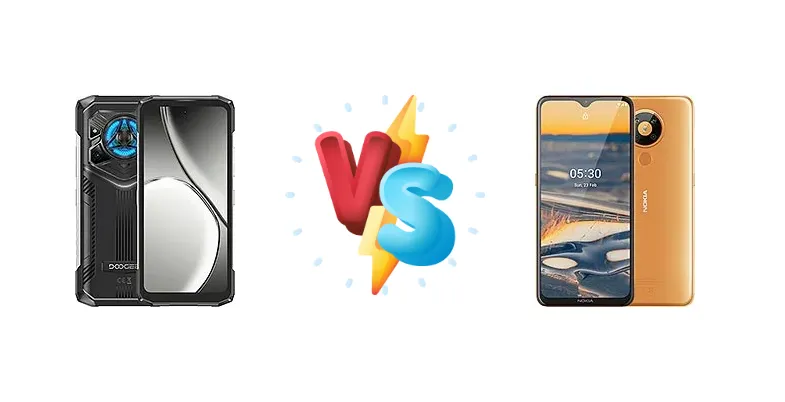
The Doogee Blade20 Play and Nokia 5.3 represent distinct approaches to the budget smartphone market. The Blade20 Play aggressively targets performance with a modern Dimensity 7050 chipset, while the Nokia 5.3 prioritizes a familiar Android experience and a more conservative, efficiency-focused design with the Snapdragon 665. This comparison dissects these choices to determine which phone delivers the best value for different user needs.
🏆 Quick Verdict
For users prioritizing raw performance and fast charging, the Doogee Blade20 Play is the clear winner. Its Dimensity 7050 chipset offers a substantial leap over the Snapdragon 665 in the Nokia 5.3. However, the Nokia 5.3 remains a viable option for those seeking a reliable, long-lasting device with a simpler software experience.
| Network |
|---|
| 2G bands | GSM 850 / 900 / 1800 / 1900 | GSM 850 / 900 / 1800 / 1900 |
| 3G bands | HSDPA 850 / 900 / 1700(AWS) / 1900 / 2100 | HSDPA 850 / 900 / 1900 / 2100 - Global |
| 4G bands | 1, 2, 3, 4, 5, 7, 8, 18, 19, 20, 25, 26, 28, 34, 38, 39, 40, 41, 66 | 1, 3, 5, 7, 8, 20, 28, 38, 40, 41 - Global |
| 5G bands | 1, 3, 7, 8, 28, 38, 41, 77, 78 SA/NSA | - |
| Speed | HSPA, LTE, 5G | HSPA 42.2/5.76 Mbps, LTE Cat4 150/50 Mbps |
| Technology | GSM / HSPA / LTE / 5G | GSM / HSPA / LTE |
| | - | 1, 3, 5, 8, 40, 41 - India |
| Launch |
|---|
| Announced | 2025, May | 2020, March 19. Released 2020, April 02 |
| Status | Available. Released 2025, May | Discontinued |
| Body |
|---|
| Build | - | Glass front (Gorilla Glass 3), plastic back, plastic frame |
| Dimensions | 174 x 81.2 x 15.8 mm (6.85 x 3.20 x 0.62 in) | 164.3 x 76.6 x 8.5 mm (6.47 x 3.02 x 0.33 in) |
| SIM | Nano-SIM + Nano-SIM | · Nano-SIM· Nano-SIM + Nano-SIM |
| Weight | 362 g (12.77 oz) | 185 g (6.53 oz) |
| Display |
|---|
| Protection | Mohs level 6 | Corning Gorilla Glass 3 |
| Resolution | 720 x 1612 pixels, 20:9 ratio (~267 ppi density) | 720 x 1600 pixels, 20:9 ratio (~268 ppi density) |
| Size | 6.6 inches, 104.6 cm2 (~74.1% screen-to-body ratio) | 6.55 inches, 103.6 cm2 (~82.3% screen-to-body ratio) |
| Type | IPS LCD, 90Hz | IPS LCD, 450 nits (typ) |
| Platform |
|---|
| CPU | Octa-core (2x2.6 GHz Cortex-A78 & 6x2.0 GHz Cortex-A55) | Octa-core (4x2.0 GHz Kryo 260 Gold & 4x1.8 GHz Kryo 260 Silver) |
| Chipset | Mediatek Dimensity 7050 (6 nm) | Qualcomm SM6125 Snapdragon 665 (11 nm) |
| GPU | Mali-G68 MC4 | Adreno 610 |
| OS | Android 15 | Android 10, upgradable to Android 11, Android One |
| Memory |
|---|
| Card slot | microSDXC (dedicated slot) | microSDXC (dedicated slot) |
| Internal | 256GB 8GB RAM | 64GB 3GB RAM, 64GB 4GB RAM, 64GB 6GB RAM, 128GB 4GB RAM |
| | - | eMMC 5.1 |
| Main Camera |
|---|
| Dual | 50 MP, f/1.8, (wide), 1/2.5", PDAF
20 MP, f/1.8, (night vision), infrared night vision light | - |
| Features | Dual-LED flash, HDR, panorama | LED flash, HDR, panorama |
| Quad | - | 13 MP, f/1.8, (wide), PDAF
5 MP, 13mm (ultrawide)
2 MP (macro)
Auxiliary lens |
| Video | 4K@30fps, 1080p@30fps | 4K@30fps, 1080p@30fps |
| Selfie camera |
|---|
| Single | 16 MP, f/2.5, (wide), 1/3.1" | 8 MP, f/2.0, (wide) |
| Video | 1080p@30fps | 1080p@30fps |
| Sound |
|---|
| 3.5mm jack | - | Yes |
| 35mm jack | No | Yes |
| Loudspeaker | Yes (125dB, 3.5W peak) | Yes |
| Comms |
|---|
| Bluetooth | 5.2, A2DP, LE | 4.2, A2DP, LE, aptX |
| NFC | Yes | Yes |
| Positioning | GPS, GLONASS, BDS, GALILEO | GPS, GLONASS, BDS |
| Radio | FM radio | FM radio |
| USB | USB Type-C 2.0, OTG | USB Type-C 2.0, OTG |
| WLAN | Wi-Fi 802.11 a/b/g/n/ac/6, dual-band | Wi-Fi 802.11 b/g/n/ac, Wi-Fi Direct |
| Features |
|---|
| Sensors | Fingerprint (side-mounted), accelerometer, proximity, compass | Fingerprint (rear-mounted), accelerometer, proximity |
| Battery |
|---|
| Charging | 33W wired
Reverse wired | 10W wired |
| Type | 10300 mAh | Li-Po 4000 mAh |
| Misc |
|---|
| Colors | Red, Silver | Cyan, Sand, Charcoal |
| Models | - | TA-1234, TA-1223, TA-1227, TA-1229 |
| Price | € 274.99 / $ 221.42 / £ 227.99 | About 290 EUR |
| SAR | - | 1.03 W/kg (head) 0.95 W/kg (body) |
| SAR EU | - | 0.70 W/kg (head) 1.39 W/kg (body) |
| EU LABEL |
|---|
| Battery | 85:58h endurance, 1100 cycles | - |
| Energy | Class C | - |
| Free fall | Class A (270 falls) | - |
| Repairability | Class C | - |
Doogee Blade20 Play
- Significantly faster processor (Dimensity 7050)
- 33W fast charging for quick power-ups
- Long battery life (85-58h endurance)
- High battery cycle count (1100 cycles)
- Potential for more aggressive software customization
- Display specifications unknown, potentially lower quality
Nokia 5.3
- Clean and simple Android experience
- Power-efficient Snapdragon 665 chipset
- Reliable performance for basic tasks
- Potentially lower price point
- Slow 10W charging
- Outdated chipset with limited performance
- Likely lower display quality
Display Comparison
Display specifications are not provided, so a direct comparison is limited. However, given the price points, both devices likely utilize LCD panels. The Nokia 5.3, being an older model, may have lower peak brightness and color accuracy. The Blade20 Play, being newer, *may* benefit from improvements in panel technology, but this is speculative without further data. Bezels are likely comparable, reflecting the budget nature of both phones.
Camera Comparison
Camera details are limited. Without sensor size or aperture information, a detailed comparison is difficult. However, the Nokia 5.3’s camera system is likely to focus on providing reliable image quality in good lighting conditions. The Blade20 Play, while potentially offering higher resolution sensors, may rely more on software processing to enhance image quality. The presence of a 2MP macro camera on either device is unlikely to significantly impact the overall camera experience; these sensors often lack the detail and clarity needed for truly useful macro photography.
Performance
The performance gap between these two devices is significant. The Doogee Blade20 Play’s Mediatek Dimensity 7050 (6nm) is a modern chipset featuring a powerful octa-core configuration with 2x2.6 GHz Cortex-A78 cores and 6x2.0 GHz Cortex-A55 cores. This architecture provides a substantial uplift in CPU and GPU performance compared to the Nokia 5.3’s Qualcomm Snapdragon 665 (11nm). The Snapdragon 665’s Kryo 260 cores, while capable, are older and less efficient. The 6nm process node of the Dimensity 7050 also contributes to better thermal efficiency, potentially reducing throttling during sustained workloads. This translates to smoother multitasking, faster app loading times, and a more enjoyable gaming experience on the Blade20 Play.
Battery Life
The Doogee Blade20 Play boasts an impressive 85-58h endurance rating, suggesting excellent battery life. While the Nokia 5.3’s battery capacity is unknown, its Snapdragon 665 chipset is more power-efficient. However, the Blade20 Play compensates with 33W wired charging, a significant advantage over the Nokia 5.3’s slow 10W charging. The Blade20 Play’s 1100 charge cycles suggest a longer lifespan for the battery, indicating a commitment to long-term durability. The faster charging speed of the Blade20 Play will be a major convenience factor for users who frequently need to top up their battery.
Buying Guide
Buy the Doogee Blade20 Play if you need a phone for demanding tasks like gaming, video editing, or running multiple apps simultaneously, and value the convenience of 33W fast charging. Buy the Nokia 5.3 if you prefer a clean Android experience, prioritize battery endurance over peak performance, and are looking for a dependable daily driver without breaking the bank.
Frequently Asked Questions
❓ Is the Mediatek Dimensity 7050 in the Doogee Blade20 Play capable of running demanding games like Genshin Impact?
Yes, the Dimensity 7050 is a capable chipset for gaming. While it won't deliver flagship-level performance, it should be able to run Genshin Impact at medium settings with playable frame rates. The 6nm process node also helps to mitigate thermal throttling during extended gaming sessions.
❓ How long will it take to fully charge the Doogee Blade20 Play from 0% to 100% with the 33W charger?
With 33W charging, the Doogee Blade20 Play should fully charge from 0% to 100% in approximately 60-75 minutes, a significant improvement over the Nokia 5.3’s 10W charging which could take over 3 hours.
❓ Does the Nokia 5.3 receive regular software updates and security patches?
Nokia is known for providing relatively timely software updates and security patches, even for its budget devices. However, the Nokia 5.3 is an older model, so its update support window may be nearing its end. The Doogee Blade20 Play's update schedule is less predictable.
❓ Is the battery on the Doogee Blade20 Play likely to degrade quickly given its fast charging capabilities?
Not necessarily. The Blade20 Play boasts 1100 charge cycles, indicating a robust battery designed to withstand frequent fast charging. Modern battery management systems also help to minimize degradation by optimizing charging speeds and reducing heat.