
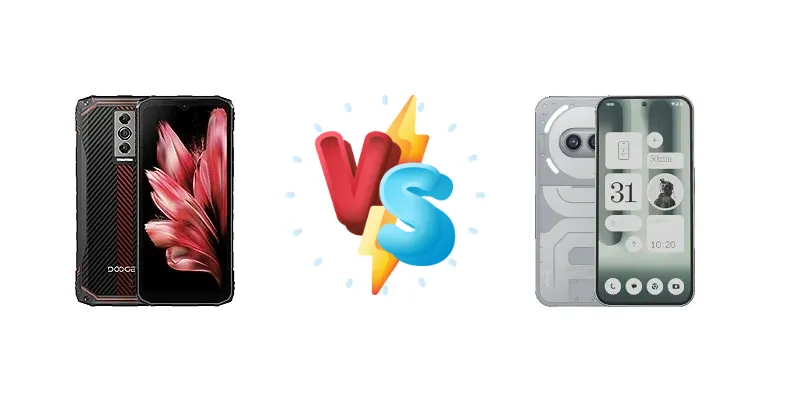
Doogee Blade10 vs Nothing Phone (2a) Plus: A Deep Dive into Value and Performance
| Phones Images | |||||
|---|---|---|---|---|---|
|
🏆 Quick Verdict
For the average user prioritizing a smooth, responsive experience and a brighter display, the Nothing Phone (2a) Plus is the clear winner. Its Mediatek Dimensity 7350 Pro chipset delivers significantly better performance, and the 50W charging is a substantial convenience. However, the Doogee Blade10’s exceptional battery endurance makes it a compelling choice for users who prioritize longevity above all else.
| PHONES | ||
|---|---|---|
| Phone Names | Doogee Blade10 | Nothing Phone (2a) Plus |
| Network | ||
|---|---|---|
| 2G bands | GSM 850 / 900 / 1800 / 1900 | GSM 850 / 900 / 1800 / 1900 |
| 3G bands | HSDPA 850 / 900 / 1700(AWS) / 1900 / 2100 | HSDPA 800 / 850 / 900 / 1700(AWS) / 1900 / 2100 |
| 4G bands | 1, 2, 3, 4, 5, 7, 8, 18, 19, 20, 25, 26, 28, 34, 38, 39, 40, 41, 66 | 1, 3, 4, 5, 7, 8, 18, 19, 20, 26, 28, 38, 39, 40, 41, 42, 66 |
| 5G bands | - | 1, 3, 5, 7, 8, 20, 28, 38, 40, 41, 66, 77, 78 SA/NSA |
| Speed | HSPA, LTE | HSPA, LTE, 5G |
| Technology | GSM / HSPA / LTE | GSM / HSPA / LTE / 5G |
| Launch | ||
|---|---|---|
| Announced | 2024, August | 2024, July 31 |
| Status | Available. Released 2024, September | Available. Released 2024, August 03 |
| Body | ||
|---|---|---|
| Build | - | Glass front (Gorilla Glass 5), plastic frame, plastic back |
| Dimensions | 10.7 mm thickness | 161.7 x 76.3 x 8.5 mm (6.37 x 3.00 x 0.33 in) |
| SIM | Nano-SIM + Nano-SIM | Nano-SIM + Nano-SIM |
| Weight | 240 g (8.47 oz) | 190 g (6.70 oz) |
| Display | ||
|---|---|---|
| Protection | Mohs level 5 | Corning Gorilla Glass 5 |
| Resolution | 720 x 1612 pixels, 20:9 ratio (~269 ppi density) | 1080 x 2412 pixels, 20:9 ratio (~395 ppi density) |
| Size | 6.56 inches, 103.4 cm2 | 6.7 inches, 107.5 cm2 (~87.1% screen-to-body ratio) |
| Type | IPS LCD, 90Hz | AMOLED, 1B colors, 120Hz, 2160Hz PWM, HDR10+, 700 nits (typ), 1100 nits (HBM), 1300 nits (peak) |
| Platform | ||
|---|---|---|
| CPU | Octa-core (2x1.6 GHz Cortex-A75 & 6x1.6 GHz Cortex-A55) | Octa-core (2x3.0 GHz Cortex-A715 & 6x 2.0 GHz Cortex-A510) |
| Chipset | Unisoc T606 (12 nm) | Mediatek Dimensity 7350 Pro (4 nm) |
| GPU | Mali-G57 MP1 | Mali-G610 MC4 |
| OS | Android 14 | Android 14, up to 3 major Android upgrades, Nothing OS 3.0 |
| Memory | ||
|---|---|---|
| Card slot | microSDXC (dedicated slot) | No |
| Internal | 128GB 4GB RAM | 256GB 8GB RAM, 256GB 12GB RAM |
| Main Camera | ||
|---|---|---|
| Dual | - | 50 MP, f/1.9, 24mm (wide), 1/1.57", 1.0µm, PDAF, OIS 50 MP, f/2.2, 114˚ (ultrawide), 1/2.76", 0.64µm |
| Features | LED flash | LED flash, panorama, HDR |
| Single | 16 MP, (wide), AF | - |
| Video | Yes | 4K@30fps, 1080p@60/120fps, gyro-EIS |
| Selfie camera | ||
|---|---|---|
| Features | - | HDR |
| Single | 8 MP, (wide) | 50 MP, f/2.2, (wide), 1/2.76" |
| Video | Yes | 4K@30fps |
| Sound | ||
|---|---|---|
| 35mm jack | No | No |
| Loudspeaker | Yes | Yes, with stereo speakers |
| Comms | ||
|---|---|---|
| Bluetooth | 5.0, A2DP, LE | 5.3, A2DP, LE |
| NFC | Yes | Yes, 360˚ |
| Positioning | GPS, GLONASS, BDS, GALILEO | GPS, GALILEO, GLONASS, BDS, QZSS |
| Radio | Unspecified | No |
| USB | USB Type-C | USB Type-C 2.0, OTG |
| WLAN | Wi-Fi 802.11 a/b/g/n/ac, dual-band | Wi-Fi 802.11 a/b/g/n/ac/6, dual-band, Wi-Fi Direct |
| Features | ||
|---|---|---|
| Sensors | Unspecified | Fingerprint (under display, optical), accelerometer, gyro, proximity, compass |
| Battery | ||
|---|---|---|
| Charging | - | 50W wired, 50% in 21 min, 100% in 56 min |
| Type | 5150 mAh | 5000 mAh |
| Misc | ||
|---|---|---|
| Colors | Black, Camouflage | Black, Grey |
| Models | - | A142P |
| Price | About 170 EUR | € 269.90 / ₹ 22,599 |
| EU LABEL | ||
|---|---|---|
| Battery | 50:50h endurance, 1000 cycles | - |
| Energy | Class B | - |
| Free fall | Class A (270 falls) | - |
| Repairability | Class B | - |
Doogee Blade10
- Exceptional battery endurance (50:50h)
- Potentially lower price point
- 1000 charge cycles promise long-term reliability
- Outdated processor (Unisoc T606)
- Likely lower display quality
- Slower charging speeds
Nothing Phone (2a) Plus
- Powerful Mediatek Dimensity 7350 Pro chipset
- Bright and vibrant display (1097 nits)
- Fast 50W charging (100% in 56 minutes)
- Shorter battery life compared to Doogee Blade10
- Higher price point
- May require more frequent charging
Display Comparison
The Nothing Phone (2a) Plus boasts a significantly brighter display, reaching a measured peak of 1097 nits. This is a crucial advantage for outdoor visibility, a scenario where the Doogee Blade10’s unspecified brightness will likely struggle. While the Blade10’s panel technology isn’t detailed, the (2a) Plus’s brightness and likely higher contrast ratio will provide a more immersive viewing experience. The Nothing Phone (2a) Plus’s display is a clear upgrade for media consumption and everyday use.
Camera Comparison
Without detailed camera specifications for the Doogee Blade10, a direct comparison is difficult. However, the Nothing Phone (2a) Plus is expected to offer a more refined camera experience, leveraging its more powerful image signal processor (ISP) within the Dimensity 7350 Pro. While the Blade10 may suffice for casual snapshots, the (2a) Plus will likely deliver superior image quality, particularly in low-light conditions. We can assume the (2a) Plus will have more advanced image processing capabilities, offering features like better dynamic range and noise reduction.
Performance
The performance gap between these two devices is substantial. The Nothing Phone (2a) Plus’s Mediatek Dimensity 7350 Pro, built on a 4nm process, features a more modern CPU architecture (Cortex-A715 vs A75) and higher clock speeds (2x3.0 GHz vs 2x1.6 GHz). This translates to significantly faster app loading times, smoother multitasking, and a more enjoyable gaming experience. The Unisoc T606 in the Doogee Blade10, while adequate for basic tasks, will show its limitations when pushed with demanding applications. The 4nm fabrication process of the Dimensity 7350 Pro also contributes to better thermal efficiency, reducing the likelihood of performance throttling during extended use.
Battery Life
The Doogee Blade10 claims an impressive 50:50h endurance, suggesting exceptional battery life. This is likely achieved through a combination of a larger battery (unspecified) and the power efficiency of the Unisoc T606 chipset. However, the Nothing Phone (2a) Plus compensates for its 16:34h active use score with significantly faster charging – 50% in 21 minutes and 100% in 56 minutes. This rapid charging capability is a major convenience factor, allowing users to quickly top up their battery when needed. While the Blade10’s longevity is commendable, the (2a) Plus’s charging speed offers a different kind of flexibility.
Buying Guide
Buy the Doogee Blade10 if you need a phone that can reliably last through two full days of moderate use and prioritize battery life over raw processing power. It’s ideal for users who primarily browse, communicate, and occasionally use social media. Buy the Nothing Phone (2a) Plus if you prefer a more modern design, a significantly faster processor for gaming and multitasking, and the convenience of rapid charging. This phone caters to users who demand a smoother, more responsive experience and appreciate a brighter, more vibrant display.