
Doogee Blade10 vs Motorola Edge 40 Neo: A Detailed Comparison
| Phones Images | |||||
|---|---|---|---|---|---|
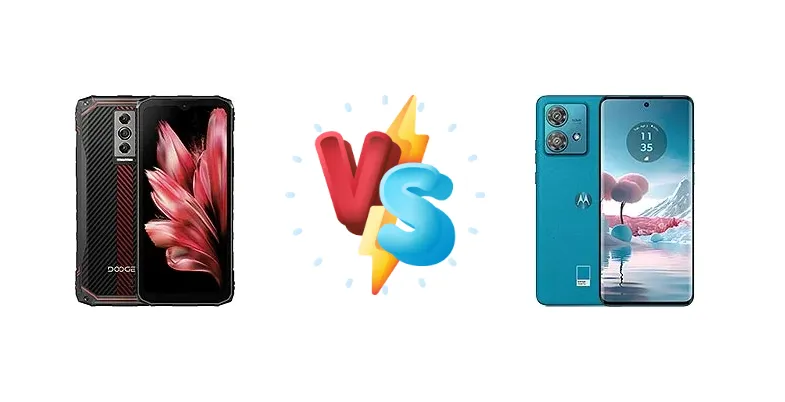
|
🏆 Quick Verdict
For the average user prioritizing a smooth experience and faster charging, the Motorola Edge 40 Neo is the clear winner. Its Dimensity 7030 chipset and 68W charging significantly outperform the Doogee Blade10, justifying the price difference. However, the Blade10 offers impressive battery endurance for its cost.
| PHONES | ||
|---|---|---|
| Phone Names | Doogee Blade10 | Motorola Edge 40 Neo |
| Network | ||
|---|---|---|
| 2G bands | GSM 850 / 900 / 1800 / 1900 | GSM 850 / 900 / 1800 / 1900 |
| 3G bands | HSDPA 850 / 900 / 1700(AWS) / 1900 / 2100 | HSDPA 800 / 850 / 900 / 1700(AWS) / 1900 / 2100 |
| 4G bands | 1, 2, 3, 4, 5, 7, 8, 18, 19, 20, 25, 26, 28, 34, 38, 39, 40, 41, 66 | 1, 2, 3, 4, 5, 7, 8, 12, 13, 17, 18, 19, 20, 25, 26, 28, 32, 38, 38, 39, 40, 41, 42, 43, 48, 66 |
| 5G bands | - | 1, 2, 3, 5, 7, 8, 20, 28, 38, 40, 41, 66, 77, 78 SA/NSA |
| Speed | HSPA, LTE | HSPA, LTE, 5G |
| Technology | GSM / HSPA / LTE | GSM / HSPA / LTE / 5G |
| Launch | ||
|---|---|---|
| Announced | 2024, August | 2023, September 14 |
| Status | Available. Released 2024, September | Available. Released 2023, September 14 |
| Body | ||
|---|---|---|
| Build | - | Glass front (Gorilla Glass 3), plastic frame, plastic back |
| Dimensions | 10.7 mm thickness | 159.6 x 72 x 7.9 mm (6.28 x 2.83 x 0.31 in) |
| SIM | Nano-SIM + Nano-SIM | · Nano-SIM + eSIM· Nano-SIM + Nano-SIM |
| Weight | 240 g (8.47 oz) | 170 g or 172 g (6.00 oz) |
| Display | ||
|---|---|---|
| Protection | Mohs level 5 | Corning Gorilla Glass 3 |
| Resolution | 720 x 1612 pixels, 20:9 ratio (~269 ppi density) | 1080 x 2400 pixels, 20:9 ratio (~402 ppi density) |
| Size | 6.56 inches, 103.4 cm2 | 6.55 inches, 103.6 cm2 (~90.1% screen-to-body ratio) |
| Type | IPS LCD, 90Hz | P-OLED, 1B colors, 144Hz, HDR10+, 1300 nits (peak) |
| Platform | ||
|---|---|---|
| CPU | Octa-core (2x1.6 GHz Cortex-A75 & 6x1.6 GHz Cortex-A55) | Octa-core (2x2.5 GHz Cortex-A78 & 6x2.0 GHz Cortex-A55) |
| Chipset | Unisoc T606 (12 nm) | MediaTek Dimensity 7030 (6 nm) |
| GPU | Mali-G57 MP1 | Mali-G610 MC3 |
| OS | Android 14 | Android 13, up to 2 major Android upgrades |
| Memory | ||
|---|---|---|
| Card slot | microSDXC (dedicated slot) | No |
| Internal | 128GB 4GB RAM | 128GB 8GB RAM, 256GB 8GB RAM, 256GB 12GB RAM |
| Main Camera | ||
|---|---|---|
| Dual | - | 50 MP, f/1.8, (wide), 1/1.55", 1.0µm, multi-directional PDAF, OIS 13 MP, f/2.2, 120˚ (ultrawide), 1/3.0", 1.12µm, PDAF |
| Features | LED flash | LED flash, HDR, panorama |
| Single | 16 MP, (wide), AF | - |
| Video | Yes | 4K@30fps, 1080p@30/60/120/240fps, gyro-EIS |
| Selfie camera | ||
|---|---|---|
| Features | - | HDR |
| Single | 8 MP, (wide) | 32 MP, f/2.4, (wide), 1/3.0", 0.7µm |
| Video | Yes | 4K@30fps, 1080p@30fps |
| Sound | ||
|---|---|---|
| 35mm jack | No | No |
| Loudspeaker | Yes | Yes, with stereo speakers |
| Comms | ||
|---|---|---|
| Bluetooth | 5.0, A2DP, LE | 5.4, A2DP, LE |
| NFC | Yes | Yes |
| Positioning | GPS, GLONASS, BDS, GALILEO | GPS, GLONASS, GALILEO |
| Radio | Unspecified | No |
| USB | USB Type-C | USB Type-C 2.0, OTG |
| WLAN | Wi-Fi 802.11 a/b/g/n/ac, dual-band | Wi-Fi 802.11 a/b/g/n/ac/6e, tri-band, Wi-Fi Direct |
| Features | ||
|---|---|---|
| Sensors | Unspecified | Fingerprint (under display, optical), accelerometer, gyro, proximity, compass |
| Battery | ||
|---|---|---|
| Charging | - | 68W wired, 50% in 15 min |
| Type | 5150 mAh | Li-Po 5000 mAh |
| Misc | ||
|---|---|---|
| Colors | Black, Camouflage | Black, Soothing Sea, Caneel Bay, Peach Fuzz |
| Models | - | XT2307-1 |
| Price | About 170 EUR | $ 299.00 / € 168.73 / ₹ 19,900 |
| EU LABEL | ||
|---|---|---|
| Battery | 50:50h endurance, 1000 cycles | - |
| Energy | Class B | - |
| Free fall | Class A (270 falls) | - |
| Repairability | Class B | - |
Doogee Blade10
- Exceptional battery endurance (claimed 50:50h)
- Long battery lifespan (1000 cycles)
- Extremely affordable price point
- Outdated processor (Unisoc T606)
- Likely lower display quality
- Slow charging speeds (unspecified)
Motorola Edge 40 Neo
- Powerful processor (Dimensity 7030)
- Fast 68W charging (50% in 15 min)
- Bright and vibrant display (1073 nits)
- Higher price than Doogee Blade10
- Shorter battery endurance compared to Blade10 (claimed)
- May require more frequent charging
Display Comparison
The Motorola Edge 40 Neo boasts a significantly brighter display, reaching a measured 1073 nits. This is crucial for outdoor visibility, a clear advantage over the Doogee Blade10, which lacks published brightness data. While the Blade10’s panel specifics are unknown, its price point suggests a less advanced IPS LCD. The Edge 40 Neo’s higher brightness and likely superior color accuracy make it the better choice for media consumption and gaming. We expect the Edge 40 Neo to have a higher contrast ratio as well.
Camera Comparison
Both phones feature 'Photo / Video' capabilities, but details are sparse for the Doogee Blade10. The Motorola Edge 40 Neo likely benefits from MediaTek’s image signal processor (ISP) and potentially more sophisticated software algorithms. While the Blade10 may suffice for casual snapshots, the Edge 40 Neo is expected to deliver superior image quality, particularly in challenging lighting conditions. Without specific sensor details for the Blade10, it’s difficult to assess its capabilities beyond basic functionality. We can assume the Edge 40 Neo will have better video stabilization and dynamic range.
Performance
The performance gap is substantial. The Motorola Edge 40 Neo’s MediaTek Dimensity 7030, built on a 6nm process, features a more modern CPU architecture (2x2.5 GHz Cortex-A78 & 6x2.0 GHz Cortex-A55) compared to the Doogee Blade10’s Unisoc T606 (12nm) with its older Cortex-A75 cores. This translates to faster app loading times, smoother multitasking, and better gaming performance. The 6nm node also contributes to improved thermal efficiency, reducing the likelihood of throttling under sustained load. The Edge 40 Neo is the clear winner for users who demand responsiveness.
Battery Life
The Doogee Blade10 claims a remarkable 50:50h endurance and 1000 charge cycles, suggesting exceptional longevity. However, this is a lab-based metric. The Motorola Edge 40 Neo, with a 10:28h active use score and an older 80h endurance rating, offers a more realistic picture of daily usage. Crucially, the Edge 40 Neo supports 68W wired charging, achieving 50% charge in just 15 minutes – a massive convenience advantage over the Blade10, which lacks fast charging specifications. While the Blade10 may last longer between charges, the Edge 40 Neo’s rapid charging mitigates any potential battery anxiety.
Buying Guide
Buy the Doogee Blade10 if you need a functional smartphone for basic tasks, prioritize exceptional battery life above all else, and are on a very tight budget. Buy the Motorola Edge 40 Neo if you prefer a more responsive user experience, faster charging speeds, a brighter display, and are willing to spend more for a more polished overall package.