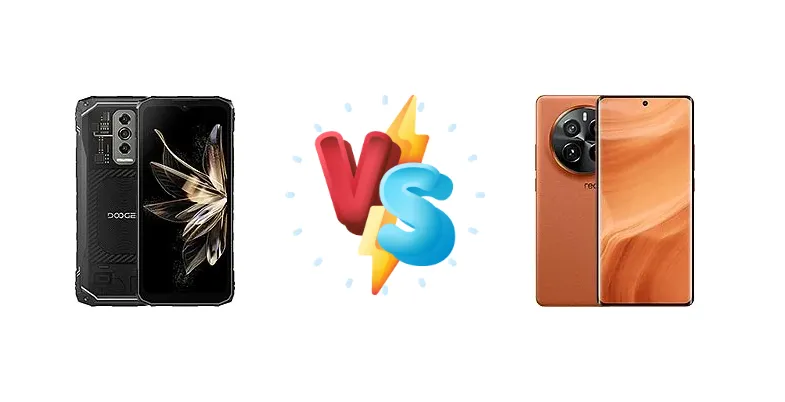
The smartphone landscape is increasingly segmented. The Realme GT5 Pro represents the cutting edge of Android power, boasting the latest Snapdragon chipset and rapid charging. Conversely, the Doogee Blade10 Ultra aims for a different target: maximizing battery life and offering solid functionality at a more accessible price point. This comparison dissects these contrasting philosophies to determine which device best suits your needs.
🏆 Quick Verdict
For users prioritizing raw performance, gaming, and a premium display, the Realme GT5 Pro is the clear winner. However, the Doogee Blade10 Ultra’s exceptional 50-hour battery endurance and 1000-cycle lifespan make it ideal for users who value longevity and minimizing charging frequency above all else.
| Network |
|---|
| 2G bands | GSM 850 / 900 / 1800 / 1900 | GSM 850 / 900 / 1800 / 1900 |
| 3G bands | HSDPA 850 / 900 / 1700(AWS) / 1900 / 2100 | HSDPA 850 / 900 / 2100 |
| 4G bands | 1, 2, 3, 4, 5, 7, 8, 18, 19, 20, 25, 26, 28, 34, 38, 39, 40, 41, 66 | 1, 3, 5, 7, 8, 28, 34, 38, 39, 40, 41 |
| 5G bands | - | 1, 3, 5, 8, 28, 41, 77, 78 SA/NSA |
| Speed | HSPA, LTE | HSPA, LTE, 5G |
| Technology | GSM / HSPA / LTE | GSM / CDMA / HSPA / CDMA2000 / LTE / 5G |
| Launch |
|---|
| Announced | 2024, August | 2023, December 07 |
| Status | Available. Released 2024, September | Available. Released 2023, December 14 |
| Body |
|---|
| Build | - | Glass front, glass back or silicone polymer back (eco leather), aluminum frame |
| Dimensions | 10.7 mm thickness | 161.7 x 75.1 x 9.2 mm (6.37 x 2.96 x 0.36 in) |
| SIM | Nano-SIM + Nano-SIM | Nano-SIM + Nano-SIM |
| Weight | 240 g (8.47 oz) | 218 g / 224 g (7.69 oz) |
| Display |
|---|
| Protection | Corning Gorilla Glass 5, Mohs level 5 | - |
| Resolution | 720 x 1612 pixels, 20:9 ratio (~269 ppi density) | 1264 x 2780 pixels (~450 ppi density) |
| Size | 6.56 inches, 103.4 cm2 | 6.78 inches, 111.7 cm2 (~92.0% screen-to-body ratio) |
| Type | IPS LCD, 90Hz | LTPO AMOLED, 1B colors, 144Hz, HDR10+, Dolby Vision, 4500 nits (peak) |
| Platform |
|---|
| CPU | Octa-core (2x1.6 GHz Cortex-A75 & 6x1.6 GHz Cortex-A55) | Octa-core (1x3.3 GHz Cortex-X4 & 3x3.2 GHz Cortex-A720 & 2x3.0 GHz Cortex-A720 & 2x2.3 GHz Cortex-A520) |
| Chipset | Unisoc T606 (12 nm) | Qualcomm SM8650-AB Snapdragon 8 Gen 3 (4 nm) |
| GPU | Mali-G57 MP1 | Adreno 750 |
| OS | Android 14 | Android 14, upgradable to Android 15, Realme UI 6.0 |
| Memory |
|---|
| Card slot | microSDXC (dedicated slot) | No |
| Internal | 256GB 8GB RAM | 256GB 12GB RAM, 256GB 16GB RAM, 512GB 16GB RAM, 1TB 16GB RAM |
| Main Camera |
|---|
| Features | LED flash | Color spectrum sensor, Dual-LED dual-tone flash, HDR, panorama |
| Single | 50 MP, (wide), AF | - |
| Triple | - | 50 MP, f/1.7, 23mm (wide), 1/1.43", 1.12µm, dual pixel PDAF, OIS
50 MP, f/2.6, 65mm (periscope telephoto), 1/1.56", 1.0µm, multi-directional PDAF, OIS, 2.7x optical zoom
8 MP, f/2.2, 16mm, 112˚ (ultrawide), 1/4.0", 1.12µm |
| Video | Yes | 8K@24fps, 4K@30/60fps, 1080p@30/60fps, gyro-EIS, Dolby Vision |
| Selfie camera |
|---|
| Features | - | HDR, panorama |
| Single | 8 MP, (wide) | 32 MP, f/2.5, 22mm (wide), 1/2.74" |
| Video | Yes | 4K@30fps, 1080p@30fps, gyro-EIS |
| Sound |
|---|
| 35mm jack | No | No |
| Loudspeaker | Yes | Yes, with stereo speakers (Dolby Atmos certified) |
| Comms |
|---|
| Bluetooth | 5.0, A2DP, LE | 5.4, A2DP, LE, aptX HD |
| Infrared port | - | Yes |
| NFC | Yes | Yes, 360˚ |
| Positioning | GPS, GLONASS, BDS, GALILEO | GPS (L1+L5), GLONASS, BDS (B1I+B1c+B2a), GALILEO (E1+E5a), QZSS (L1+L5), NavIC |
| Radio | Unspecified | No |
| USB | USB Type-C | USB Type-C 3.2 |
| WLAN | Wi-Fi 802.11 a/b/g/n/ac, dual-band | Wi-Fi 802.11 a/b/g/n/ac/6/7, tri-band, Wi-Fi Direct |
| Features |
|---|
| Sensors | Fingerprint (side-mounted); unspecified sensors | Fingerprint (under display, optical), accelerometer, gyro, proximity, compass |
| Battery |
|---|
| Charging | - | 100W wired, 50% in 12 min
50W wireless |
| Type | 5150 mAh | Li-Ion 5400 mAh |
| Misc |
|---|
| Colors | Black | Black, Silver, Orange |
| Models | - | RMX3888 |
| Price | About 230 EUR | About 430 EUR |
| EU LABEL |
|---|
| Battery | 50:50h endurance, 1000 cycles | - |
| Energy | Class B | - |
| Free fall | Class A (270 falls) | - |
| Repairability | Class B | - |
Doogee Blade10 Ultra
- Exceptional 50-hour battery life
- 1000-cycle battery lifespan for long-term reliability
- More affordable price point
- Significantly weaker performance compared to the GT5 Pro
- Likely lower quality display
Realme GT5 Pro
- Blazing-fast Snapdragon 8 Gen 3 performance
- High brightness display (1660 nits)
- Ultra-fast 100W wired and 50W wireless charging
- Shorter battery life compared to the Blade10 Ultra
- Higher price tag
Display Comparison
The Realme GT5 Pro’s display is a significant advantage, boasting a measured peak brightness of 1660 nits. This ensures excellent visibility even in direct sunlight, a feature the Doogee Blade10 Ultra likely lacks given its market positioning. While the Blade10 Ultra’s display specifications are not provided, it’s reasonable to assume a lower peak brightness and potentially a less advanced panel technology. The GT5 Pro’s higher brightness translates to a more vibrant and immersive viewing experience, particularly for HDR content.
Camera Comparison
The Realme GT5 Pro is expected to feature a sophisticated camera system, though specific details are missing. However, given its flagship status, it likely includes features like Optical Image Stabilization (OIS) and advanced image processing algorithms. The Doogee Blade10 Ultra’s camera specifications are not detailed, suggesting a more basic setup. While both phones likely offer photo and video capabilities, the GT5 Pro will almost certainly deliver superior image quality, particularly in low-light conditions and when recording video. The absence of details on the Doogee suggests a focus on functional, rather than exceptional, photography.
Performance
The performance gap between these devices is substantial. The Realme GT5 Pro’s Qualcomm Snapdragon 8 Gen 3 (4nm) is a powerhouse, featuring an octa-core configuration with a prime Cortex-X4 core clocked at 3.3 GHz. This contrasts sharply with the Doogee Blade10 Ultra’s Unisoc T606 (12nm) chipset, which utilizes older Cortex-A75 and A55 cores clocked at 1.6 GHz. The 4nm process node of the Snapdragon 8 Gen 3 offers significantly improved power efficiency and thermal performance, allowing for sustained peak performance during demanding tasks like gaming. The GT5 Pro will handle graphically intensive games and applications with ease, while the Blade10 Ultra will likely struggle with more complex titles.
Battery Life
The Doogee Blade10 Ultra’s standout feature is its exceptional battery endurance, rated at 50:50h. This is significantly longer than the Realme GT5 Pro’s active use score of 14:16h. However, the GT5 Pro compensates with incredibly fast charging: 100W wired charging can replenish 50% of the battery in just 12 minutes, and 50W wireless charging provides a convenient alternative. The Blade10 Ultra’s charging speed is not specified, but is likely considerably slower. The Blade10 Ultra prioritizes longevity, while the GT5 Pro prioritizes quick top-ups.
Buying Guide
Buy the Doogee Blade10 Ultra if you need a phone that can reliably last two full days on a single charge, and prioritize battery health over demanding applications. You'll appreciate its simplicity and focus on core functionality. Buy the Realme GT5 Pro if you prefer a flagship experience with blazing-fast performance for gaming, content creation, and everyday multitasking, and are willing to charge your phone more frequently to unlock that power.
Frequently Asked Questions
❓ How does the Unisoc T606 in the Doogee Blade10 Ultra handle demanding games like Genshin Impact?
The Unisoc T606 is a budget-focused chipset. While it can run less demanding games, Genshin Impact will likely require significantly reduced graphics settings and may still experience noticeable frame rate drops. It's not designed for high-end gaming.
❓ Is the 100W charging on the Realme GT5 Pro likely to degrade the battery health quickly?
While fast charging can theoretically contribute to battery degradation over the long term, Realme employs charging algorithms designed to mitigate this effect. The GT5 Pro’s charging system is expected to intelligently manage the charging process to minimize heat and stress on the battery.
❓ What type of display technology does the Realme GT5 Pro use (e.g., AMOLED, LTPO)?
While not explicitly stated in the provided data, Realme flagships typically utilize AMOLED displays with high refresh rates. It's highly probable the GT5 Pro features an AMOLED panel, and potentially LTPO technology for variable refresh rate and improved power efficiency.
❓ Does the Doogee Blade10 Ultra support software updates beyond the initial release?
Doogee’s software update track record is less consistent than brands like Realme. While the Blade10 Ultra will likely receive security patches, major Android version updates are less guaranteed. This is a common trade-off for more affordable devices.