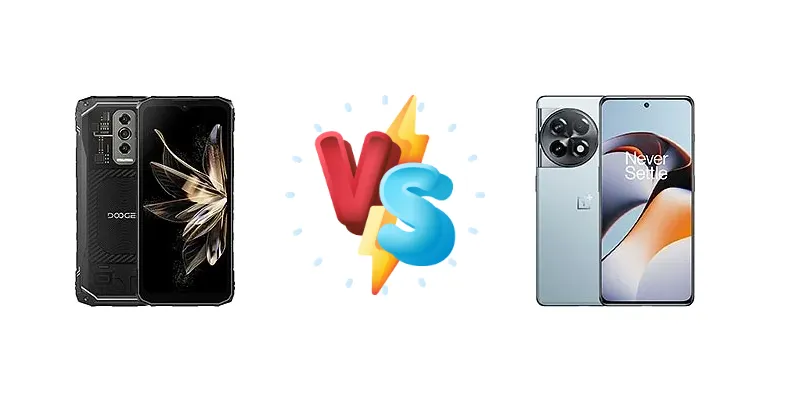
The smartphone market is crowded with options, but finding the right balance between price and performance can be challenging. We pit the Doogee Blade10 Ultra, a budget-focused device emphasizing endurance, against the OnePlus 11R, a former flagship offering substantial power at a more accessible price point. This comparison will dissect their core components to determine which phone best suits your needs.
🏆 Quick Verdict
For the average user prioritizing raw performance and fast charging, the OnePlus 11R is the clear winner. Its Snapdragon 8+ Gen 1 chipset delivers a significantly smoother experience for demanding tasks and gaming. However, the Doogee Blade10 Ultra offers impressive battery endurance and a lower price, making it a viable option for those on a tight budget.
| Network |
|---|
| 2G bands | GSM 850 / 900 / 1800 / 1900 | GSM 850 / 900 / 1800 / 1900 |
| 3G bands | HSDPA 850 / 900 / 1700(AWS) / 1900 / 2100 | HSDPA 850 / 900 / 1700(AWS) / 2100 |
| 4G bands | 1, 2, 3, 4, 5, 7, 8, 18, 19, 20, 25, 26, 28, 34, 38, 39, 40, 41, 66 | 1, 3, 4, 5, 8, 28, 34, 38, 39, 40, 41 |
| 5G bands | - | 1, 3, 5, 8, 28, 40, 41, 77, 78 SA/NSA |
| Speed | HSPA, LTE | HSPA, LTE (3CA), 5G |
| Technology | GSM / HSPA / LTE | GSM / CDMA / HSPA / LTE / 5G |
| | - | CDMA 800 |
| Launch |
|---|
| Announced | 2024, August | 2023, February 07 |
| Status | Available. Released 2024, September | Available. Released 2023, February 21 |
| Body |
|---|
| Build | - | Glass front, glass back (Gorilla Glass 5), plastic frame |
| Dimensions | 10.7 mm thickness | 163.4 x 74.3 x 8.7 mm (6.43 x 2.93 x 0.34 in) |
| SIM | Nano-SIM + Nano-SIM | Nano-SIM + Nano-SIM |
| Weight | 240 g (8.47 oz) | 204 g (7.20 oz) |
| Display |
|---|
| Protection | Corning Gorilla Glass 5, Mohs level 5 | - |
| Resolution | 720 x 1612 pixels, 20:9 ratio (~269 ppi density) | 1240 x 2772 pixels, 20:9 ratio (~451 ppi density) |
| Size | 6.56 inches, 103.4 cm2 | 6.74 inches, 109.2 cm2 (~90.0% screen-to-body ratio) |
| Type | IPS LCD, 90Hz | Fluid AMOLED, 1B colors, 120Hz, HDR10+, 1450 nits (peak) |
| Platform |
|---|
| CPU | Octa-core (2x1.6 GHz Cortex-A75 & 6x1.6 GHz Cortex-A55) | Octa-core (1x3.0 GHz Cortex-X2 & 3x2.5 GHz Cortex-A710 & 4x1.80 GHz Cortex-A510) |
| Chipset | Unisoc T606 (12 nm) | Qualcomm SM8475 Snapdragon 8+ Gen 1 (4 nm) |
| GPU | Mali-G57 MP1 | Adreno 730 |
| OS | Android 14 | Android 13, upgradable to Android 15, OxygenOS 15 |
| Memory |
|---|
| Card slot | microSDXC (dedicated slot) | No |
| Internal | 256GB 8GB RAM | 128GB 8GB RAM, 256GB 16GB RAM, 512GB 18GB RAM |
| | - | UFS 3.1 |
| Main Camera |
|---|
| Features | LED flash | Color spectrum sensor, LED flash, HDR, panorama |
| Single | 50 MP, (wide), AF | 16 MP, f/2.4, 24mm (wide), 1/3.09", 1.0µm |
| Triple | - | 50 MP, f/1.8, 24mm (wide), 1/1.56", 1.0µm, multi-directional PDAF, OIS
8 MP, f/2.2, 120˚ (ultrawide), 1/4.0", 1.12µm
2 MP (macro) |
| Video | Yes | 4K@30/60fps, 1080p@30/60/240fps, gyro-EIS |
| Selfie camera |
|---|
| Features | - | HDR |
| Single | 8 MP, (wide) | 16 MP, f/2.4, 24mm (wide), 1/3.09", 1.0µm |
| Video | Yes | 1080p@30fps |
| Sound |
|---|
| 3.5mm jack | - | No |
| 35mm jack | No | No |
| Loudspeaker | Yes | Yes, with stereo speakers |
| | - | 24-bit/192kHz audio |
| Comms |
|---|
| Bluetooth | 5.0, A2DP, LE | 5.3, A2DP, LE, aptX HD |
| Infrared port | - | Yes |
| NFC | Yes | Yes |
| Positioning | GPS, GLONASS, BDS, GALILEO | GPS (L1+L5), GLONASS (G1), BDS (B1I+B1c+B2a), GALILEO (E1+E5a), QZSS (L1+L5) |
| Radio | Unspecified | No |
| USB | USB Type-C | USB Type-C 2.0 |
| WLAN | Wi-Fi 802.11 a/b/g/n/ac, dual-band | Wi-Fi 802.11 a/b/g/n/ac/6, dual-band |
| Features |
|---|
| Sensors | Fingerprint (side-mounted); unspecified sensors | Fingerprint (under display, optical), accelerometer, gyro, proximity, compass |
| Battery |
|---|
| Charging | - | 100W wired |
| Type | 5150 mAh | Li-Po 5000 mAh |
| Misc |
|---|
| Colors | Black | Galactic Silver, Sonic Black, Solar Red |
| Models | - | CPH2487 |
| Price | About 230 EUR | About 600 EUR |
| SAR | - | 1.16 W/kg (head) 0.61 W/kg (body) |
| EU LABEL |
|---|
| Battery | 50:50h endurance, 1000 cycles | - |
| Energy | Class B | - |
| Free fall | Class A (270 falls) | - |
| Repairability | Class B | - |
Doogee Blade10 Ultra
- Exceptional battery endurance (50:50h)
- Long-lasting battery health (1000 charge cycles)
- More affordable price point
- Significantly lower performance
- Likely a less impressive display
- Limited camera capabilities
OnePlus 11R
- Flagship-level performance (Snapdragon 8+ Gen 1)
- Ultra-fast 100W charging
- Superior display quality (AMOLED)
- Potentially shorter battery lifespan compared to Doogee
- Higher price tag
- May require more frequent charging
Display Comparison
While display specifications aren't provided for the Doogee Blade10 Ultra, it's reasonable to assume a standard LCD panel given its price point. The OnePlus 11R, however, benefits from a more advanced AMOLED display, likely offering superior contrast and color accuracy. The absence of LTPO technology on the 11R means it won't dynamically adjust refresh rates for maximum efficiency, but the panel's inherent characteristics will still provide a more visually appealing experience. Bezels are likely to be more pronounced on the Doogee, contributing to a less immersive viewing experience.
Camera Comparison
Without detailed camera specifications for the Doogee Blade10 Ultra, a direct comparison is limited. However, given its price bracket, it likely features a basic camera setup focused on everyday snapshots. The OnePlus 11R, while not boasting a top-tier camera system, benefits from a more sophisticated image processing pipeline and potentially larger sensor sizes. The Snapdragon 8+ Gen 1’s ISP (Image Signal Processor) contributes to better dynamic range and noise reduction. We can expect the OnePlus 11R to deliver more consistent and detailed images, particularly in challenging lighting conditions. The presence of OIS (Optical Image Stabilization) on the OnePlus 11R would further enhance image quality and video stability.
Performance
The performance gap between these two devices is substantial. The OnePlus 11R’s Qualcomm SM8475 Snapdragon 8+ Gen 1 (4nm) is a flagship-level chipset featuring a Cortex-X2 prime core clocked at 3.0 GHz, supported by Cortex-A710 and A510 cores. This architecture, built on a 4nm process, delivers significantly higher CPU and GPU performance compared to the Doogee’s Unisoc T606 (12nm). The T606, with its Cortex-A75 and A55 cores, is designed for efficiency and basic tasks. The 4nm node of the Snapdragon 8+ Gen 1 offers superior thermal efficiency, meaning less throttling during sustained workloads like gaming. Users who play graphically intensive games or frequently multitask will find the OnePlus 11R a far more capable device.
Battery Life
The Doogee Blade10 Ultra boasts a 50:50h endurance rating and a claimed 1000 charge cycles, highlighting its focus on longevity. While the OnePlus 11R’s battery capacity isn’t specified, its 100W wired charging is a game-changer. This allows for a full charge in a remarkably short time, mitigating any potential capacity disadvantage. The Doogee’s endurance rating suggests it can comfortably last a full day, but the OnePlus 11R’s fast charging provides a level of convenience the Doogee cannot match. The 12nm process of the Unisoc T606 contributes to better power efficiency, but the Snapdragon 8+ Gen 1’s optimizations and the 11R’s charging speed ultimately provide a more versatile battery experience.
Buying Guide
Buy the Doogee Blade10 Ultra if you need a phone that can reliably last through a full day (and potentially beyond) on a single charge, and your primary use cases are basic communication, social media, and light web browsing. You'll appreciate the extended battery lifespan and 1000 charge cycles. Buy the OnePlus 11R if you prioritize a responsive user experience, enjoy mobile gaming, and value the convenience of incredibly fast 100W charging. The Snapdragon 8+ Gen 1 provides a substantial performance uplift for demanding applications.
Frequently Asked Questions
❓ Is the Unisoc T606 chipset in the Doogee Blade10 Ultra capable of handling demanding games like Genshin Impact?
While the Unisoc T606 can run less demanding games, Genshin Impact and similar titles will likely require significant graphical settings reductions and may still experience noticeable lag. The chipset's focus is on efficiency, not raw gaming performance.
❓ How long does it actually take to fully charge the OnePlus 11R with the 100W charger?
OnePlus claims the 11R can charge from 1-100% in around 25 minutes with the 100W SuperVOOC charger. Real-world results may vary slightly depending on usage and ambient temperature, but it remains exceptionally fast.
❓ Does the OnePlus 11R get noticeably hot during extended gaming sessions?
The Snapdragon 8+ Gen 1 is known for its thermal efficiency, but prolonged gaming will inevitably generate heat. The OnePlus 11R incorporates cooling solutions to mitigate throttling, but some warmth is expected. It's less prone to overheating than older Snapdragon 8 Gen 1 devices.
❓ What type of storage does the Doogee Blade10 Ultra use, and is it expandable?
Unfortunately, storage specifications for the Doogee Blade10 Ultra are not available. However, budget smartphones often utilize eMMC storage, which is slower than UFS. Expandability via microSD card is common in this segment, but confirmation is needed.