
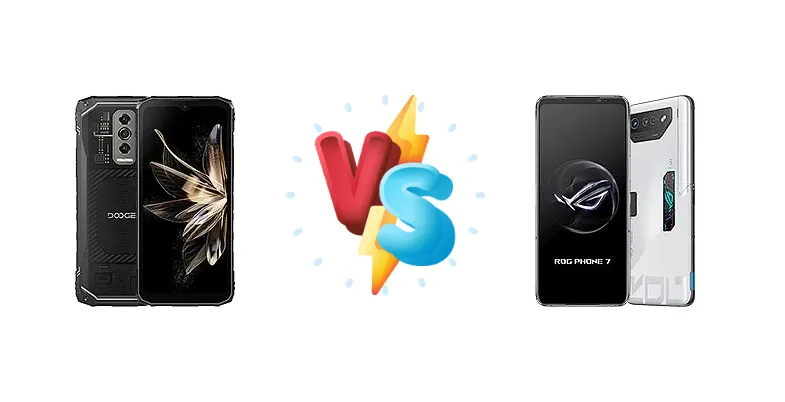
Asus ROG Phone 7 Ultimate vs. Doogee Blade10 Ultra: A Clash of Priorities
| Phones Images | |||||
|---|---|---|---|---|---|
|
🏆 Quick Verdict
For dedicated mobile gamers, the Asus ROG Phone 7 Ultimate is the clear winner, delivering unmatched performance and a superior display. However, the Doogee Blade10 Ultra provides exceptional battery endurance and a compelling value proposition for users prioritizing longevity and affordability over raw power.
| PHONES | ||
|---|---|---|
| Phone Names | Doogee Blade10 Ultra | Asus ROG Phone 7 Ultimate |
| Network | ||
|---|---|---|
| 2G bands | GSM 850 / 900 / 1800 / 1900 | GSM 850 / 900 / 1800 / 1900 |
| 3G bands | HSDPA 850 / 900 / 1700(AWS) / 1900 / 2100 | HSDPA 800 / 850 / 900 / 1700(AWS) / 1900 / 2100 |
| 4G bands | 1, 2, 3, 4, 5, 7, 8, 18, 19, 20, 25, 26, 28, 34, 38, 39, 40, 41, 66 | 1, 2, 3, 4, 5, 7, 8, 12, 17, 18, 19, 20, 25, 26, 28, 32, 34, 38, 39, 40, 41, 42, 43, 48, 66 - International |
| 5G bands | - | 1, 2, 3, 5, 7, 8, 12, 18, 20, 25, 26, 28, 38, 40, 41, 48, 66, 77, 78, 79 SA/NSA/Sub6 - International |
| Speed | HSPA, LTE | HSPA, LTE (Up to 7CA), 5G |
| Technology | GSM / HSPA / LTE | GSM / CDMA / HSPA / LTE / 5G |
| - | 1, 3, 5, 8, 28, 41, 77, 78, 79 SA/NSA/Sub6 - China | |
| Launch | ||
|---|---|---|
| Announced | 2024, August | 2023, April 13 |
| Status | Available. Released 2024, September | Available. Released 2023, May |
| Body | ||
|---|---|---|
| Build | - | Glass front (Gorilla Glass Victus), glass back (Gorilla Glass 3), aluminum frame |
| Dimensions | 10.7 mm thickness | 173 x 77 x 10.3 mm (6.81 x 3.03 x 0.41 in) |
| SIM | Nano-SIM + Nano-SIM | Nano-SIM + Nano-SIM |
| Weight | 240 g (8.47 oz) | 239 g (8.43 oz) |
| - | Built-in motorized cooling air vent (AeroActive Portal) IP54 water resistant 2" OLED display (on the back) Pressure sensitive zones (Gaming triggers) | |
| Display | ||
|---|---|---|
| Protection | Corning Gorilla Glass 5, Mohs level 5 | Corning Gorilla Glass Victus |
| Resolution | 720 x 1612 pixels, 20:9 ratio (~269 ppi density) | 1080 x 2448 pixels (~395 ppi density) |
| Size | 6.56 inches, 103.4 cm2 | 6.78 inches, 109.5 cm2 (~82.2% screen-to-body ratio) |
| Type | IPS LCD, 90Hz | AMOLED, 1B colors, 165Hz, HDR10+, 1000 nits (HBM), 1500 nits (peak) |
| Platform | ||
|---|---|---|
| CPU | Octa-core (2x1.6 GHz Cortex-A75 & 6x1.6 GHz Cortex-A55) | Octa-core (1x3.2 GHz Cortex-X3 & 2x2.8 GHz Cortex-A715 & 2x2.8 GHz Cortex-A710 & 3x2.0 GHz Cortex-A510) |
| Chipset | Unisoc T606 (12 nm) | Qualcomm SM8550-AB Snapdragon 8 Gen 2 (4 nm) |
| GPU | Mali-G57 MP1 | Adreno 740 |
| OS | Android 14 | Android 13, up to 2 major Android upgrades |
| Memory | ||
|---|---|---|
| Card slot | microSDXC (dedicated slot) | No |
| Internal | 256GB 8GB RAM | 512GB 16GB RAM |
| - | UFS 4.0 NTFS support for external storage | |
| Main Camera | ||
|---|---|---|
| Features | LED flash | LED flash, HDR, panorama |
| Single | 50 MP, (wide), AF | - |
| Triple | - | 50 MP, f/1.9, 24mm (wide), 1/1.56", 1.0µm, PDAF 13 MP, f/2.2, 13mm, 120˚ (ultrawide) 5 MP (macro) |
| Video | Yes | 8K@24fps, 4K@30/60fps, 1080p@30/60/120/240fps, 720p@480fps; gyro-EIS, HDR10+ |
| Selfie camera | ||
|---|---|---|
| Features | - | Panorama, HDR |
| Single | 8 MP, (wide) | 32 MP, f/2.5, 29mm (wide), 1/3.2", 0.7µm |
| Video | Yes | 1080p@30fps |
| Sound | ||
|---|---|---|
| 3.5mm jack | - | Yes |
| 35mm jack | No | Yes |
| Loudspeaker | Yes | Yes, with stereo speakers (2 amplifiers) |
| - | 32-bit/384kHz audio | |
| Comms | ||
|---|---|---|
| Bluetooth | 5.0, A2DP, LE | 5.3, A2DP, LE, aptX HD, aptX Adaptive, aptX Lossless |
| NFC | Yes | Yes |
| Positioning | GPS, GLONASS, BDS, GALILEO | GPS (L1+L5), GLONASS (L1), BDS (B1I+B1c+B2a), GALILEO (E1+E5a), QZSS (L1+L5), NavIC (L5) |
| Radio | Unspecified | No |
| USB | USB Type-C | USB Type-C 3.1 (side), DisplayPort 1.4; USB Type-C 2.0 (bottom), OTG, accessory connector |
| WLAN | Wi-Fi 802.11 a/b/g/n/ac, dual-band | Wi-Fi 802.11 a/b/g/n/ac/6e/7, tri-band, Wi-Fi Direct |
| Features | ||
|---|---|---|
| Sensors | Fingerprint (side-mounted); unspecified sensors | Fingerprint (under display, optical), accelerometer, gyro, proximity, compass |
| Battery | ||
|---|---|---|
| Charging | - | 65W wired, PD3.0, QC5, 100% in 42 min 10W reverse wired |
| Type | 5150 mAh | Li-Po 6000 mAh |
| Misc | ||
|---|---|---|
| Colors | Black | Storm White |
| Price | About 230 EUR | About 780 EUR |
| Tests | ||
|---|---|---|
| Battery life | - | Endurance rating 131h |
| Camera | - | Photo / Video |
| Display | - | Contrast ratio: Infinite (nominal) |
| Loudspeaker | - | -25.5 LUFS (Very good) |
| Performance | - | AnTuTu: 1325105 (v9) GeekBench: 5139 (v5.5), 5567 (v6) GFXBench: 107fps (ES 3.1 onscreen) |
| EU LABEL | ||
|---|---|---|
| Battery | 50:50h endurance, 1000 cycles | - |
| Energy | Class B | - |
| Free fall | Class A (270 falls) | - |
| Repairability | Class B | - |
Doogee Blade10 Ultra
- Exceptional battery life (50:50h endurance)
- High battery cycle count (1000 cycles)
- Affordable price point
- Significantly weaker performance compared to the ROG Phone
- Likely inferior display quality
Asus ROG Phone 7 Ultimate
- Unmatched gaming performance (Snapdragon 8 Gen 2)
- Bright and vibrant display (1095 nits)
- Fast 65W charging
- Shorter battery life under heavy load
- Higher price tag
Display Comparison
The Asus ROG Phone 7 Ultimate’s display is a standout feature, reaching a measured peak brightness of 1095 nits. This ensures excellent visibility even in direct sunlight. While the Blade10 Ultra’s display specifications are not provided, it’s reasonable to assume it falls significantly behind in brightness and likely lacks the ROG Phone’s advanced features like a high refresh rate. The ROG Phone’s infinite (nominal) contrast ratio further enhances visual fidelity, offering deeper blacks and more vibrant colors. The ROG Phone’s display is geared towards immersive gaming, while the Blade10 Ultra likely prioritizes power efficiency.
Camera Comparison
Both devices offer photo and video capabilities, but details are limited. The ROG Phone 7 Ultimate, being a flagship, likely features a sophisticated camera system with advanced image processing. The Blade10 Ultra’s camera specifications are unknown, but given its price point, it’s unlikely to compete with the ROG Phone in terms of image quality or features. Without specific sensor sizes or aperture information, it’s difficult to make a precise comparison, but the ROG Phone’s camera is expected to deliver superior results in various lighting conditions.
Performance
The performance gap between these devices is substantial. The Asus ROG Phone 7 Ultimate is powered by the Qualcomm Snapdragon 8 Gen 2 (4nm), an octa-core processor featuring a Cortex-X3 prime core clocked at 3.2 GHz. This architecture, built on a 4nm process, delivers exceptional performance and efficiency. In contrast, the Doogee Blade10 Ultra utilizes the Unisoc T606 (12nm) chipset, with a less powerful octa-core configuration (2x1.6 GHz Cortex-A75 & 6x1.6 GHz Cortex-A55). The Snapdragon 8 Gen 2’s superior architecture and smaller process node translate to significantly faster processing speeds, smoother multitasking, and a far more capable gaming experience. The ROG Phone will handle demanding titles at maximum settings, while the Blade10 Ultra will struggle with graphically intensive games.
Battery Life
Battery life is where the Doogee Blade10 Ultra shines. Its claimed 50:50h endurance rating and 1000 cycle lifespan suggest exceptional longevity. The Asus ROG Phone 7 Ultimate, despite having a 131h endurance rating, is likely to drain faster under heavy gaming loads due to its power-hungry processor and display. The ROG Phone compensates with 65W wired charging (PD3.0, QC5) achieving 100% charge in 42 minutes, and 10W reverse wired charging. The Blade10 Ultra’s charging speed is not specified, but it’s likely to be slower. The Blade10 Ultra prioritizes long-term battery health and extended usage between charges, while the ROG Phone offers faster replenishment when needed.
Buying Guide
Buy the Doogee Blade10 Ultra if you need a phone that lasts for days on a single charge, prioritize affordability, and primarily use your device for basic tasks like calling, texting, and light social media. Buy the Asus ROG Phone 7 Ultimate if you demand the highest possible gaming performance, require a vibrant and responsive display, and are willing to pay a premium for a feature-packed mobile gaming experience.