
Doogee Blade10 Pro vs Xiaomi 13T Pro: A Deep Dive into Performance and Value
| Phones Images | |||||
|---|---|---|---|---|---|
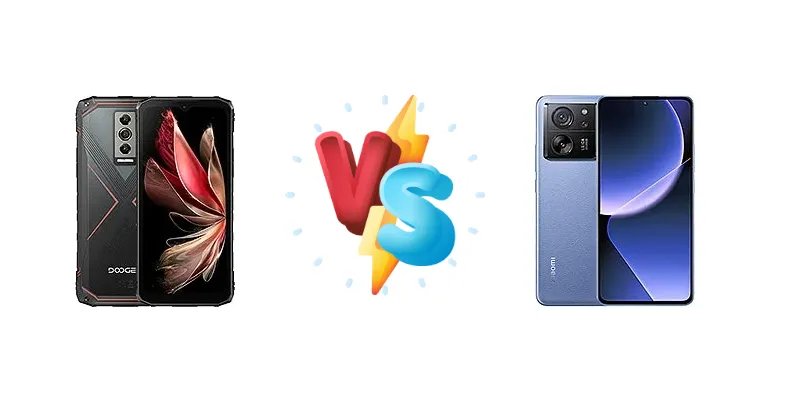
|
🏆 Quick Verdict
For the average user prioritizing raw performance and fast charging, the Xiaomi 13T Pro is the clear winner. Its Dimensity 9200+ chipset delivers significantly faster processing speeds and superior gaming capabilities. However, the Doogee Blade10 Pro offers impressive battery endurance and a lower price point, making it a viable option for those on a tight budget.
| PHONES | ||
|---|---|---|
| Phone Names | Doogee Blade10 Pro | Xiaomi 13T Pro |
| Network | ||
|---|---|---|
| 2G bands | GSM 850 / 900 / 1800 / 1900 | GSM 850 / 900 / 1800 / 1900 |
| 3G bands | HSDPA 850 / 900 / 1700(AWS) / 1900 / 2100 | HSDPA 800 / 850 / 900 / 1700(AWS) / 1900 / 2100 |
| 4G bands | 1, 2, 3, 4, 5, 7, 8, 18, 19, 20, 25, 26, 28, 34, 38, 39, 40, 41, 66 | 1, 2, 3, 4, 5, 7, 8, 12, 13, 17, 18, 19, 20, 25, 26, 28, 32, 38, 39, 40, 41, 42, 48, 66 |
| 5G bands | - | 1, 3, 5, 7, 8, 20, 28, 38, 40, 41, 66, 75, 77, 78 SA/NSA |
| Speed | HSPA, LTE | HSPA, LTE, 5G |
| Technology | GSM / HSPA / LTE | GSM / HSPA / LTE / 5G |
| Launch | ||
|---|---|---|
| Announced | 2024, August | 2023, September 26 |
| Status | Available. Released 2024, September | Available. Released 2023, September 26 |
| Body | ||
|---|---|---|
| Build | - | Glass front (Gorilla Glass 5), glass back or silicone polymer back, plastic frame |
| Dimensions | 10.7 mm thickness | 162.2 x 75.7 x 8.5 mm (6.39 x 2.98 x 0.33 in) |
| SIM | Nano-SIM + Nano-SIM | · Nano-SIM + eSIM· Nano-SIM + Nano-SIM |
| Weight | 240 g (8.47 oz) | 200 g or 206 g (7.05 oz) |
| Display | ||
|---|---|---|
| Protection | Corning Gorilla Glass 5, Mohs level 5 | Corning Gorilla Glass 5 |
| Resolution | 720 x 1612 pixels, 20:9 ratio (~269 ppi density) | 1220 x 2712 pixels, 20:9 ratio (~446 ppi density) |
| Size | 6.56 inches, 103.4 cm2 | 6.67 inches, 107.4 cm2 (~87.5% screen-to-body ratio) |
| Type | IPS LCD, 90Hz | AMOLED, 68B colors, 144Hz, Dolby Vision, HDR10+, 1200 nits (HBM), 2600 nits (peak) |
| Platform | ||
|---|---|---|
| CPU | Octa-core (2x1.6 GHz Cortex-A75 & 6x1.6 GHz Cortex-A55) | Octa-core (1x3.35 GHz Cortex-X3 & 3x3.0 GHz Cortex-A715 & 4x2.0 GHz Cortex-A510) |
| Chipset | Unisoc T606 (12 nm) | Mediatek Dimensity 9200+ (4 nm) |
| GPU | Mali-G57 MP1 | Immortalis-G715 MC11 |
| OS | Android 14 | Android 13, up to 4 major Android upgrades, HyperOS |
| Memory | ||
|---|---|---|
| Card slot | microSDXC (dedicated slot) | No |
| Internal | 256GB 6GB RAM | 256GB 12GB RAM, 512GB 12GB RAM, 1TB 16GB RAM |
| Main Camera | ||
|---|---|---|
| Features | LED flash | Leica lens, color spectrum sensor, LED flash, HDR, panorama |
| Single | 50 MP, (wide), AF | - |
| Triple | - | 50 MP, f/1.9, 24mm (wide), 1/1.28", 1.22µm, PDAF, OIS 50 MP, f/1.9, 50mm (telephoto), 1/2.88", 0.61µm, PDAF, 2x optical zoom 12 MP, f/2.2, 15mm (ultrawide), 1/3.06", 1.12µm |
| Video | Yes | 8K@24fps, 4K@24/30/60fps, 4K/1080p@30fps HDR10+, 1080p@30/60/120/240fps; 10-bit LOG, gyro-EIS |
| Selfie camera | ||
|---|---|---|
| Features | - | HDR |
| Single | 8 MP, (wide) | 20 MP, f/2.2, (wide), 0.8µm |
| Video | Yes | 1080p@30fps, HDR10+ |
| Sound | ||
|---|---|---|
| 35mm jack | No | No |
| Loudspeaker | Yes | Yes, with stereo speakers |
| Comms | ||
|---|---|---|
| Bluetooth | 5.0, A2DP, LE | 5.4, A2DP, LE |
| Infrared port | - | Yes |
| NFC | Yes | Yes |
| Positioning | GPS, GLONASS, BDS, GALILEO | GPS (L1+L5), GLONASS (G1), GALILEO (E1+E5a), NavIC (L5), BDS |
| Radio | Unspecified | No |
| USB | USB Type-C | USB Type-C 2.0, OTG |
| WLAN | Wi-Fi 802.11 a/b/g/n/ac, dual-band | Wi-Fi 802.11 a/b/g/n/ac/6e/7, dual/tri-band (market/region dependent), Wi-Fi Direct |
| Features | ||
|---|---|---|
| Sensors | Unspecified | Fingerprint (under display, optical), accelerometer, gyro, proximity, compass |
| Battery | ||
|---|---|---|
| Charging | - | 120W wired, PD3.0, QC4, 100% in 19 min |
| Type | 5150 mAh | Li-Po 5000 mAh |
| Misc | ||
|---|---|---|
| Colors | Black, Camouflage | Alpine Blue, Meadow Green, Black |
| Models | - | 23078PND5G |
| Price | About 190 EUR | $ 370.00 / £ 482.55 / € 301.99 |
| SAR EU | - | 1.00 W/kg (head) 0.99 W/kg (body) |
| EU LABEL | ||
|---|---|---|
| Battery | 50:50h endurance, 1000 cycles | - |
| Energy | Class B | - |
| Free fall | Class A (270 falls) | - |
| Repairability | Class B | - |
Doogee Blade10 Pro
- Exceptional battery endurance (50:50h)
- Long-term battery health (1000 cycles)
- More affordable price point
- Significantly slower performance
- Outdated chipset (Unisoc T606)
- Likely inferior camera quality
Xiaomi 13T Pro
- Blazing-fast performance (Dimensity 9200+)
- Ultra-fast 120W charging (0-100% in 19 min)
- Bright and vibrant display (1094 nits)
- Shorter battery endurance compared to Doogee
- Higher price tag
- Potential for thermal throttling under sustained load
Display Comparison
The Xiaomi 13T Pro boasts a significantly brighter display, reaching a measured peak of 1094 nits, compared to an unspecified brightness for the Doogee Blade10 Pro. This higher brightness translates to better visibility outdoors under direct sunlight. While the Blade10 Pro’s display specs are unknown, the 13T Pro’s panel likely benefits from a higher refresh rate and potentially LTPO technology, contributing to smoother animations and improved power efficiency. The 13T Pro’s superior display quality is a key advantage for media consumption and gaming.
Camera Comparison
The Xiaomi 13T Pro’s camera system is expected to be far more versatile and capable, though specific details are missing. The focus should be on the main sensor and image processing capabilities. While the Blade10 Pro likely includes a camera, its performance will be limited by the chipset’s image signal processor (ISP). The 13T Pro’s ISP, integrated within the Dimensity 9200+, offers advanced features like HDR processing and noise reduction, resulting in higher-quality photos and videos. The absence of details regarding the Blade10 Pro’s camera suggests it’s not a primary selling point.
Performance
The performance gap between these two devices is substantial. The Xiaomi 13T Pro’s Mediatek Dimensity 9200+ (4nm) chipset, featuring a Cortex-X3 prime core clocked at 3.35 GHz, is in a different league than the Doogee Blade10 Pro’s Unisoc T606 (12nm). The Dimensity 9200+’s more advanced architecture and smaller fabrication node deliver significantly higher CPU and GPU performance, resulting in faster app loading times, smoother multitasking, and a far superior gaming experience. The Blade10 Pro’s Cortex-A75 cores, while capable, are several generations behind and will struggle with demanding tasks. The 13T Pro’s LPDDR5X RAM further enhances performance, while the Blade10 Pro’s RAM specification is unknown.
Battery Life
The Xiaomi 13T Pro offers a compelling combination of battery life and charging speed. While its active use endurance is rated at 11:50h, its 120W wired charging capability allows for a full charge in just 19 minutes. The Doogee Blade10 Pro, on the other hand, boasts a 50:50h endurance rating, suggesting exceptional longevity. However, its charging speed is unspecified and likely significantly slower. The Blade10 Pro’s 1000 cycle battery claim indicates a focus on long-term battery health, but the 13T Pro’s faster charging mitigates the inconvenience of more frequent charging.
Buying Guide
Buy the Doogee Blade10 Pro if you need a reliable, long-lasting phone for basic tasks like calling, texting, and light social media use, and prioritize battery life above all else. Buy the Xiaomi 13T Pro if you prefer a smoother, faster experience for demanding applications, gaming, and content creation, and value rapid charging and a brighter display.