
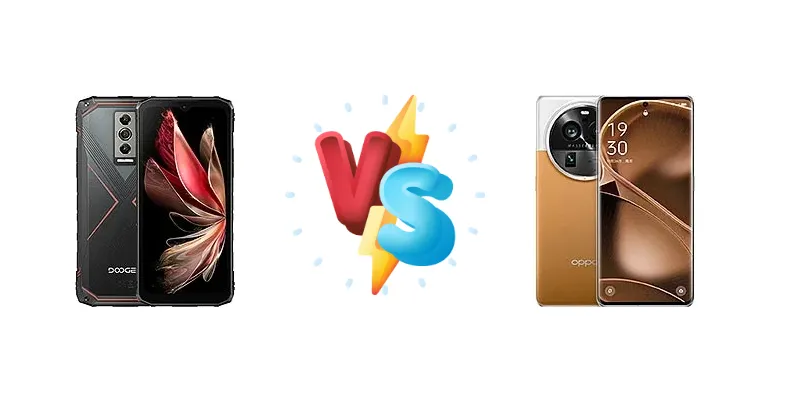
Doogee Blade10 Pro vs Oppo Find X6 Pro: A Deep Dive into Value and Performance
| Phones Images | |||||
|---|---|---|---|---|---|
|
🏆 Quick Verdict
For the average user prioritizing raw power, camera capabilities, and a premium experience, the Oppo Find X6 Pro is the clear winner. However, the Doogee Blade10 Pro presents a compelling case for those seeking exceptional battery endurance and a significantly lower price point, making it ideal for minimalists and infrequent users.
| PHONES | ||
|---|---|---|
| Phone Names | Doogee Blade10 Pro | Oppo Find X6 Pro |
| Network | ||
|---|---|---|
| 2G bands | GSM 850 / 900 / 1800 / 1900 | GSM 850 / 900 / 1800 / 1900 |
| 3G bands | HSDPA 850 / 900 / 1700(AWS) / 1900 / 2100 | HSDPA 800 / 850 / 900 / 1700(AWS) / 1900 / 2100 |
| 4G bands | 1, 2, 3, 4, 5, 7, 8, 18, 19, 20, 25, 26, 28, 34, 38, 39, 40, 41, 66 | 1, 2, 3, 4, 5, 7, 8, 12, 17, 18, 19, 20, 26, 28, 34, 38, 39, 40, 41, 66 |
| 5G bands | - | 1, 3, 5, 7, 8, 20, 28, 38, 40, 41, 66, 77, 78, 79 SA/NSA |
| Speed | HSPA, LTE | HSPA, LTE, 5G |
| Technology | GSM / HSPA / LTE | GSM / CDMA / HSPA / CDMA2000 / LTE / 5G |
| - | CDMA2000 1x | |
| Launch | ||
|---|---|---|
| Announced | 2024, August | 2023, March 21 |
| Status | Available. Released 2024, September | Available. Released 2023, March 24 |
| Body | ||
|---|---|---|
| Build | - | Glass front (Gorilla Glass Victus 2), glass back (Gorilla Glass 5) or eco leather back, aluminum frame |
| Dimensions | 10.7 mm thickness | 164.8 x 76.2 x 9.1 mm or 9.5 mm |
| SIM | Nano-SIM + Nano-SIM | Nano-SIM + Nano-SIM |
| Weight | 240 g (8.47 oz) | 216 g or 218 g (7.62 oz) |
| - | IP68 dust/water resistant (up to 1.5m for 30 min) | |
| Display | ||
|---|---|---|
| Protection | Corning Gorilla Glass 5, Mohs level 5 | Corning Gorilla Glass Victus 2 |
| Resolution | 720 x 1612 pixels, 20:9 ratio (~269 ppi density) | 1440 x 3168 pixels (~510 ppi density) |
| Size | 6.56 inches, 103.4 cm2 | 6.82 inches, 113.0 cm2 (~90.0% screen-to-body ratio) |
| Type | IPS LCD, 90Hz | LTPO3 AMOLED, 1B colors, 120Hz, Dolby Vision, HDR10+, 800 nits (typ), 1500 nits (HBM), 2500 nits (peak) |
| Platform | ||
|---|---|---|
| CPU | Octa-core (2x1.6 GHz Cortex-A75 & 6x1.6 GHz Cortex-A55) | Octa-core (1x3.2 GHz Cortex-X3 & 2x2.8 GHz Cortex-A715 & 2x2.8 GHz Cortex-A710 & 3x2.0 GHz Cortex-A510) |
| Chipset | Unisoc T606 (12 nm) | Qualcomm SM8550-AB Snapdragon 8 Gen 2 (4 nm) |
| GPU | Mali-G57 MP1 | Adreno 740 |
| OS | Android 14 | Android 13, up to 4 major Android upgrades, ColorOS 14 |
| Memory | ||
|---|---|---|
| Card slot | microSDXC (dedicated slot) | No |
| Internal | 256GB 6GB RAM | 256GB 12GB RAM, 256GB 16GB RAM, 512GB 16GB RAM |
| - | UFS 4.0 | |
| Main Camera | ||
|---|---|---|
| Features | LED flash | Laser AF, color spectrum sensor, Hasselblad Color Calibration, LED flash, HDR, panorama |
| Single | 50 MP, (wide), AF | - |
| Triple | - | 50 MP, f/1.8, 23mm (wide), 1.0"-type, 1.6µm, dual pixel PDAF, OIS 50 MP, f/2.6, 65mm (periscope telephoto), 1/1.56", 1.0µm, 2.8x optical zoom, multi-directional PDAF, OIS 50 MP, f/2.2, 15mm, 110˚ (ultrawide), 1/1.56", 1.0µm, multi-directional PDAF |
| Video | Yes | 4K@30/60fps, 1080p@30/60/240fps; gyro-EIS; HDR, 10‑bit video, Dolby Vision |
| Selfie camera | ||
|---|---|---|
| Features | - | Panorama |
| Single | 8 MP, (wide) | 32 MP, f/2.4, 21mm (wide), 1/2.74", 0.8µm, PDAF |
| Video | Yes | 4K@30fps, gyro-EIS |
| Sound | ||
|---|---|---|
| 3.5mm jack | - | No |
| 35mm jack | No | No |
| Loudspeaker | Yes | Yes, with stereo speakers |
| Comms | ||
|---|---|---|
| Bluetooth | 5.0, A2DP, LE | 5.3, A2DP, LE, aptX HD |
| Infrared port | - | Yes |
| NFC | Yes | Yes |
| Positioning | GPS, GLONASS, BDS, GALILEO | GPS (L1+L5), GLONASS (G1), BDS (B1I+B1c+B2a), GALILEO (E1+E5a), QZSS (L1+L5) |
| Radio | Unspecified | No |
| USB | USB Type-C | USB Type-C 3.1, OTG |
| WLAN | Wi-Fi 802.11 a/b/g/n/ac, dual-band | Wi-Fi 802.11 a/b/g/n/ac/6e/7, tri-band, Wi-Fi Direct |
| Features | ||
|---|---|---|
| Sensors | Unspecified | Fingerprint (under display, optical), accelerometer, gyro, proximity, compass |
| Battery | ||
|---|---|---|
| Charging | - | 100W wired, PD, 45% in 10 min, 100% in 30 min 50W wireless, 50% in 22 min, 100% in 51 min 10W reverse wireless |
| Type | 5150 mAh | Li-Po 5000 mAh |
| Misc | ||
|---|---|---|
| Colors | Black, Camouflage | Black, Green, Brown |
| Models | - | PGEM110, PGEM10 |
| Price | About 190 EUR | About 820 EUR |
| Tests | ||
|---|---|---|
| Battery life | - | Endurance rating 114h |
| Camera | - | Photo / Video |
| Display | - | Contrast ratio: Infinite (nominal) |
| Loudspeaker | - | -25.1 LUFS (Very good) |
| Performance | - | AnTuTu: 1294797 (v9) GeekBench: 4791 (v5.1), 5226 (v6) GFXBench: 60fps (ES 3.1 onscreen) |
| EU LABEL | ||
|---|---|---|
| Battery | 50:50h endurance, 1000 cycles | - |
| Energy | Class B | - |
| Free fall | Class A (270 falls) | - |
| Repairability | Class B | - |
Doogee Blade10 Pro
- Exceptional battery life (50:50h endurance)
- High charge cycle count (1000 cycles)
- Significantly lower price point
- Substantially weaker processor (Unisoc T606)
- Likely inferior display quality
- Basic camera system
Oppo Find X6 Pro
- Flagship-level performance (Snapdragon 8 Gen 2)
- Ultra-fast charging (100W wired, 50W wireless)
- Superior display quality (1318 nits brightness)
- Higher price tag
- Potentially shorter battery lifespan compared to Doogee
- May require more frequent charging
Display Comparison
The Oppo Find X6 Pro boasts a significantly more advanced display experience. While the Doogee Blade10 Pro’s display specifications are not provided, the Find X6 Pro reaches a measured peak brightness of 1318 nits, ensuring excellent visibility even in direct sunlight. The Find X6 Pro’s infinite (nominal) contrast ratio further enhances image quality. The absence of detailed display specs for the Doogee suggests a more basic panel, likely lacking the color accuracy and brightness of the Oppo.
Camera Comparison
Both devices feature photo and video capabilities, but the Oppo Find X6 Pro is expected to offer a far superior imaging experience. While specific sensor details are missing for both, Oppo’s flagship typically incorporates large, high-resolution sensors with advanced image processing algorithms and optical image stabilization (OIS). The Doogee Blade10 Pro, positioned as a budget device, likely utilizes more basic camera hardware. The absence of details suggests a focus on functionality over photographic excellence.
Performance
The performance gap between these two devices is substantial. The Oppo Find X6 Pro’s Qualcomm Snapdragon 8 Gen 2 (4nm) chipset, featuring an octa-core CPU with a Cortex-X3 prime core clocked at 3.2 GHz, delivers flagship-level performance. This contrasts sharply with the Doogee Blade10 Pro’s Unisoc T606 (12nm) chipset, which utilizes a more modest octa-core configuration with Cortex-A75 and A55 cores clocked at 1.6 GHz. The 4nm process node of the Snapdragon 8 Gen 2 offers superior power efficiency and thermal management, minimizing throttling during sustained workloads, a benefit crucial for gamers and power users. The Doogee will be sufficient for basic tasks, but will struggle with demanding applications.
Battery Life
The Doogee Blade10 Pro prioritizes battery endurance with a claimed 50:50h usage time and 1000 charge cycles, suggesting a focus on long-term reliability. The Oppo Find X6 Pro, despite a reported 114h endurance rating, compensates with incredibly fast charging capabilities: 100W wired (0-100% in 30 minutes) and 50W wireless (0-100% in 51 minutes). The Doogee’s slower charging, while not specified, will likely take considerably longer. The Oppo’s reverse wireless charging (10W) adds further versatility, allowing it to charge other devices.
Buying Guide
Buy the Doogee Blade10 Pro if you need a phone that can reliably last through multiple days on a single charge, prioritize affordability above all else, and primarily use your phone for basic communication and light tasks. Buy the Oppo Find X6 Pro if you demand the fastest possible performance for gaming and demanding applications, require a top-tier camera system, and appreciate features like incredibly fast charging and a vibrant, high-brightness display.