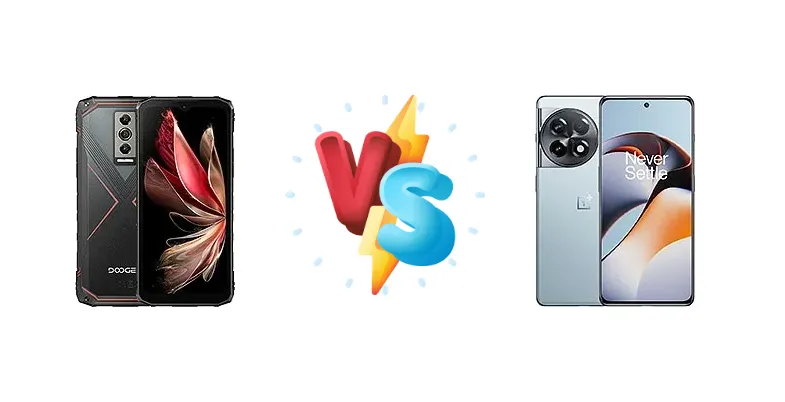
The smartphone market is flooded with options, but finding the right balance between price and performance can be challenging. We pit the Doogee Blade10 Pro, a budget-focused device emphasizing endurance, against the OnePlus 11R, a performance-oriented phone boasting rapid charging and a flagship-level chipset. This comparison will dissect their strengths and weaknesses to help you make an informed decision.
🏆 Quick Verdict
For the average user prioritizing raw speed and responsiveness, the OnePlus 11R is the clear winner. Its Snapdragon 8+ Gen 1 chipset delivers significantly superior performance. However, the Doogee Blade10 Pro offers impressive battery endurance and a lower price point, making it a viable option for those on a tight budget.
| Network |
|---|
| 2G bands | GSM 850 / 900 / 1800 / 1900 | GSM 850 / 900 / 1800 / 1900 |
| 3G bands | HSDPA 850 / 900 / 1700(AWS) / 1900 / 2100 | HSDPA 850 / 900 / 1700(AWS) / 2100 |
| 4G bands | 1, 2, 3, 4, 5, 7, 8, 18, 19, 20, 25, 26, 28, 34, 38, 39, 40, 41, 66 | 1, 3, 4, 5, 8, 28, 34, 38, 39, 40, 41 |
| 5G bands | - | 1, 3, 5, 8, 28, 40, 41, 77, 78 SA/NSA |
| Speed | HSPA, LTE | HSPA, LTE (3CA), 5G |
| Technology | GSM / HSPA / LTE | GSM / CDMA / HSPA / LTE / 5G |
| | - | CDMA 800 |
| Launch |
|---|
| Announced | 2024, August | 2023, February 07 |
| Status | Available. Released 2024, September | Available. Released 2023, February 21 |
| Body |
|---|
| Build | - | Glass front, glass back (Gorilla Glass 5), plastic frame |
| Dimensions | 10.7 mm thickness | 163.4 x 74.3 x 8.7 mm (6.43 x 2.93 x 0.34 in) |
| SIM | Nano-SIM + Nano-SIM | Nano-SIM + Nano-SIM |
| Weight | 240 g (8.47 oz) | 204 g (7.20 oz) |
| Display |
|---|
| Protection | Corning Gorilla Glass 5, Mohs level 5 | - |
| Resolution | 720 x 1612 pixels, 20:9 ratio (~269 ppi density) | 1240 x 2772 pixels, 20:9 ratio (~451 ppi density) |
| Size | 6.56 inches, 103.4 cm2 | 6.74 inches, 109.2 cm2 (~90.0% screen-to-body ratio) |
| Type | IPS LCD, 90Hz | Fluid AMOLED, 1B colors, 120Hz, HDR10+, 1450 nits (peak) |
| Platform |
|---|
| CPU | Octa-core (2x1.6 GHz Cortex-A75 & 6x1.6 GHz Cortex-A55) | Octa-core (1x3.0 GHz Cortex-X2 & 3x2.5 GHz Cortex-A710 & 4x1.80 GHz Cortex-A510) |
| Chipset | Unisoc T606 (12 nm) | Qualcomm SM8475 Snapdragon 8+ Gen 1 (4 nm) |
| GPU | Mali-G57 MP1 | Adreno 730 |
| OS | Android 14 | Android 13, upgradable to Android 15, OxygenOS 15 |
| Memory |
|---|
| Card slot | microSDXC (dedicated slot) | No |
| Internal | 256GB 6GB RAM | 128GB 8GB RAM, 256GB 16GB RAM, 512GB 18GB RAM |
| | - | UFS 3.1 |
| Main Camera |
|---|
| Features | LED flash | Color spectrum sensor, LED flash, HDR, panorama |
| Single | 50 MP, (wide), AF | 16 MP, f/2.4, 24mm (wide), 1/3.09", 1.0µm |
| Triple | - | 50 MP, f/1.8, 24mm (wide), 1/1.56", 1.0µm, multi-directional PDAF, OIS
8 MP, f/2.2, 120˚ (ultrawide), 1/4.0", 1.12µm
2 MP (macro) |
| Video | Yes | 4K@30/60fps, 1080p@30/60/240fps, gyro-EIS |
| Selfie camera |
|---|
| Features | - | HDR |
| Single | 8 MP, (wide) | 16 MP, f/2.4, 24mm (wide), 1/3.09", 1.0µm |
| Video | Yes | 1080p@30fps |
| Sound |
|---|
| 3.5mm jack | - | No |
| 35mm jack | No | No |
| Loudspeaker | Yes | Yes, with stereo speakers |
| | - | 24-bit/192kHz audio |
| Comms |
|---|
| Bluetooth | 5.0, A2DP, LE | 5.3, A2DP, LE, aptX HD |
| Infrared port | - | Yes |
| NFC | Yes | Yes |
| Positioning | GPS, GLONASS, BDS, GALILEO | GPS (L1+L5), GLONASS (G1), BDS (B1I+B1c+B2a), GALILEO (E1+E5a), QZSS (L1+L5) |
| Radio | Unspecified | No |
| USB | USB Type-C | USB Type-C 2.0 |
| WLAN | Wi-Fi 802.11 a/b/g/n/ac, dual-band | Wi-Fi 802.11 a/b/g/n/ac/6, dual-band |
| Features |
|---|
| Sensors | Unspecified | Fingerprint (under display, optical), accelerometer, gyro, proximity, compass |
| Battery |
|---|
| Charging | - | 100W wired |
| Type | 5150 mAh | Li-Po 5000 mAh |
| Misc |
|---|
| Colors | Black, Camouflage | Galactic Silver, Sonic Black, Solar Red |
| Models | - | CPH2487 |
| Price | About 190 EUR | About 600 EUR |
| SAR | - | 1.16 W/kg (head) 0.61 W/kg (body) |
| EU LABEL |
|---|
| Battery | 50:50h endurance, 1000 cycles | - |
| Energy | Class B | - |
| Free fall | Class A (270 falls) | - |
| Repairability | Class B | - |
Doogee Blade10 Pro
- Exceptional battery endurance (50:50h)
- Long battery lifespan (1000 cycles)
- More affordable price point
- Significantly weaker performance
- Likely lower quality display
- Limited camera capabilities
OnePlus 11R
- Flagship-level performance (Snapdragon 8+ Gen 1)
- Ultra-fast 100W charging
- Superior display quality (AMOLED)
- Potentially shorter battery lifespan compared to Doogee
- Higher price tag
- May require more frequent charging
Display Comparison
While display specifications aren't provided for the Doogee Blade10 Pro, it's reasonable to assume a standard LCD panel given its price point. The OnePlus 11R, however, benefits from a more advanced AMOLED display, likely offering superior contrast and color accuracy. The absence of LTPO technology in the 11R means it won't dynamically adjust refresh rates for power saving like some flagships, but the panel quality itself is a significant advantage. Bezels are likely to be more pronounced on the Doogee, impacting the overall viewing experience.
Camera Comparison
Without detailed camera specs for the Doogee Blade10 Pro, a direct comparison is limited. However, given its price bracket, it likely features a basic camera setup focused on everyday snapshots. The OnePlus 11R, while not boasting a top-tier camera system, benefits from a more sophisticated image processing pipeline and potentially larger sensor sizes. The absence of information regarding OIS on the Doogee suggests it will struggle in low-light conditions compared to a phone with optical image stabilization. We can assume the OnePlus 11R will deliver more detailed and dynamic range in most scenarios.
Performance
The performance gap between these two devices is substantial. The OnePlus 11R’s Qualcomm SM8475 Snapdragon 8+ Gen 1 (4nm) is a flagship-tier chipset featuring a Cortex-X2 prime core clocked at 3.0 GHz, supported by Cortex-A710 and A510 cores. This architecture, built on a 4nm process, delivers significantly higher CPU and GPU performance compared to the Doogee’s Unisoc T606 (12nm). The T606, with its Cortex-A75 and A55 cores, is designed for efficiency and basic tasks, not demanding gaming or multitasking. The 4nm process of the Snapdragon 8+ Gen 1 also translates to better thermal efficiency, reducing the likelihood of throttling during sustained workloads. Users who play graphically intensive games or edit videos will find the OnePlus 11R far more capable.
Battery Life
The Doogee Blade10 Pro claims a 50:50h endurance rating and 1000 charge cycles, highlighting its focus on longevity. While the OnePlus 11R’s battery capacity isn’t specified, its 100W wired charging is a game-changer. This allows for a full charge in a remarkably short time, mitigating the impact of a potentially smaller battery. The Doogee’s slower charging speed means a significantly longer time plugged into the wall. The 1000 cycle claim on the Doogee is impressive, suggesting a longer lifespan before battery degradation, but the OnePlus 11R’s rapid charging offers convenience and reduces range anxiety.
Buying Guide
Buy the Doogee Blade10 Pro if you need a phone that can reliably last through a full day (and potentially longer) on a single charge, and your primary use cases are basic communication, social media, and light web browsing. You'll appreciate the extended battery lifespan and lower upfront cost. Buy the OnePlus 11R if you prioritize gaming, demanding applications, and fast charging. The Snapdragon 8+ Gen 1 provides a smooth, responsive experience, and the 100W charging ensures minimal downtime.
Frequently Asked Questions
❓ Is the Unisoc T606 chipset in the Doogee Blade10 Pro sufficient for playing modern mobile games?
The Unisoc T606 is an entry-level chipset. While it can handle less demanding games, it will struggle with graphically intensive titles like Genshin Impact or Call of Duty: Mobile, even on lower settings. Expect noticeable frame drops and lag.
❓ How long does it actually take to fully charge the OnePlus 11R with the 100W charger?
OnePlus claims the 11R can charge from 1-100% in around 25 minutes with the 100W SUPERVOOC charger. This is a significant advantage over the Doogee Blade10 Pro, which will likely take several hours to fully charge.
❓ Does the OnePlus 11R get excessively hot during prolonged gaming sessions?
The Snapdragon 8+ Gen 1 is known for its thermal efficiency, but it can still generate heat under heavy load. The OnePlus 11R incorporates cooling solutions to mitigate this, but some warming is expected during extended gaming. It's unlikely to reach uncomfortable temperatures, but performance throttling is possible.
❓ What type of storage does the Doogee Blade10 Pro use, and is it expandable?
Unfortunately, storage specifications for the Doogee Blade10 Pro are not available. However, budget phones often utilize eMMC storage, which is slower than UFS. Expandability via microSD card is likely, but not confirmed.