
Doogee Blade10 Pro vs Honor Magic5 Pro: A Deep Dive into Value and Performance
| Phones Images | |||||
|---|---|---|---|---|---|
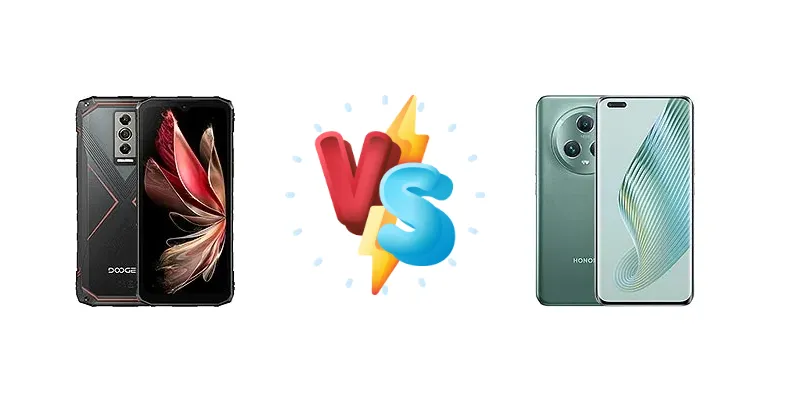
|
🏆 Quick Verdict
For the average user prioritizing long-term battery life and affordability, the Doogee Blade10 Pro is the clear winner. However, if you demand uncompromising performance, a superior camera system, and fast charging, the Honor Magic5 Pro justifies its higher price tag with a significantly more powerful experience.
| PHONES | ||
|---|---|---|
| Phone Names | Doogee Blade10 Pro | Honor Magic5 Pro |
| Network | ||
|---|---|---|
| 2G bands | GSM 850 / 900 / 1800 / 1900 | GSM 850 / 900 / 1800 / 1900 |
| 3G bands | HSDPA 850 / 900 / 1700(AWS) / 1900 / 2100 | HSDPA 800 / 850 / 900 / 1700(AWS) / 1900 / 2100 |
| 4G bands | 1, 2, 3, 4, 5, 7, 8, 18, 19, 20, 25, 26, 28, 34, 38, 39, 40, 41, 66 | 1, 2, 3, 4, 5, 7, 8, 12, 17, 18, 19, 20, 26, 28, 34, 38, 39, 40, 41 - China |
| 5G bands | - | 1, 3, 5, 8, 28, 38, 41, 77, 78, 79 SA/NSA - China |
| Speed | HSPA, LTE | HSPA, LTE, 5G |
| Technology | GSM / HSPA / LTE | GSM / CDMA / HSPA / EVDO / LTE / 5G |
| - | CDMA2000 1xEV-DO | |
| Launch | ||
|---|---|---|
| Announced | 2024, August | 2023, February 27 |
| Status | Available. Released 2024, September | Available. Released 2023, March 31 |
| Body | ||
|---|---|---|
| Build | - | Glass front, glass back or eco leather back |
| Dimensions | 10.7 mm thickness | 162.9 x 76.7 x 8.8 mm (6.41 x 3.02 x 0.35 in) |
| SIM | Nano-SIM + Nano-SIM | · Nano-SIM + eSIM· Nano-SIM + Nano-SIM + eSIM (max 2 at a time) |
| Weight | 240 g (8.47 oz) | 219 g (7.72 oz) |
| - | IP68 dust/water resistant (up to 1.5m for 30 min) | |
| Display | ||
|---|---|---|
| Protection | Corning Gorilla Glass 5, Mohs level 5 | - |
| Resolution | 720 x 1612 pixels, 20:9 ratio (~269 ppi density) | 1312 x 2848 pixels, 19.5:9 ratio (~460 ppi density) |
| Size | 6.56 inches, 103.4 cm2 | 6.81 inches, 113.7 cm2 (~91.0% screen-to-body ratio) |
| Type | IPS LCD, 90Hz | LTPO OLED, 1B colors, 120Hz, HDR10+, 1800 nits (peak) |
| Platform | ||
|---|---|---|
| CPU | Octa-core (2x1.6 GHz Cortex-A75 & 6x1.6 GHz Cortex-A55) | Octa-core (1x3.2 GHz Cortex-X3 & 2x2.8 GHz Cortex-A715 & 2x2.8 GHz Cortex-A710 & 3x2.0 GHz Cortex-A510) |
| Chipset | Unisoc T606 (12 nm) | Qualcomm SM8550-AB Snapdragon 8 Gen 2 (4 nm) |
| GPU | Mali-G57 MP1 | Adreno 740 |
| OS | Android 14 | Android 13, upgradable to Android 14, MagicOS 8 |
| Memory | ||
|---|---|---|
| Card slot | microSDXC (dedicated slot) | No |
| Internal | 256GB 6GB RAM | 256GB 8GB RAM, 256GB 12GB RAM, 512GB 12GB RAM, 512GB 16GB RAM |
| - | UFS 4.0 | |
| Main Camera | ||
|---|---|---|
| Features | LED flash | Laser AF, color spectrum sensor, LED flash, HDR, panorama |
| Single | 50 MP, (wide), AF | 12 MP, f/2.4, 100˚ (ultrawide), 1.22µm TOF 3D, (depth/biometrics sensor) |
| Triple | - | 50 MP, f/1.6, 23mm (wide), 1/1.12" 1.4µm, multi-directional PDAF, OIS 50 MP, f/3.0, 90mm (periscope telephoto), PDAF, OIS, 3.5x optical zoom 50 MP, f/2.0, 13mm, 122˚ (ultrawide), 1/2.76", AF TOF 3D (depth) |
| Video | Yes | 4K@30/60fps, 1080p@30/60fps, gyro-EIS, HDR10, 10-bit video |
| Selfie camera | ||
|---|---|---|
| Features | - | HDR |
| Single | 8 MP, (wide) | 12 MP, f/2.4, 100˚ (ultrawide), 1.22µm TOF 3D, (depth/biometrics sensor) |
| Video | Yes | 4K@30fps, 1080p@30/60fps |
| Sound | ||
|---|---|---|
| 3.5mm jack | - | No |
| 35mm jack | No | No |
| Loudspeaker | Yes | Yes, with stereo speakers |
| - | 24-bit audio stereo recording | |
| Comms | ||
|---|---|---|
| Bluetooth | 5.0, A2DP, LE | 5.2, A2DP, LE, aptX HD |
| Infrared port | - | Yes |
| NFC | Yes | Yes |
| Positioning | GPS, GLONASS, BDS, GALILEO | GPS (L1+L5), GLONASS (L1), BDS (B1I+B1c+B2a), GALILEO (E1+E5a) |
| Radio | Unspecified | No |
| USB | USB Type-C | USB Type-C 3.1, DisplayPort 1.2, OTG |
| WLAN | Wi-Fi 802.11 a/b/g/n/ac, dual-band | Wi-Fi 802.11 a/b/g/n/ac/6, dual-band, Wi-Fi Direct |
| Features | ||
|---|---|---|
| Sensors | Unspecified | Fingerprint (under display, optical), Face ID, accelerometer, gyro, proximity, compass |
| Battery | ||
|---|---|---|
| Charging | - | 66W wired 50W wireless Reverse wireless 5W reverse wired |
| Type | 5150 mAh | Market-dependent versions:· Li-Po 5100 mAh (Global)· Si/C Li-Ion 5450 mAh (China only) |
| Misc | ||
|---|---|---|
| Colors | Black, Camouflage | Black, Meadow Green, Blue, Purple, Orange |
| Models | - | PGT-AN10, PGT-N19 |
| Price | About 190 EUR | £ 799.99 / € 407.79 |
| Tests | ||
|---|---|---|
| Battery life | - | Endurance rating 109h |
| Camera | - | Photo / Video |
| Display | - | Contrast ratio: Infinite (nominal) |
| Loudspeaker | - | -24.6 LUFS (Very good) |
| Performance | - | GeekBench: 4378 (v5.1), 5096 (v6) |
| EU LABEL | ||
|---|---|---|
| Battery | 50:50h endurance, 1000 cycles | - |
| Energy | Class B | - |
| Free fall | Class A (270 falls) | - |
| Repairability | Class B | - |
Doogee Blade10 Pro
- Exceptional battery endurance (50:50h)
- Long battery lifespan (1000 cycles)
- Affordable price point
- Outdated chipset (Unisoc T606)
- Likely limited performance for demanding tasks
- Display specs are unknown and likely inferior
Honor Magic5 Pro
- Flagship-level performance (Snapdragon 8 Gen 2)
- Bright and high-quality display (1227 nits)
- Fast charging (66W wired, 50W wireless)
- Higher price tag
- Shorter battery endurance compared to Doogee
- May require more frequent charging
Display Comparison
The Honor Magic5 Pro boasts a significantly brighter display, reaching a measured 1227 nits, compared to the Doogee Blade10 Pro (brightness data unavailable). This translates to superior visibility in direct sunlight. While the Doogee’s display specs are not provided, the Magic5 Pro’s infinite contrast ratio suggests a high-quality OLED panel. The Magic5 Pro likely incorporates LTPO technology for adaptive refresh rates, further enhancing efficiency and smoothness, a feature absent in the Blade10 Pro’s likely LCD panel. This difference in display technology caters to users who consume a lot of media outdoors or value a visually immersive experience.
Camera Comparison
Both devices offer photo and video capabilities, but the Honor Magic5 Pro is expected to deliver a far superior imaging experience. While specific camera specs for the Doogee Blade10 Pro are unavailable, the Magic5 Pro benefits from a flagship-level sensor and image processing pipeline. The Snapdragon 8 Gen 2’s ISP (Image Signal Processor) is significantly more advanced, enabling features like improved low-light performance, faster autofocus, and more detailed image capture. The Magic5 Pro’s camera system is geared towards users who prioritize high-quality photos and videos, while the Blade10 Pro likely offers a more basic camera experience suitable for casual snapshots.
Performance
The performance gap between these devices is substantial. The Honor Magic5 Pro’s Qualcomm Snapdragon 8 Gen 2 (4nm) chipset, with its octa-core configuration featuring a Cortex-X3 prime core clocked at 3.2 GHz, is in a different league than the Doogee Blade10 Pro’s Unisoc T606 (12nm). The Snapdragon 8 Gen 2’s smaller fabrication node (4nm vs 12nm) delivers significantly improved power efficiency and thermal performance, minimizing throttling during demanding tasks. The Magic5 Pro’s CPU architecture (Cortex-X3, A715, A710, A510) is a generation ahead of the Blade10 Pro’s (A75, A55), resulting in faster application loading, smoother multitasking, and a superior gaming experience. The Doogee Blade10 Pro will handle everyday tasks adequately, but will struggle with graphically intensive games or demanding applications.
Battery Life
The Doogee Blade10 Pro claims a 50:50h endurance rating with 1000 cycles, suggesting exceptional longevity and a focus on long-term battery health. The Honor Magic5 Pro, while offering a respectable 109h endurance rating and a 12:06h active use score, is outmatched in sheer endurance. However, the Magic5 Pro compensates with significantly faster charging capabilities: 66W wired, 50W wireless, and even reverse wireless charging at 5W. The Blade10 Pro’s charging speed is not specified, but is likely considerably slower. The Magic5 Pro’s charging versatility caters to users who need to quickly top up their battery, while the Blade10 Pro prioritizes minimizing the need to charge in the first place.
Buying Guide
Buy the Doogee Blade10 Pro if you need a phone that can reliably last through two full days of moderate use, and value battery endurance above all else. It's ideal for travelers, users with limited access to charging, or those simply seeking a dependable daily driver. Buy the Honor Magic5 Pro if you prioritize a premium experience, demanding mobile gaming, professional-quality photography, and the convenience of rapid wired and wireless charging. This is the phone for power users and tech enthusiasts.