
Doogee Blade10 Pro vs Google Pixel 7 Pro: A Deep Dive into Value and Performance
| Phones Images | |||||
|---|---|---|---|---|---|
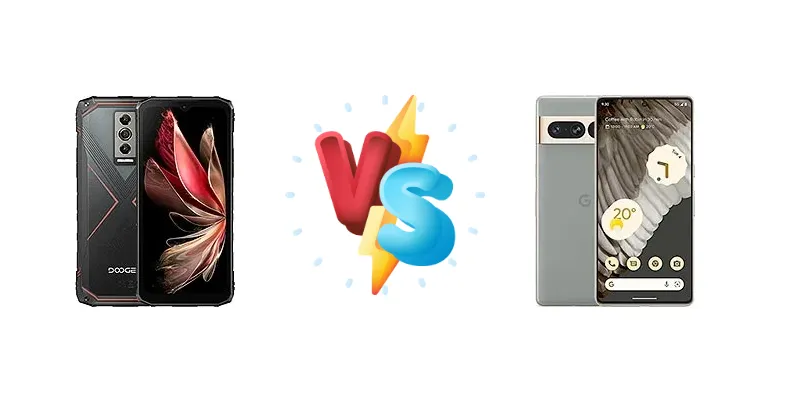
|
🏆 Quick Verdict
For the average user prioritizing longevity and affordability, the Doogee Blade10 Pro offers exceptional battery endurance and a usable experience. However, the Google Pixel 7 Pro is the clear winner for those demanding top-tier performance, a superior display, and a class-leading camera system, justifying its higher price.
| PHONES | ||
|---|---|---|
| Phone Names | Doogee Blade10 Pro | Google Pixel 7 Pro |
| Network | ||
|---|---|---|
| 2G bands | GSM 850 / 900 / 1800 / 1900 | GSM 850 / 900 / 1800 / 1900 |
| 3G bands | HSDPA 850 / 900 / 1700(AWS) / 1900 / 2100 | HSDPA 800 / 850 / 900 / 1700(AWS) / 1900 / 2100 |
| 4G bands | 1, 2, 3, 4, 5, 7, 8, 18, 19, 20, 25, 26, 28, 34, 38, 39, 40, 41, 66 | 1, 2, 3, 4, 5, 7, 8, 12, 13, 14, 17, 18, 19, 20, 25, 26, 28, 29, 30, 38, 39, 40, 41, 42, 46, 48, 66, 71 - GE2AE |
| 5G bands | - | 1, 2, 3, 5, 7, 8, 12, 14, 20, 25, 28, 30, 38, 40, 41, 48, 66, 71, 77, 78, 257, 258, 260, 261 SA/NSA/Sub6/mmWave - GE2AE |
| Speed | HSPA, LTE | HSPA, LTE, 5G |
| Technology | GSM / HSPA / LTE | GSM / CDMA / HSPA / EVDO / LTE / 5G |
| - | 1, 2, 3, 5, 7, 8, 12, 14, 20, 25, 28, 30, 38, 40, 41, 48, 66, 71, 75, 76, 77, 78 SA/NSA/Sub6 - GP4BC | |
| Launch | ||
|---|---|---|
| Announced | 2024, August | 2022, October 06 |
| Status | Available. Released 2024, September | Available. Released 2022, October 13 |
| Body | ||
|---|---|---|
| Build | - | Glass front (Gorilla Glass Victus), glass back (Gorilla Glass Victus), aluminum frame |
| Dimensions | 10.7 mm thickness | 162.9 x 76.6 x 8.9 mm (6.41 x 3.02 x 0.35 in) |
| SIM | Nano-SIM + Nano-SIM | Nano-SIM + eSIM |
| Weight | 240 g (8.47 oz) | 212 g (7.48 oz) |
| - | IP68 dust/water resistant (up to 1.5m for 30 min) | |
| Display | ||
|---|---|---|
| Protection | Corning Gorilla Glass 5, Mohs level 5 | Corning Gorilla Glass Victus |
| Resolution | 720 x 1612 pixels, 20:9 ratio (~269 ppi density) | 1440 x 3120 pixels, 19.5:9 ratio (~512 ppi density) |
| Size | 6.56 inches, 103.4 cm2 | 6.7 inches, 110.6 cm2 (~88.7% screen-to-body ratio) |
| Type | IPS LCD, 90Hz | LTPO AMOLED, 120Hz, HDR10+, 1000 nits (HBM), 1500 nits (peak) |
| - | Always-on display | |
| Platform | ||
|---|---|---|
| CPU | Octa-core (2x1.6 GHz Cortex-A75 & 6x1.6 GHz Cortex-A55) | Octa-core (2x2.85 GHz Cortex-X1 & 2x2.35 GHz Cortex-A78 & 4x1.80 GHz Cortex-A55) |
| Chipset | Unisoc T606 (12 nm) | Google Tensor G2 (5 nm) |
| GPU | Mali-G57 MP1 | Mali-G710 MP7 |
| OS | Android 14 | Android 13, upgradable to Android 15, up to 5 major Android upgrades |
| Memory | ||
|---|---|---|
| Card slot | microSDXC (dedicated slot) | No |
| Internal | 256GB 6GB RAM | 128GB 8GB RAM, 256GB 8GB RAM, 128GB 12GB RAM, 256GB 12GB RAM, 512GB 12GB RAM |
| - | UFS 3.1 | |
| Main Camera | ||
|---|---|---|
| Features | LED flash | Laser AF, Dual-LED flash, Pixel Shift, Auto-HDR, panorama |
| Single | 50 MP, (wide), AF | 10.8 MP, f/2.2, 21mm (ultrawide), 1/3.1", 1.22µm |
| Triple | - | 50 MP, f/1.9, 25mm (wide), 1/1.31", 1.2µm, dual pixel PDAF, OIS 48 MP, f/3.5, 120mm (periscope telephoto), 1/2.55", 0.7µm, dual pixel PDAF, OIS, 5x optical zoom 12 MP, f/2.2, 126˚ (ultrawide), 1/2.9", 1.25µm, AF |
| Video | Yes | 4K@30/60fps, 1080p@30/60/120/240fps; gyro-EIS, OIS, 10-bit HDR |
| Selfie camera | ||
|---|---|---|
| Features | - | HDR, panorama |
| Single | 8 MP, (wide) | 10.8 MP, f/2.2, 21mm (ultrawide), 1/3.1", 1.22µm |
| Video | Yes | 4K@30/60fps, 1080p@30/60fps |
| Sound | ||
|---|---|---|
| 3.5mm jack | - | No |
| 35mm jack | No | No |
| Loudspeaker | Yes | Yes, with stereo speakers |
| Comms | ||
|---|---|---|
| Bluetooth | 5.0, A2DP, LE | 5.2, A2DP, LE, aptX HD |
| NFC | Yes | Yes |
| Positioning | GPS, GLONASS, BDS, GALILEO | GPS (L1+L5), GLONASS (G1), BDS (B1I+B1c+B2a), GALILEO (E1+E5a), QZSS (L1+L5) |
| Radio | Unspecified | No |
| USB | USB Type-C | USB Type-C 3.2 |
| WLAN | Wi-Fi 802.11 a/b/g/n/ac, dual-band | Wi-Fi 802.11 a/b/g/n/ac/6e, tri-band, Wi-Fi Direct |
| Features | ||
|---|---|---|
| Sensors | Unspecified | Fingerprint (under display, optical), accelerometer, gyro, proximity, compass, barometer |
| - | Ultra Wideband (UWB) support | |
| Battery | ||
|---|---|---|
| Charging | - | 23W wired, PD3.0, 50% in 30 min 23W wireless Reverse wireless |
| Type | 5150 mAh | Li-Ion 5000 mAh |
| Misc | ||
|---|---|---|
| Colors | Black, Camouflage | Obsidian, Snow, Hazel |
| Models | - | GP4BC, GE2AE, GFE4J |
| Price | About 190 EUR | € 248.84 / $ 204.00 / £ 259.99 / ₹ 36,999 |
| Tests | ||
|---|---|---|
| Battery life | - | Endurance rating 83h |
| Camera | - | Photo / Video |
| Display | - | Contrast ratio: Infinite (nominal) |
| Loudspeaker | - | -24.8 LUFS (Very good) |
| Performance | - | AnTuTu: 796369 (v9) GeekBench: 3187 (v5.1) GFXBench: 34fps (ES 3.1 onscreen) |
| EU LABEL | ||
|---|---|---|
| Battery | 50:50h endurance, 1000 cycles | - |
| Energy | Class B | - |
| Free fall | Class A (270 falls) | - |
| Repairability | Class B | - |
Doogee Blade10 Pro
- Exceptional battery endurance (50:50h)
- High charge cycle lifespan (1000 cycles)
- Significantly lower price point
- Substantially weaker processor
- Inferior display quality
- Limited camera capabilities
Google Pixel 7 Pro
- Powerful Google Tensor G2 processor
- Bright and vibrant display (1090 nits)
- Exceptional camera system with advanced features
- Higher price tag
- Shorter battery endurance compared to Doogee
- May require more frequent charging
Display Comparison
The Google Pixel 7 Pro boasts a significantly brighter display, peaking at 1090 nits, compared to the Doogee Blade10 Pro (brightness data unavailable). This translates to superior visibility in direct sunlight. While the Blade10 Pro’s display specs are limited, the Pixel 7 Pro’s infinite contrast ratio and likely higher resolution contribute to a more immersive viewing experience. The Pixel 7 Pro likely utilizes LTPO technology for adaptive refresh rates, further enhancing efficiency and smoothness, a feature absent in the Blade10 Pro’s likely standard LCD panel.
Camera Comparison
Both devices offer photo and video capabilities, but the Pixel 7 Pro’s camera system is in a different league. While specific sensor details for the Blade10 Pro are missing, the Pixel 7 Pro benefits from Google’s computational photography expertise and likely larger, higher-resolution sensors. The Pixel 7 Pro’s image processing algorithms excel in dynamic range, low-light performance, and detail preservation. The Blade10 Pro will likely offer acceptable image quality in good lighting conditions, but will fall short in challenging scenarios. The Pixel 7 Pro’s video recording capabilities are also expected to be superior, with features like cinematic mode and advanced stabilization.
Performance
The performance gap is substantial. The Pixel 7 Pro’s Google Tensor G2, fabricated on a 5nm process, features a powerful octa-core configuration with 2x2.85 GHz Cortex-X1 cores, designed for peak performance. This contrasts sharply with the Doogee Blade10 Pro’s Unisoc T606 (12nm) with its 2x1.6 GHz Cortex-A75 and 6x1.6 GHz Cortex-A55 cores. The Tensor G2’s architecture and smaller node size deliver significantly faster processing speeds and improved power efficiency, making the Pixel 7 Pro ideal for gaming, video editing, and multitasking. The Blade10 Pro is sufficient for basic tasks, but will struggle with demanding applications.
Battery Life
The Doogee Blade10 Pro claims a remarkable 50:50h endurance rating and 1000 charge cycles, suggesting exceptional longevity. The Pixel 7 Pro, with an 83h endurance rating, still offers excellent battery life, but the Doogee’s focus is clearly on maximizing uptime. The Pixel 7 Pro offers faster charging with 23W wired (50% in 30 minutes) and 23W wireless charging, alongside reverse wireless charging, features absent on the Blade10 Pro. While the Pixel 7 Pro charges faster, the Doogee’s overall endurance may mean fewer charging cycles are needed.
Buying Guide
Buy the Doogee Blade10 Pro if you need a phone that lasts for days on a single charge, prioritize value over premium features, and primarily use your phone for basic communication and media consumption. Buy the Google Pixel 7 Pro if you prefer a flagship experience with a stunning display, exceptional camera capabilities, smooth performance for demanding tasks, and access to Google’s latest software innovations.