
Doogee Blade GT vs Samsung Galaxy A53 5G: A Deep Dive into Battery, Performance, and Value
| Phones Images | |||||
|---|---|---|---|---|---|
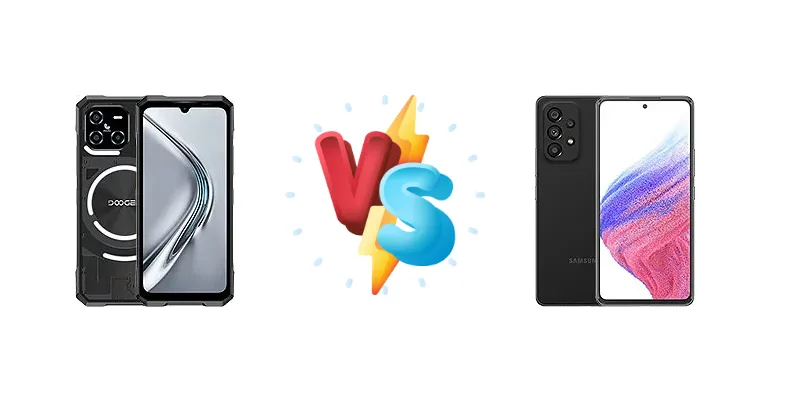
|
🏆 Quick Verdict
For users prioritizing longevity and all-day (and multi-day) battery life, the Doogee Blade GT is the clear winner. Its exceptional 30:21h endurance and 1300 battery cycles significantly outperform the Samsung Galaxy A53 5G's 113h rating, despite the A53's faster 25W charging.
| PHONES | ||
|---|---|---|
| Phone Names | Doogee Blade GT | Samsung Galaxy A53 5G |
| Network | ||
|---|---|---|
| 2G bands | GSM 850 / 900 / 1800 / 1900 | GSM 850 / 900 / 1800 / 1900 |
| 3G bands | HSDPA 850 / 900 / 1700(AWS) / 1900 / 2100 | HSDPA 850 / 900 / 1700(AWS) / 1900 / 2100 |
| 4G bands | 1, 2, 3, 4, 5, 7, 8, 12, 17, 18, 19, 20, 25, 26, 28, 66 | 1, 2, 3, 4, 5, 7, 12, 14, 20, 29, 30, 38, 39, 40, 41, 46, 48, 66 - SM-A536U |
| 5G bands | 1, 3, 7, 8, 28, 38, 41, 77, 78, 79 SA/NSA | 2, 5, 41, 66, 77, 78 SA/NSA/Sub6/mmWave - SM-A536U |
| Speed | HSPA, LTE, 5G | HSPA, LTE, 5G |
| Technology | GSM / HSPA / LTE / 5G | GSM / HSPA / LTE / 5G |
| - | 2, 5, 48, 66, 77, 78, 260, 261 SA/NSA/Sub6/mmWave - SM-A536V | |
| Launch | ||
|---|---|---|
| Announced | 2024, December | 2022, March 17 |
| Status | Available. Released 2025, January | Available. Released 2022, March 24 |
| Body | ||
|---|---|---|
| Build | - | Glass front (Gorilla Glass 5), plastic frame, plastic back |
| Dimensions | 178.5 x 83.5 x 10.5 mm (7.03 x 3.29 x 0.41 in) | 159.6 x 74.8 x 8.1 mm (6.28 x 2.94 x 0.32 in) |
| SIM | Nano-SIM + Nano-SIM | · Nano-SIM· Nano-SIM + Nano-SIM |
| Weight | 260 g (9.17 oz) | 189 g (6.67 oz) |
| - | IP67 dust/water resistant (up to 1m for 30 min) | |
| Display | ||
|---|---|---|
| Protection | Mohs level 6 | Corning Gorilla Glass 5 |
| Resolution | 1080 x 2400 pixels, 20:9 ratio (~392 ppi density) | 1080 x 2400 pixels, 20:9 ratio (~405 ppi density) |
| Size | 6.72 inches, 109.0 cm2 (~73.1% screen-to-body ratio) | 6.5 inches, 102.0 cm2 (~85.4% screen-to-body ratio) |
| Type | IPS LCD, 120Hz | Super AMOLED, 120Hz, 800 nits (HBM) |
| Platform | ||
|---|---|---|
| CPU | Octa-core (2x2.6 GHz Cortex-A78 & 6x2.0 GHz Cortex-A55) | Octa-core (2x2.4 GHz Cortex-A78 & 6x2.0 GHz Cortex-A55) |
| Chipset | Mediatek Dimensity 7050 (6 nm) | Exynos 1280 (5 nm) |
| GPU | Mali-G68 MC4 | Mali-G68 |
| OS | Android 14 | Android 12, up to 4 major Android upgrades, One UI 8 |
| Memory | ||
|---|---|---|
| Card slot | microSDXC (uses shared SIM slot) | microSDXC (uses shared SIM slot) |
| Internal | 256GB 12GB RAM | 128GB 4GB RAM, 128GB 6GB RAM, 128GB 8GB RAM, 256GB 6GB RAM, 256GB 8GB RAM |
| Main Camera | ||
|---|---|---|
| Dual | 48 MP, f/1.8, (wide), PDAF, OIS 5 MP, f/2.2, 120˚ (ultrawide) Auxiliary lens | - |
| Features | LED flash, HDR, panorama | LED flash, panorama, HDR |
| Quad | - | 64 MP, f/1.8, 26mm (wide), 1/1.7X", 0.8µm, PDAF, OIS 12 MP, f/2.2, 123˚ (ultrawide), 1.12µm 5 MP (macro) Auxiliary lens |
| Single | - | 32 MP, f/2.2, 26mm (wide), 1/2.8", 0.8µm |
| Video | 4K@30fps, 1080p@30fps, gyro-EIS | 4K@30fps, 1080p@30/60fps; gyro-EIS |
| Selfie camera | ||
|---|---|---|
| Features | - | HDR |
| Single | 20 MP, f/2.3, (wide) | 32 MP, f/2.2, 26mm (wide), 1/2.8", 0.8µm |
| Video | 1080p@30fps | 4K@30fps, 1080p@30fps |
| Sound | ||
|---|---|---|
| 3.5mm jack | - | No |
| 35mm jack | No | No |
| Loudspeaker | Yes | Yes, with stereo speakers |
| Comms | ||
|---|---|---|
| Bluetooth | 5.2, A2DP, LE | 5.1, A2DP, LE |
| NFC | Yes | Yes (market/region dependent) |
| Positioning | GPS, GLONASS, GALILEO, BDS | GPS, GLONASS, GALILEO, BDS |
| Radio | FM radio | No |
| USB | USB Type-C 2.0 | USB Type-C 2.0, OTG |
| WLAN | Wi-Fi 802.11 a/b/g/n/ac/6, dual-band | Wi-Fi 802.11 a/b/g/n/ac, dual-band, Wi-Fi Direct |
| Features | ||
|---|---|---|
| Sensors | Fingerprint (side-mounted), accelerometer, gyro, proximity, compass | Fingerprint (under display, optical), accelerometer, gyro, compass, barometer (market/region dependent) |
| - | Virtual proximity sensing | |
| Battery | ||
|---|---|---|
| Charging | 18W wired | 25W wired |
| Type | 5500 mAh | Li-Po 5000 mAh |
| Misc | ||
|---|---|---|
| Colors | Black, Silver | Black, White, Blue, Peach |
| Models | - | SM-A536B, SM-A536B/DS, SM-A536U, SM-A536U1, SM-A5360, SM-A536E, SM-A536E/DS, SM-A536V, SM-A536W, SM-A536N, SM-S536DL |
| Price | About 340 EUR | $ 151.42 / £ 185.00 / € 169.14 |
| SAR | - | 0.75 W/kg (head) 1.58 W/kg (body) |
| SAR EU | - | 0.89 W/kg (head) 1.60 W/kg (body) |
| Tests | ||
|---|---|---|
| Battery life | - | Endurance rating 113h |
| Camera | - | Photo / Video |
| Display | - | Contrast ratio: Infinite (nominal) |
| Loudspeaker | - | -26.5 LUFS (Good) |
| Performance | - | AnTuTu: 329802 (v8), 379313 (v9) GeekBench: 1891 (v5.1) GFXBench: 19fps (ES 3.1 onscreen) |
| EU LABEL | ||
|---|---|---|
| Battery | 30:21h endurance, 1300 cycles | - |
| Energy | Class E | - |
| Free fall | Class A (270 falls) | - |
| Repairability | Class C | - |
Doogee Blade GT
- Exceptional battery life (30:21h endurance)
- High battery cycle count (1300 cycles)
- Potentially faster CPU clock speeds
- Slower charging speed (18W)
- Display specs unknown, likely inferior to A53
Samsung Galaxy A53 5G
- Brighter display (830 nits)
- Established brand reputation and software support
- Faster charging (25W)
- Significantly shorter battery life (113h endurance)
- Less impressive battery cycle life
- Exynos 1280 may throttle under sustained load
Display Comparison
The Samsung Galaxy A53 5G boasts a significantly brighter display, peaking at 830 nits, which translates to better visibility outdoors. While the Doogee Blade GT’s display specs are not provided, the A53’s 'Infinite' contrast ratio (nominal) suggests a Super AMOLED panel, offering richer colors and deeper blacks compared to what is typically found in the Blade GT’s price bracket. The A53’s brightness advantage is crucial for users who frequently consume media in direct sunlight.
Camera Comparison
Both phones offer photo and video capabilities, but detailed sensor information is lacking for the Doogee Blade GT. The Samsung Galaxy A53 5G likely benefits from Samsung’s established image processing pipeline, offering consistent and pleasing results. Without knowing the main sensor size or aperture of the Blade GT, it’s difficult to assess its low-light performance. It’s safe to assume the A53’s camera system will be more versatile and refined, especially in challenging conditions. The inclusion of OIS on the A53 is also a significant advantage for video recording.
Performance
Both devices utilize an octa-core CPU configuration with 2x Cortex-A78 performance cores and 6x Cortex-A55 efficiency cores. However, the Doogee Blade GT’s Mediatek Dimensity 7050 (6nm) and the Samsung Galaxy A53 5G’s Exynos 1280 (5nm) represent different approaches to performance. The 5nm process of the Exynos 1280 *should* offer better power efficiency, but the Dimensity 7050’s slightly higher clock speeds (2.6GHz vs 2.4GHz) could translate to a marginal performance edge in CPU-intensive tasks. Real-world performance will depend on software optimization and thermal management, which are areas where Samsung typically excels.
Battery Life
The Doogee Blade GT’s battery endurance of 30:21h is a standout feature, dwarfing the Samsung Galaxy A53 5G’s 113h rating. This difference is substantial and translates to significantly longer usage between charges. While the A53 5G supports 25W wired charging, potentially offering a faster 0-100% charge time, the Blade GT’s 18W charging is less important given its exceptional battery life. Furthermore, the Blade GT’s advertised 1300 battery cycles suggest superior long-term battery health compared to the A53.
Buying Guide
Buy the Doogee Blade GT if you need a phone that can reliably last through heavy usage, travel, or situations where access to a charger is limited. Its focus on battery endurance makes it ideal for power users and those seeking freedom from constant charging. Buy the Samsung Galaxy A53 5G if you prioritize a brighter, more color-accurate display, a well-established brand reputation, and a more refined software experience, even if it means compromising on battery life.