
Doogee Blade GT vs OnePlus Nord 2T: A Deep Dive into Battery, Performance, and Value
| Phones Images | |||||
|---|---|---|---|---|---|
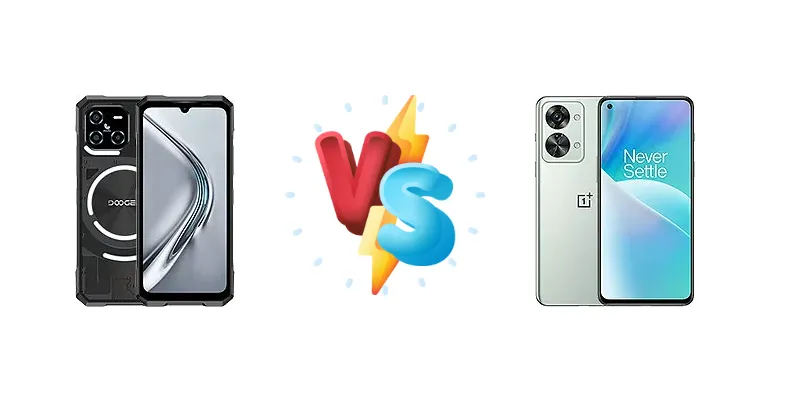
|
🏆 Quick Verdict
For users prioritizing exceptional battery life and long-term reliability, the Doogee Blade GT emerges as the winner. Its remarkable 30:21h endurance and 1300 charge cycles significantly outperform the OnePlus Nord 2T’s 100h rating. However, the Nord 2T counters with blazing-fast 80W charging, making it ideal for those who value convenience over longevity.
| PHONES | ||
|---|---|---|
| Phone Names | Doogee Blade GT | OnePlus Nord 2T |
| Network | ||
|---|---|---|
| 2G bands | GSM 850 / 900 / 1800 / 1900 | GSM 850 / 900 / 1800 / 1900 |
| 3G bands | HSDPA 850 / 900 / 1700(AWS) / 1900 / 2100 | HSDPA 800 / 850 / 900 / 1700(AWS) / 1800 / 1900 / 2100 |
| 4G bands | 1, 2, 3, 4, 5, 7, 8, 12, 17, 18, 19, 20, 25, 26, 28, 66 | 1, 2, 3, 4, 5, 7, 8, 12, 17, 18, 19, 20, 26, 28, 32, 34, 38, 39, 40, 41, 66 |
| 5G bands | 1, 3, 7, 8, 28, 38, 41, 77, 78, 79 SA/NSA | 1, 3, 7, 8, 20, 28, 38, 41, 78 SA/NSA |
| Speed | HSPA, LTE, 5G | HSPA 42.2/5.76 Mbps, LTE Cat18 1200/150 Mbps, 5G |
| Technology | GSM / HSPA / LTE / 5G | GSM / HSPA / LTE / 5G |
| Launch | ||
|---|---|---|
| Announced | 2024, December | 2022, May 19 |
| Status | Available. Released 2025, January | Available. Released 2022, May 21 |
| Body | ||
|---|---|---|
| Build | - | Glass front (Gorilla Glass 5), plastic frame |
| Dimensions | 178.5 x 83.5 x 10.5 mm (7.03 x 3.29 x 0.41 in) | 159.1 x 73.2 x 8.2 mm (6.26 x 2.88 x 0.32 in) |
| SIM | Nano-SIM + Nano-SIM | Nano-SIM + Nano-SIM |
| Weight | 260 g (9.17 oz) | 190 g (6.70 oz) |
| Display | ||
|---|---|---|
| Protection | Mohs level 6 | Corning Gorilla Glass 5 |
| Resolution | 1080 x 2400 pixels, 20:9 ratio (~392 ppi density) | 1080 x 2400 pixels, 20:9 ratio (~409 ppi density) |
| Size | 6.72 inches, 109.0 cm2 (~73.1% screen-to-body ratio) | 6.43 inches, 99.8 cm2 (~85.7% screen-to-body ratio) |
| Type | IPS LCD, 120Hz | AMOLED, 90Hz, HDR10+ |
| Platform | ||
|---|---|---|
| CPU | Octa-core (2x2.6 GHz Cortex-A78 & 6x2.0 GHz Cortex-A55) | Octa-core (1x3.0 GHz Cortex-A78 & 3x2.6 GHz Cortex-A78 & 4x2.0 GHz Cortex-A55) |
| Chipset | Mediatek Dimensity 7050 (6 nm) | Mediatek Dimensity 1300 (6 nm) |
| GPU | Mali-G68 MC4 | Mali-G77 MC9 |
| OS | Android 14 | Android 12, upgradable to Android 14, OxygenOS 14 |
| Memory | ||
|---|---|---|
| Card slot | microSDXC (uses shared SIM slot) | No |
| Internal | 256GB 12GB RAM | 128GB 8GB RAM, 256GB 12GB RAM |
| - | UFS 3.1 | |
| Main Camera | ||
|---|---|---|
| Dual | 48 MP, f/1.8, (wide), PDAF, OIS 5 MP, f/2.2, 120˚ (ultrawide) Auxiliary lens | - |
| Features | LED flash, HDR, panorama | Dual-LED flash, HDR, panorama |
| Single | - | 32 MP, f/2.4, (wide), 1/2.8", 0.8µm |
| Triple | - | 50 MP, f/1.9, 24mm (wide), 1/1.56", 1.0µm, PDAF, OIS 8 MP, f/2.2, 120˚ (ultrawide) Auxiliary lens |
| Video | 4K@30fps, 1080p@30fps, gyro-EIS | 4K@30fps, 1080p@30/60/120/480fps, gyro-EIS |
| Selfie camera | ||
|---|---|---|
| Features | - | Auto HDR |
| Single | 20 MP, f/2.3, (wide) | 32 MP, f/2.4, (wide), 1/2.8", 0.8µm |
| Video | 1080p@30fps | 1080p@30fps, gyro-EIS |
| Sound | ||
|---|---|---|
| 3.5mm jack | - | No |
| 35mm jack | No | No |
| Loudspeaker | Yes | Yes, with stereo speakers |
| Comms | ||
|---|---|---|
| Bluetooth | 5.2, A2DP, LE | 5.2, A2DP, LE, aptX HD |
| NFC | Yes | Yes |
| Positioning | GPS, GLONASS, GALILEO, BDS | GPS, GLONASS, GALILEO, BDS, NavIC |
| Radio | FM radio | No |
| USB | USB Type-C 2.0 | USB Type-C 2.0, OTG |
| WLAN | Wi-Fi 802.11 a/b/g/n/ac/6, dual-band | Wi-Fi 802.11 a/b/g/n/ac/6, dual-band, Wi-Fi Direct |
| Features | ||
|---|---|---|
| Sensors | Fingerprint (side-mounted), accelerometer, gyro, proximity, compass | Fingerprint (under display, optical), accelerometer, gyro, proximity, compass |
| Battery | ||
|---|---|---|
| Charging | 18W wired | 80W wired, PD |
| Type | 5500 mAh | Li-Po 4500 mAh |
| Misc | ||
|---|---|---|
| Colors | Black, Silver | Gray Shadow, Jade Fog |
| Models | - | CPH2399, CPH2401 |
| Price | About 340 EUR | € 144.39 / $ 169.99 / ₹ 31,490 |
| Tests | ||
|---|---|---|
| Battery life | - | Endurance rating 100h |
| Camera | - | Photo / Video |
| Display | - | Contrast ratio: Infinite (nominal) |
| Loudspeaker | - | -25.6 LUFS (Very good) |
| Performance | - | AnTuTu: 490545 (v8) | 604467 (v9) GeekBench: 2790 (v5.1) GFXBench: 40fps (ES 3.1 onscreen) |
| EU LABEL | ||
|---|---|---|
| Battery | 30:21h endurance, 1300 cycles | - |
| Energy | Class E | - |
| Free fall | Class A (270 falls) | - |
| Repairability | Class C | - |
Doogee Blade GT
- Exceptional battery life (30:21h endurance)
- High battery cycle count (1300 cycles)
- Efficient Mediatek Dimensity 7050 chipset
- Slow 18W charging
- Display brightness data unavailable
OnePlus Nord 2T
- Fast 80W wired charging with PD
- Brighter display (636 nits)
- More powerful Dimensity 1300 chipset
- Significantly shorter battery life (100h endurance)
- Lower battery cycle count (estimated)
Display Comparison
The OnePlus Nord 2T boasts a brighter display, peaking at 636 nits, which translates to better visibility in direct sunlight compared to the Doogee Blade GT (brightness data unavailable). While the Doogee lacks specific brightness figures, the Nord 2T’s ‘Infinite’ contrast ratio (nominal) suggests a superior viewing experience for content consumption. The absence of LTPO technology in either device means refresh rate adjustments aren’t as dynamic as flagship phones, but both likely offer a standard 120Hz panel.
Camera Comparison
Both devices offer photo and video capabilities, but detailed camera specifications are limited. Without sensor size or aperture information, a direct comparison is difficult. However, the Nord 2T’s brand reputation suggests more refined image processing algorithms. The inclusion of OIS (Optical Image Stabilization) on the Nord 2T, if present, would provide a significant advantage in low-light photography and video recording. We can assume both phones include standard features like HDR and portrait modes, but the Nord 2T is likely to deliver more consistent results.
Performance
Both phones utilize Mediatek Dimensity chipsets fabricated on a 6nm process, but the OnePlus Nord 2T’s Dimensity 1300 holds a performance advantage. Its CPU configuration – 1x3.0 GHz Cortex-A78, 3x2.6 GHz Cortex-A78, and 4x2.0 GHz Cortex-A55 – is more aggressive than the Doogee Blade GT’s 2x2.6 GHz Cortex-A78 & 6x2.0 GHz Cortex-A55. This translates to faster app loading times and smoother multitasking on the Nord 2T. While both likely feature LPDDR4X RAM, the Nord 2T’s superior chipset will be the primary performance differentiator.
Battery Life
The Doogee Blade GT’s battery endurance of 30:21h is a standout feature, dwarfing the OnePlus Nord 2T’s 100h rating. This difference is substantial and indicates the Doogee will last significantly longer on a single charge. However, the Nord 2T compensates with 80W wired charging, utilizing Power Delivery (PD) for faster and more efficient charging. The Doogee Blade GT’s 18W charging is comparatively slow. The Doogee also claims 1300 charge cycles, suggesting superior long-term battery health compared to the Nord 2T.
Buying Guide
Buy the Doogee Blade GT if you need a phone that will reliably last through a full day – and multiple days – of heavy use, and you value long-term battery health. This is the phone for travelers, outdoor enthusiasts, or anyone who dislikes frequent charging. Buy the OnePlus Nord 2T if you prioritize quick top-ups and don't mind charging more often. Its 80W charging is a game-changer for users who need a rapid power boost, and its brighter display enhances media consumption.