
Doogee Blade GT vs Nothing Phone (1): A Battle of Battery and Bold Design
| Phones Images | |||||
|---|---|---|---|---|---|
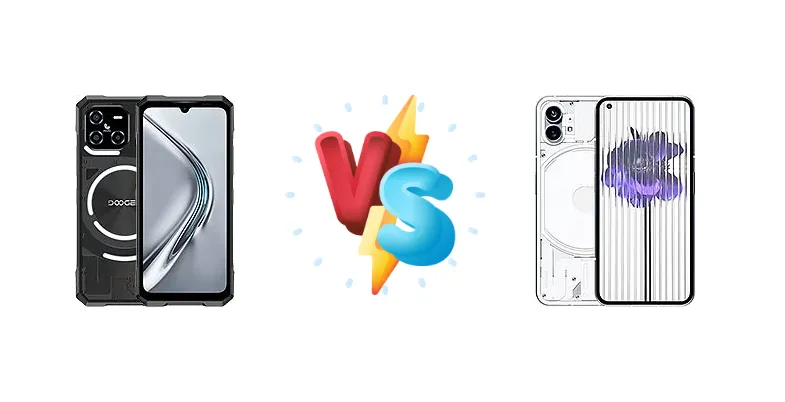
|
🏆 Quick Verdict
For users prioritizing battery life and sustained performance, the Doogee Blade GT is the clear winner. Its 30:21h endurance significantly outpaces the Nothing Phone (1)'s 108h rating, and the Dimensity 7050 offers competitive power. However, the Nothing Phone (1) excels in design and charging convenience.
| PHONES | ||
|---|---|---|
| Phone Names | Doogee Blade GT | Nothing Phone (1) |
| Network | ||
|---|---|---|
| 2G bands | GSM 850 / 900 / 1800 / 1900 | GSM 850 / 900 / 1800 / 1900 |
| 3G bands | HSDPA 850 / 900 / 1700(AWS) / 1900 / 2100 | HSDPA 800 / 850 / 900 / 1700(AWS) / 1900 / 2100 |
| 4G bands | 1, 2, 3, 4, 5, 7, 8, 12, 17, 18, 19, 20, 25, 26, 28, 66 | 1, 2, 3, 4, 5, 7, 8, 12, 17, 18, 19, 20, 26, 28, 32, 34, 38, 39, 40, 41, 66 |
| 5G bands | 1, 3, 7, 8, 28, 38, 41, 77, 78, 79 SA/NSA | 1, 3, 5, 7, 8, 20, 28, 38, 40, 41, 77, 78 SA/NSA |
| Speed | HSPA, LTE, 5G | HSPA, LTE, 5G |
| Technology | GSM / HSPA / LTE / 5G | GSM / HSPA / LTE / 5G |
| Launch | ||
|---|---|---|
| Announced | 2024, December | 2022, July 12 |
| Status | Available. Released 2025, January | Available. Released 2022, July 16 |
| Body | ||
|---|---|---|
| Build | - | Glass front (Gorilla Glass 5), glass back (Gorilla Glass 5), aluminum frame |
| Dimensions | 178.5 x 83.5 x 10.5 mm (7.03 x 3.29 x 0.41 in) | 159.2 x 75.8 x 8.3 mm (6.27 x 2.98 x 0.33 in) |
| SIM | Nano-SIM + Nano-SIM | Nano-SIM + Nano-SIM |
| Weight | 260 g (9.17 oz) | 193.5 g (6.84 oz) |
| Display | ||
|---|---|---|
| Protection | Mohs level 6 | Corning Gorilla Glass 5 |
| Resolution | 1080 x 2400 pixels, 20:9 ratio (~392 ppi density) | 1080 x 2400 pixels, 20:9 ratio (~402 ppi density) |
| Size | 6.72 inches, 109.0 cm2 (~73.1% screen-to-body ratio) | 6.55 inches, 103.6 cm2 (~85.8% screen-to-body ratio) |
| Type | IPS LCD, 120Hz | OLED, 1B colors, 120Hz, 1440Hz PWM, HDR10+, 500 nits (typ), 1200 nits (peak) |
| Platform | ||
|---|---|---|
| CPU | Octa-core (2x2.6 GHz Cortex-A78 & 6x2.0 GHz Cortex-A55) | Octa-core (1x2.5 GHz Cortex-A78 & 3x2.4 GHz Cortex-A78 & 4x1.9 GHz Cortex-A55) |
| Chipset | Mediatek Dimensity 7050 (6 nm) | Qualcomm SM7325-AE Snapdragon 778G+ 5G (6 nm) |
| GPU | Mali-G68 MC4 | Adreno 642L |
| OS | Android 14 | Android 12, upgradable to Android 15, up to 3 major Android upgrades, Nothing OS 3.0 |
| Memory | ||
|---|---|---|
| Card slot | microSDXC (uses shared SIM slot) | No |
| Internal | 256GB 12GB RAM | 128GB 8GB RAM, 256GB 8GB RAM, 256GB 12GB RAM |
| Main Camera | ||
|---|---|---|
| Dual | 48 MP, f/1.8, (wide), PDAF, OIS 5 MP, f/2.2, 120˚ (ultrawide) Auxiliary lens | 50 MP, f/1.9, 24mm (wide), 1/1.56", 1.0µm, PDAF, OIS 50 MP, f/2.2, 114˚ (ultrawide), 1/2.76", 0.64µm, AF |
| Features | LED flash, HDR, panorama | LED flash, panorama, HDR |
| Video | 4K@30fps, 1080p@30fps, gyro-EIS | 4K@30fps, 1080p@30/60fps, gyro-EIS, live HDR |
| Selfie camera | ||
|---|---|---|
| Single | 20 MP, f/2.3, (wide) | 16 MP, f/2.5, (wide), 1/3.1", 1.0µm |
| Video | 1080p@30fps | 1080p@30fps |
| Sound | ||
|---|---|---|
| 35mm jack | No | No |
| Loudspeaker | Yes | Yes, with stereo speakers |
| Comms | ||
|---|---|---|
| Bluetooth | 5.2, A2DP, LE | 5.2, A2DP, LE |
| NFC | Yes | Yes |
| Positioning | GPS, GLONASS, GALILEO, BDS | GPS (L1), GLONASS (L1), BDS (B1I+B1c), GALILEO (E1), QZSS (L1) |
| Radio | FM radio | No |
| USB | USB Type-C 2.0 | USB Type-C 2.0, OTG |
| WLAN | Wi-Fi 802.11 a/b/g/n/ac/6, dual-band | Wi-Fi 802.11 a/b/g/n/ac/6, dual-band |
| Features | ||
|---|---|---|
| Sensors | Fingerprint (side-mounted), accelerometer, gyro, proximity, compass | Fingerprint (under display, optical), accelerometer, proximity, gyro, compass |
| Battery | ||
|---|---|---|
| Charging | 18W wired | 33W wired, PD3.0, QC4, 50% in 30 min, 100% in 70 min 15W wireless 5W reverse wireless |
| Type | 5500 mAh | Li-Ion 4500 mAh (17.42 Wh) |
| Misc | ||
|---|---|---|
| Colors | Black, Silver | White, Black |
| Models | - | A063 |
| Price | About 340 EUR | $ 539.00 / £ 234.77 / € 249.95 / ₹ 17,990 |
| SAR | - | 1.29 W/kg (head) 1.09 W/kg (body) |
| SAR EU | - | 0.99 W/kg (head) 1.48 W/kg (body) |
| EU LABEL | ||
|---|---|---|
| Battery | 30:21h endurance, 1300 cycles | - |
| Energy | Class E | - |
| Free fall | Class A (270 falls) | - |
| Repairability | Class C | - |
Doogee Blade GT
- Exceptional battery life (30:21h endurance)
- Long battery lifespan (1300 cycles)
- Powerful Dimensity 7050 chipset
- Slower charging speed (18W)
- Camera specifications unknown
Nothing Phone (1)
- Unique and eye-catching design
- Faster charging (33W wired, 15W wireless)
- More refined software experience
- Significantly shorter battery life (108h)
- Less powerful chipset compared to Doogee
Display Comparison
The Nothing Phone (1) features a 6.55-inch display capable of reaching 663 nits of peak brightness, providing good visibility outdoors. While the Doogee Blade GT’s display specifications are not provided, its focus on battery life suggests a potentially less power-hungry panel, though likely at the expense of peak brightness. The Nothing Phone (1)'s display is a key strength, offering a vibrant and easily viewable experience, while the Doogee’s display remains an unknown quantity.
Camera Comparison
The Nothing Phone (1) boasts a dual 50MP camera system, focusing on photo and video capabilities. Details regarding the Doogee Blade GT’s camera are absent, making a direct comparison difficult. However, given its price point, it’s reasonable to expect a less sophisticated camera setup. The Nothing Phone (1)'s emphasis on image processing and sensor quality likely provides a superior photographic experience, particularly in challenging lighting conditions. The absence of details on the Doogee’s camera makes it difficult to assess its capabilities beyond basic functionality.
Performance
Both devices utilize 6nm chipsets, but the architectures differ significantly. The Doogee Blade GT’s Mediatek Dimensity 7050 employs a dual-core Cortex-A78 setup (2x2.6 GHz) alongside six Cortex-A55 cores (6x2.0 GHz). The Nothing Phone (1) uses the Qualcomm Snapdragon 778G+ 5G, featuring a single Cortex-A78 core (1x2.5 GHz) and a tri-cluster of Cortex-A78 cores (3x2.4 GHz) plus four Cortex-A55 cores (4x1.9 GHz). The Snapdragon 778G+’s more numerous high-performance cores *suggest* a slight edge in multi-threaded tasks, but the Dimensity 7050’s higher clock speeds on its A78 cores could translate to better single-core performance. The Doogee’s chipset is newer, potentially benefiting from optimizations. Neither device specifies RAM type, but LPDDR5 is likely on both.
Battery Life
The Doogee Blade GT’s 30:21h endurance rating is a standout feature, indicating exceptional battery life. This is coupled with a 1300 cycle lifespan, suggesting long-term battery health. In contrast, the Nothing Phone (1) offers a significantly lower 108h endurance. The Doogee’s 18W wired charging is slower than the Nothing Phone (1)’s 33W wired charging (50% in 30 min, 100% in 70 min), which also includes 15W wireless and 5W reverse wireless charging. While the Doogee prioritizes longevity, the Nothing Phone (1) offers greater charging flexibility and speed.
Buying Guide
Buy the Doogee Blade GT if you need a phone that can reliably last through two full days of heavy use, or if you frequently engage in demanding tasks like gaming or video editing. Buy the Nothing Phone (1) if you prioritize a unique aesthetic, faster charging speeds (including wireless), and a more polished software experience, even if it means compromising on battery longevity.