
Doogee Blade GT vs Google Pixel 6a: A Deep Dive into Battery, Performance, and Value
| Phones Images | |||||
|---|---|---|---|---|---|
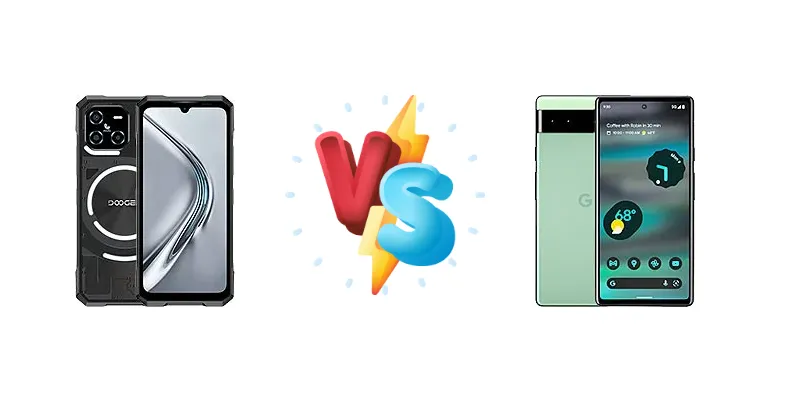
|
🏆 Quick Verdict
For users prioritizing all-day (and multi-day) battery life, the Doogee Blade GT is the clear winner, offering over three times the endurance of the Pixel 6a. However, the Pixel 6a’s Google Tensor chip delivers a smoother, more refined software experience and superior image processing, making it ideal for photography enthusiasts.
| PHONES | ||
|---|---|---|
| Phone Names | Doogee Blade GT | Google Pixel 6a |
| Network | ||
|---|---|---|
| 2G bands | GSM 850 / 900 / 1800 / 1900 | GSM 850 / 900 / 1800 / 1900 |
| 3G bands | HSDPA 850 / 900 / 1700(AWS) / 1900 / 2100 | HSDPA 800 / 850 / 900 / 1700(AWS) / 1900 / 2100 |
| 4G bands | 1, 2, 3, 4, 5, 7, 8, 12, 17, 18, 19, 20, 25, 26, 28, 66 | 1, 2, 3, 4, 5, 7, 8, 12, 13, 14, 17, 18, 19, 20, 25, 26, 28, 29, 30, 38, 39, 40, 41, 42, 48, 66, 71 - GX7AS, GB62Z (USA/Canada) |
| 5G bands | 1, 3, 7, 8, 28, 38, 41, 77, 78, 79 SA/NSA | 1, 2, 3, 5, 7, 8, 12, 20, 25, 28, 30, 38, 40, 41, 48, 66, 71, 77, 78 SA/NSA/Sub6 - GX7AS (USA/Canada) |
| Speed | HSPA, LTE, 5G | HSPA, LTE, 5G |
| Technology | GSM / HSPA / LTE / 5G | GSM / HSPA / LTE / 5G |
| - | 1, 2, 3, 5, 7, 8, 12, 20, 25, 28, 30, 40, 48, 66, 71, 77, 78 SA/NSA/Sub6 - G1AZG (International) | |
| Launch | ||
|---|---|---|
| Announced | 2024, December | 2022, May 11 |
| Status | Available. Released 2025, January | Available. Released 2022, July 21 |
| Body | ||
|---|---|---|
| Build | - | Glass front (Gorilla Glass 3), aluminum frame, plastic back |
| Dimensions | 178.5 x 83.5 x 10.5 mm (7.03 x 3.29 x 0.41 in) | 152.2 x 71.8 x 8.9 mm (5.99 x 2.83 x 0.35 in) |
| SIM | Nano-SIM + Nano-SIM | Nano-SIM + eSIM |
| Weight | 260 g (9.17 oz) | 178 g (6.28 oz) |
| - | IP67 dust/water resistant (up to 1m for 30 min) | |
| Display | ||
|---|---|---|
| Protection | Mohs level 6 | Corning Gorilla Glass 3 |
| Resolution | 1080 x 2400 pixels, 20:9 ratio (~392 ppi density) | 1080 x 2400 pixels, 20:9 ratio (~429 ppi density) |
| Size | 6.72 inches, 109.0 cm2 (~73.1% screen-to-body ratio) | 6.1 inches, 90.7 cm2 (~83.0% screen-to-body ratio) |
| Type | IPS LCD, 120Hz | OLED, HDR |
| - | Always-on display | |
| Platform | ||
|---|---|---|
| CPU | Octa-core (2x2.6 GHz Cortex-A78 & 6x2.0 GHz Cortex-A55) | Octa-core (2x2.80 GHz Cortex-X1 & 2x2.25 GHz Cortex-A76 & 4x1.80 GHz Cortex-A55) |
| Chipset | Mediatek Dimensity 7050 (6 nm) | Google Tensor (5 nm) |
| GPU | Mali-G68 MC4 | Mali-G78 MP20 |
| OS | Android 14 | Android 12, upgradable to Android 15, up to 5 major Android upgrades |
| Memory | ||
|---|---|---|
| Card slot | microSDXC (uses shared SIM slot) | No |
| Internal | 256GB 12GB RAM | 128GB 6GB RAM |
| - | UFS 3.1 | |
| Main Camera | ||
|---|---|---|
| Dual | 48 MP, f/1.8, (wide), PDAF, OIS 5 MP, f/2.2, 120˚ (ultrawide) Auxiliary lens | 12.2 MP, f/1.7, 27mm, (wide), 1/2.55", 1.4µm, dual pixel PDAF, OIS 12 MP, f/2.2, 17mm, 114˚ (ultrawide), 1.25µm |
| Features | LED flash, HDR, panorama | Dual-LED flash, Pixel Shift, Auto-HDR, panorama |
| Single | - | 8 MP, f/2.0, 24mm (wide), 1.12µm |
| Video | 4K@30fps, 1080p@30fps, gyro-EIS | 4K@30/60fps, 1080p@30/60/120/240fps; gyro-EIS, OIS |
| Selfie camera | ||
|---|---|---|
| Features | - | HDR, panorama |
| Single | 20 MP, f/2.3, (wide) | 8 MP, f/2.0, 24mm (wide), 1.12µm |
| Video | 1080p@30fps | 1080p@30fps |
| Sound | ||
|---|---|---|
| 3.5mm jack | - | No |
| 35mm jack | No | No |
| Loudspeaker | Yes | Yes, with stereo speakers |
| Comms | ||
|---|---|---|
| Bluetooth | 5.2, A2DP, LE | 5.2, A2DP, LE |
| NFC | Yes | Yes |
| Positioning | GPS, GLONASS, GALILEO, BDS | GPS, GLONASS, GALILEO, QZSS |
| Radio | FM radio | No |
| USB | USB Type-C 2.0 | USB Type-C 3.1 |
| WLAN | Wi-Fi 802.11 a/b/g/n/ac/6, dual-band | Wi-Fi 802.11 a/b/g/n/ac/6e, dual-band, Wi-Fi Direct |
| Features | ||
|---|---|---|
| Sensors | Fingerprint (side-mounted), accelerometer, gyro, proximity, compass | Fingerprint (under display, optical), accelerometer, gyro, proximity, compass, barometer |
| Battery | ||
|---|---|---|
| Charging | 18W wired | 18W wired, PD3.0 |
| Type | 5500 mAh | Li-Po 4410 mAh |
| Misc | ||
|---|---|---|
| Colors | Black, Silver | Chalk, Charcoal, Sage |
| Models | - | GX7AS, GB62Z, G1AZG, GB17L |
| Price | About 340 EUR | $ 138.99 / C$ 228.74 / ₹ 23,999 |
| Tests | ||
|---|---|---|
| Battery life | - | Endurance rating 94h |
| Display | - | Contrast ratio: Infinite (nominal) |
| EU LABEL | ||
|---|---|---|
| Battery | 30:21h endurance, 1300 cycles | - |
| Energy | Class E | - |
| Free fall | Class A (270 falls) | - |
| Repairability | Class C | - |
Doogee Blade GT
- Exceptional battery life (30:21h endurance)
- Long-lasting battery health (1300 charge cycles)
- Powerful Mediatek Dimensity 7050 chipset
- Software experience likely less refined than Pixel
- Display specs currently unknown
Google Pixel 6a
- Superior camera image processing and features
- Smooth and responsive performance with Google Tensor
- Bright and high-contrast display (876 nits)
- Significantly shorter battery life (94h endurance)
- Charging speed is not significantly faster
Display Comparison
The Google Pixel 6a features a brighter display, peaking at 876 nits, offering excellent visibility in direct sunlight. While the Doogee Blade GT’s display brightness isn’t specified, the Pixel 6a’s infinite contrast ratio suggests a superior viewing experience with deeper blacks. The Pixel 6a’s display is likely to be more color accurate, benefiting content creators and media consumers. The Blade GT’s display specs are currently unknown, making a direct comparison difficult, but the Pixel 6a holds a clear advantage based on measured data.
Camera Comparison
The Pixel 6a’s camera system benefits immensely from Google’s computational photography prowess, leveraging the Tensor chip’s image signal processor. While specific sensor details for the Doogee Blade GT are missing, the Pixel 6a’s image processing excels in dynamic range, low-light performance, and overall image quality. The Pixel 6a’s software features like Magic Eraser and Real Tone further enhance the photographic experience. Without knowing the Blade GT’s sensor size or aperture, it’s difficult to assess its raw image capture capabilities, but the Pixel 6a’s software advantage is substantial.
Performance
The Google Pixel 6a’s Google Tensor (5nm) chip, with its Cortex-X1 prime core clocked at 2.80 GHz, is architecturally more advanced than the Doogee Blade GT’s MediaTek Dimensity 7050 (6nm). The Cortex-X1 offers significantly higher single-core performance, crucial for responsive app launches and smooth multitasking. While the Dimensity 7050’s octa-core configuration is competitive, the Tensor’s integrated machine learning capabilities provide advantages in areas like voice recognition and image processing. The 5nm process node of the Tensor also contributes to better thermal efficiency, potentially reducing throttling during sustained workloads. However, the Blade GT’s Cortex-A78 cores are still powerful and will handle everyday tasks efficiently.
Battery Life
The Doogee Blade GT’s standout feature is its exceptional battery endurance, rated at 30:21 hours. This dwarfs the Pixel 6a’s 94-hour endurance rating. The Blade GT also boasts an impressive 1300 charge cycles, indicating long-term battery health. Both devices support 18W wired charging, but the Blade GT’s longer battery life means you’ll need to charge it less frequently. The Pixel 6a’s PD3.0 support offers potentially faster charging speeds with compatible chargers, but the difference is unlikely to offset the Blade GT’s significantly longer runtime.
Buying Guide
Buy the Doogee Blade GT if you need exceptional battery life, prioritize longevity with its 1300 charge cycles, and are comfortable with a less polished software experience. Buy the Google Pixel 6a if you prefer a clean Android experience, prioritize camera quality and computational photography, and value the performance benefits of Google’s Tensor chip, even with a shorter battery lifespan.