
Xiaomi Redmi K60 Ultra vs. Doogee Blade GT Ultra: A Performance and Battery Showdown
| Phones Images | |||||
|---|---|---|---|---|---|
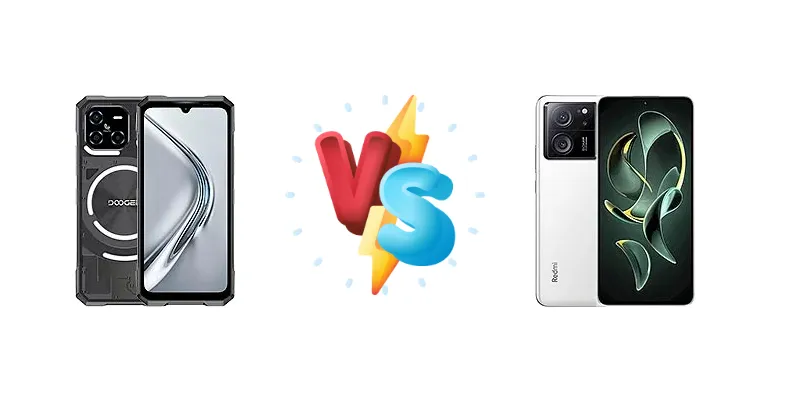
|
🏆 Quick Verdict
For most users, the Xiaomi Redmi K60 Ultra emerges as the superior choice. Its Dimensity 9200+ chipset delivers substantially higher performance, complemented by blazing-fast 120W charging. While the Doogee Blade GT Ultra boasts impressive battery endurance, it can't match the K60 Ultra's overall speed and convenience.
| PHONES | ||
|---|---|---|
| Phone Names | Doogee Blade GT Ultra | Xiaomi Redmi K60 Ultra |
| Network | ||
|---|---|---|
| 2G bands | GSM 850 / 900 / 1800 / 1900 | GSM 850 / 900 / 1800 / 1900 |
| 3G bands | HSDPA 850 / 900 / 1700(AWS) / 1900 / 2100 | HSDPA 800 / 850 / 900 / 1700(AWS) / 2100 |
| 4G bands | 1, 2, 3, 4, 5, 7, 8, 12, 17, 18, 19, 20, 25, 26, 28, 66 | 1, 3, 4, 5, 8, 18, 19, 26, 34, 38, 39, 40, 41, 42, 66 |
| 5G bands | 1, 3, 7, 8, 28, 38, 41, 77, 78, 79 SA/NSA | 1, 3, 5, 8, 28, 38, 41, 66, 77, 78 SA/NSA |
| Speed | HSPA, LTE, 5G | HSPA, LTE, 5G |
| Technology | GSM / HSPA / LTE / 5G | GSM / CDMA / HSPA / CDMA2000 / LTE / 5G |
| Launch | ||
|---|---|---|
| Announced | 2025, February | 2023, August 15 |
| Status | Available. Released 2025, February | Available. Released 2023, August 15 |
| Body | ||
|---|---|---|
| Dimensions | 178.5 x 83.5 x 10.5 mm (7.03 x 3.29 x 0.41 in) | 162.2 x 75.7 x 8.5 mm (6.39 x 2.98 x 0.33 in) |
| SIM | Nano-SIM + Nano-SIM | Nano-SIM + Nano-SIM |
| Weight | 260 g (9.17 oz) | 204 g (7.20 oz) |
| Display | ||
|---|---|---|
| Protection | Mohs level 6 | Unspecified |
| Resolution | 1080 x 2400 pixels, 20:9 ratio (~392 ppi density) | 1220 x 2712 pixels, 20:9 ratio (~446 ppi density) |
| Size | 6.72 inches, 109.0 cm2 (~73.1% screen-to-body ratio) | 6.67 inches, 107.4 cm2 (~87.5% screen-to-body ratio) |
| Type | IPS LCD, 120Hz | OLED, 68B colors, 144Hz, Dolby Vision, HDR10+, 2600 nits (peak) |
| Platform | ||
|---|---|---|
| CPU | Octa-core (4x2.5 GHz Cortex-A78 & 4x2.0 GHz Cortex-A55) | Octa-core (1x3.35 GHz Cortex-X3 & 3x3.0 GHz Cortex-A715 & 4x2.0 GHz Cortex-A510) |
| Chipset | Mediatek Dimensity 7300 (4 nm) | Mediatek Dimensity 9200+ (4 nm) |
| GPU | Mali-G615 MC2 | Immortalis-G715 MC11 |
| OS | Android 14 | Android 13, MIUI 14 |
| Memory | ||
|---|---|---|
| Card slot | microSDXC (uses shared SIM slot) | No |
| Internal | 512GB 16GB RAM | 256GB 12GB RAM, 256GB 16GB RAM, 512GB 16GB RAM, 1TB 16GB RAM, 1TB 24GB RAM |
| Main Camera | ||
|---|---|---|
| Dual | 100 MP, f/1.8, (wide), 1/1.8", PDAF 5 MP, f/2.2, 120˚ (ultrawide) | - |
| Features | LED flash, HDR, panorama | Color spectrum sensor, Dual-LED dual-tone flash, HDR, panorama |
| Triple | - | 50 MP, f/1.7, (wide), 1/1.49", 1.0µm, PDAF, OIS 8 MP, 119˚ (ultrawide), 1/4.0", 1.12µm 2 MP (macro) |
| Video | 4K@30fps, 1080p@30fps, gyro-EIS | 8K@24fps, 4K@30/60fps, 1080p@30/60/120/240/960fps, gyro-EIS, HDR10+, 10-bit |
| Selfie camera | ||
|---|---|---|
| Features | - | HDR |
| Single | 32 MP, f/2.3, (wide), 1/2.8" | 20 MP, (wide), 1/2.0", 0.8µm |
| Video | 1080p@30fps | 1080p@30/120fps |
| Sound | ||
|---|---|---|
| 35mm jack | No | No |
| Loudspeaker | Yes | Yes, with stereo speakers |
| Comms | ||
|---|---|---|
| Bluetooth | 5.2, A2DP, LE | 5.4, A2DP, LE |
| Infrared port | Yes | Yes |
| NFC | Yes | Yes |
| Positioning | GPS, GLONASS, GALILEO, BDS | GPS (L1+L5), GLONASS (G1), BDS (B1I+B1C+B2a+B2b), GALILEO (E1+E5a), QZSS (L1+L5), NavIC |
| Radio | FM radio | Unspecified |
| USB | USB Type-C 2.0 | USB Type-C, OTG |
| WLAN | Wi-Fi 802.11 a/b/g/n/ac/6, dual-band | Wi-Fi 802.11 a/b/g/n/ac/6e, dual-band, Wi-Fi Direct |
| Features | ||
|---|---|---|
| Sensors | Fingerprint (side-mounted), accelerometer, gyro, proximity, compass | Fingerprint (under display, optical), accelerometer, gyro, proximity, compass |
| Battery | ||
|---|---|---|
| Charging | 33W wired | 120W wired, PD3.0, 100% in 19 min |
| Type | 5500 mAh | Li-Po 5000 mAh |
| Misc | ||
|---|---|---|
| Colors | Black, Silver | Black, White, Green |
| Models | - | 23078RKD5C |
| Price | About 480 EUR | About 330 EUR |
| EU LABEL | ||
|---|---|---|
| Battery | 30:21h endurance, 1300 cycles | - |
| Energy | Class E | - |
| Free fall | Class A (270 falls) | - |
| Repairability | Class C | - |
Doogee Blade GT Ultra
- Exceptional battery endurance (30:21h)
- High battery cycle count (1300 cycles)
- Competitive price point (likely)
- Decent performance for everyday tasks
- Slower charging speed (33W)
- Less powerful chipset (Dimensity 7300)
- Potentially less refined camera system
Xiaomi Redmi K60 Ultra
- Significantly faster performance (Dimensity 9200+)
- Ultra-fast 120W charging (19 minutes to full)
- Likely superior camera system
- Better gaming performance
- Potentially shorter battery life compared to Doogee
- May be more expensive than Doogee
- Faster charging may degrade battery health over time (though mitigated by charging algorithms)
Display Comparison
Display specifications are not provided, but given the market positioning, we can infer differences. The K60 Ultra likely features a higher-quality AMOLED panel with a higher refresh rate and peak brightness. Doogee often focuses on value, potentially resulting in a slightly less refined display experience. The absence of LTPO information suggests neither phone prioritizes variable refresh rate for maximum efficiency, though the K60 Ultra's more powerful chipset could mitigate the impact of a fixed refresh rate.
Camera Comparison
Camera details are absent, but we can speculate. Xiaomi typically invests heavily in camera technology, suggesting the K60 Ultra likely features a more sophisticated camera system with a larger sensor and advanced image processing algorithms. Doogee tends to focus on providing a functional camera experience at a lower price point. The absence of any mention of OIS on either device suggests both may rely primarily on software stabilization. Without specific sensor details, it's difficult to make a definitive judgment, but Xiaomi's track record points to a superior camera experience.
Performance
The core difference lies in the chipsets. The Xiaomi Redmi K60 Ultra’s Dimensity 9200+ (4nm) is a significant step up from the Doogee Blade GT Ultra’s Dimensity 7300 (4nm). The 9200+ features a Cortex-X3 prime core clocked at 3.35 GHz, alongside three Cortex-A715 cores at 3.0 GHz, and four Cortex-A510 cores at 2.0 GHz. This contrasts with the Blade GT Ultra’s configuration of four Cortex-A78 cores at 2.5 GHz and four Cortex-A55 cores at 2.0 GHz. The X3 core provides a substantial performance boost in single-threaded tasks, while the A715 cores offer improved efficiency and multi-core performance. This translates to faster app loading, smoother multitasking, and a more responsive gaming experience on the K60 Ultra. While both are 4nm chips, the architectural advantages of the 9200+ are substantial.
Battery Life
The Doogee Blade GT Ultra boasts a remarkable 30:21h endurance and 1300 charge cycles, indicating a focus on long-term battery health and longevity. However, the Xiaomi Redmi K60 Ultra counters with a game-changing 120W wired charging capability, achieving a full charge in just 19 minutes. While the K60 Ultra’s battery capacity isn’t specified, the rapid charging significantly reduces downtime. The Doogee’s 33W charging is comparatively slow. The trade-off is clear: the Doogee prioritizes sustained battery life, while the Xiaomi prioritizes convenience and quick top-ups.
Buying Guide
Buy the Doogee Blade GT Ultra if you prioritize exceptional battery life and are willing to trade raw processing power for extended usage. This phone is ideal for users who frequently travel or rely heavily on their device throughout the day. Buy the Xiaomi Redmi K60 Ultra if you demand top-tier performance for gaming, multitasking, and demanding applications, and value the convenience of incredibly fast charging. This is the phone for power users and mobile gamers.