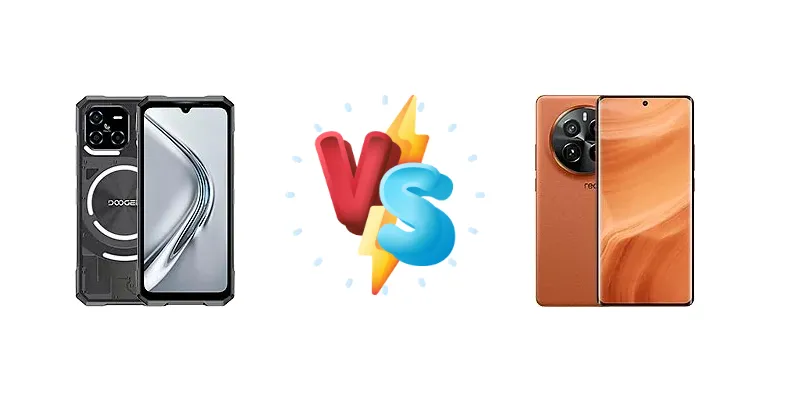
The smartphone landscape is increasingly segmented, with options catering to diverse needs. The Realme GT5 Pro arrives as a performance-focused flagship powered by the latest Snapdragon silicon, while the Doogee Blade GT Ultra carves a niche with its impressive battery endurance. This comparison dissects these two devices, revealing which one best suits your priorities.
🏆 Quick Verdict
For the average user prioritizing raw power and fast charging, the Realme GT5 Pro is the clear winner. Its Snapdragon 8 Gen 3 chipset delivers significantly superior performance. However, if battery life is paramount and you value longevity over peak speed, the Doogee Blade GT Ultra offers a compelling alternative.
| Network |
|---|
| 2G bands | GSM 850 / 900 / 1800 / 1900 | GSM 850 / 900 / 1800 / 1900 |
| 3G bands | HSDPA 850 / 900 / 1700(AWS) / 1900 / 2100 | HSDPA 850 / 900 / 2100 |
| 4G bands | 1, 2, 3, 4, 5, 7, 8, 12, 17, 18, 19, 20, 25, 26, 28, 66 | 1, 3, 5, 7, 8, 28, 34, 38, 39, 40, 41 |
| 5G bands | 1, 3, 7, 8, 28, 38, 41, 77, 78, 79 SA/NSA | 1, 3, 5, 8, 28, 41, 77, 78 SA/NSA |
| Speed | HSPA, LTE, 5G | HSPA, LTE, 5G |
| Technology | GSM / HSPA / LTE / 5G | GSM / CDMA / HSPA / CDMA2000 / LTE / 5G |
| Launch |
|---|
| Announced | 2025, February | 2023, December 07 |
| Status | Available. Released 2025, February | Available. Released 2023, December 14 |
| Body |
|---|
| Build | - | Glass front, glass back or silicone polymer back (eco leather), aluminum frame |
| Dimensions | 178.5 x 83.5 x 10.5 mm (7.03 x 3.29 x 0.41 in) | 161.7 x 75.1 x 9.2 mm (6.37 x 2.96 x 0.36 in) |
| SIM | Nano-SIM + Nano-SIM | Nano-SIM + Nano-SIM |
| Weight | 260 g (9.17 oz) | 218 g / 224 g (7.69 oz) |
| Display |
|---|
| Protection | Mohs level 6 | - |
| Resolution | 1080 x 2400 pixels, 20:9 ratio (~392 ppi density) | 1264 x 2780 pixels (~450 ppi density) |
| Size | 6.72 inches, 109.0 cm2 (~73.1% screen-to-body ratio) | 6.78 inches, 111.7 cm2 (~92.0% screen-to-body ratio) |
| Type | IPS LCD, 120Hz | LTPO AMOLED, 1B colors, 144Hz, HDR10+, Dolby Vision, 4500 nits (peak) |
| Platform |
|---|
| CPU | Octa-core (4x2.5 GHz Cortex-A78 & 4x2.0 GHz Cortex-A55) | Octa-core (1x3.3 GHz Cortex-X4 & 3x3.2 GHz Cortex-A720 & 2x3.0 GHz Cortex-A720 & 2x2.3 GHz Cortex-A520) |
| Chipset | Mediatek Dimensity 7300 (4 nm) | Qualcomm SM8650-AB Snapdragon 8 Gen 3 (4 nm) |
| GPU | Mali-G615 MC2 | Adreno 750 |
| OS | Android 14 | Android 14, upgradable to Android 15, Realme UI 6.0 |
| Memory |
|---|
| Card slot | microSDXC (uses shared SIM slot) | No |
| Internal | 512GB 16GB RAM | 256GB 12GB RAM, 256GB 16GB RAM, 512GB 16GB RAM, 1TB 16GB RAM |
| Main Camera |
|---|
| Dual | 100 MP, f/1.8, (wide), 1/1.8", PDAF
5 MP, f/2.2, 120˚ (ultrawide) | - |
| Features | LED flash, HDR, panorama | Color spectrum sensor, Dual-LED dual-tone flash, HDR, panorama |
| Triple | - | 50 MP, f/1.7, 23mm (wide), 1/1.43", 1.12µm, dual pixel PDAF, OIS
50 MP, f/2.6, 65mm (periscope telephoto), 1/1.56", 1.0µm, multi-directional PDAF, OIS, 2.7x optical zoom
8 MP, f/2.2, 16mm, 112˚ (ultrawide), 1/4.0", 1.12µm |
| Video | 4K@30fps, 1080p@30fps, gyro-EIS | 8K@24fps, 4K@30/60fps, 1080p@30/60fps, gyro-EIS, Dolby Vision |
| Selfie camera |
|---|
| Features | - | HDR, panorama |
| Single | 32 MP, f/2.3, (wide), 1/2.8" | 32 MP, f/2.5, 22mm (wide), 1/2.74" |
| Video | 1080p@30fps | 4K@30fps, 1080p@30fps, gyro-EIS |
| Sound |
|---|
| 35mm jack | No | No |
| Loudspeaker | Yes | Yes, with stereo speakers (Dolby Atmos certified) |
| Comms |
|---|
| Bluetooth | 5.2, A2DP, LE | 5.4, A2DP, LE, aptX HD |
| Infrared port | Yes | Yes |
| NFC | Yes | Yes, 360˚ |
| Positioning | GPS, GLONASS, GALILEO, BDS | GPS (L1+L5), GLONASS, BDS (B1I+B1c+B2a), GALILEO (E1+E5a), QZSS (L1+L5), NavIC |
| Radio | FM radio | No |
| USB | USB Type-C 2.0 | USB Type-C 3.2 |
| WLAN | Wi-Fi 802.11 a/b/g/n/ac/6, dual-band | Wi-Fi 802.11 a/b/g/n/ac/6/7, tri-band, Wi-Fi Direct |
| Features |
|---|
| Sensors | Fingerprint (side-mounted), accelerometer, gyro, proximity, compass | Fingerprint (under display, optical), accelerometer, gyro, proximity, compass |
| Battery |
|---|
| Charging | 33W wired | 100W wired, 50% in 12 min
50W wireless |
| Type | 5500 mAh | Li-Ion 5400 mAh |
| Misc |
|---|
| Colors | Black, Silver | Black, Silver, Orange |
| Models | - | RMX3888 |
| Price | About 480 EUR | About 430 EUR |
| EU LABEL |
|---|
| Battery | 30:21h endurance, 1300 cycles | - |
| Energy | Class E | - |
| Free fall | Class A (270 falls) | - |
| Repairability | Class C | - |
Doogee Blade GT Ultra
- Exceptional battery life (30:21h endurance)
- High battery cycle count (1300 cycles)
- Efficient Mediatek Dimensity 7300 chipset
- Slower charging speed (33W)
- Less powerful processor compared to Snapdragon 8 Gen 3
Realme GT5 Pro
- Blazing-fast Snapdragon 8 Gen 3 performance
- Ultra-fast 100W wired and 50W wireless charging
- High peak display brightness (1660 nits)
- Shorter battery life (14:16h endurance)
- Potentially higher thermal throttling under sustained load
Display Comparison
The Realme GT5 Pro immediately distinguishes itself with a measured peak brightness of 1660 nits, offering superior visibility in direct sunlight compared to the Doogee Blade GT Ultra (brightness data unavailable). While the Doogee’s panel specifics are unknown, the GT5 Pro’s high brightness, combined with potential LTPO technology (typical for this segment), suggests a more dynamic and power-efficient display experience. The GT5 Pro’s display is geared towards content consumption and outdoor usability.
Camera Comparison
The Realme GT5 Pro’s camera system is likely to be more versatile, though specific details are missing. The focus here is on the processing power of the Snapdragon 8 Gen 3, which enables advanced computational photography features. The Doogee Blade GT Ultra’s camera capabilities are less defined, and without sensor size or aperture information, it’s difficult to assess its low-light performance. The GT5 Pro’s chipset will likely provide superior video recording capabilities and faster image processing.
Performance
The performance gap is substantial. The Realme GT5 Pro’s Qualcomm Snapdragon 8 Gen 3 (4nm) chipset, featuring a 1x3.3 GHz Cortex-X4 prime core, dwarfs the Doogee Blade GT Ultra’s Mediatek Dimensity 7300 (4nm). The Snapdragon 8 Gen 3’s architecture – with its 3x3.2 GHz Cortex-A720 and 2x3.0 GHz Cortex-A720 cores – provides a significant advantage in multi-threaded tasks and gaming. While both chips utilize a 4nm process, the Snapdragon 8 Gen 3’s newer architecture and higher clock speeds translate to demonstrably faster performance. The Doogee’s Cortex-A78 cores, while capable, are a generation behind and operate at lower frequencies.
Battery Life
The Doogee Blade GT Ultra excels in battery endurance, achieving a remarkable 30:21h of usage. This is significantly longer than the Realme GT5 Pro’s 14:16h score. However, the GT5 Pro compensates with its blazing-fast 100W wired charging, capable of reaching 50% charge in just 12 minutes, and 50W wireless charging. The Doogee is limited to 33W wired charging, meaning a full charge will take considerably longer. The Doogee also boasts a claimed 1300 charge cycles, suggesting superior long-term battery health.
Buying Guide
Buy the Doogee Blade GT Ultra if you need a phone that can reliably last through two full days of moderate use, and you prioritize battery health with its 1300 charge cycles. Buy the Realme GT5 Pro if you prefer a top-tier gaming experience, demand the fastest possible charging speeds (100W wired, 50W wireless), and require the processing power of the Snapdragon 8 Gen 3 for demanding applications.
Frequently Asked Questions
❓ Does the Realme GT5 Pro's Snapdragon 8 Gen 3 chipset get excessively hot during prolonged gaming sessions?
While the Snapdragon 8 Gen 3 is a powerful chip, Realme likely incorporates advanced cooling solutions (vapor chamber, graphite sheets) to mitigate thermal throttling. However, sustained peak performance will inevitably generate heat. Expect some performance reduction after extended gaming, but it should remain a smooth experience overall.
❓ How does the Doogee Blade GT Ultra's 33W charging compare to the Realme GT5 Pro's 100W charging in real-world use?
The difference is substantial. The Realme GT5 Pro can add a significant charge in just a few minutes, making it ideal for users who frequently need a quick top-up. The Doogee Blade GT Ultra’s 33W charging will take considerably longer to fully charge, requiring more planning and patience.
❓ Is the Doogee Blade GT Ultra's battery cycle count of 1300 a significant advantage?
Yes, it is. Most smartphones offer around 500-800 charge cycles before significant battery degradation. The Doogee’s 1300 cycle claim suggests the battery will retain a higher percentage of its original capacity after extended use, potentially extending the phone’s lifespan.