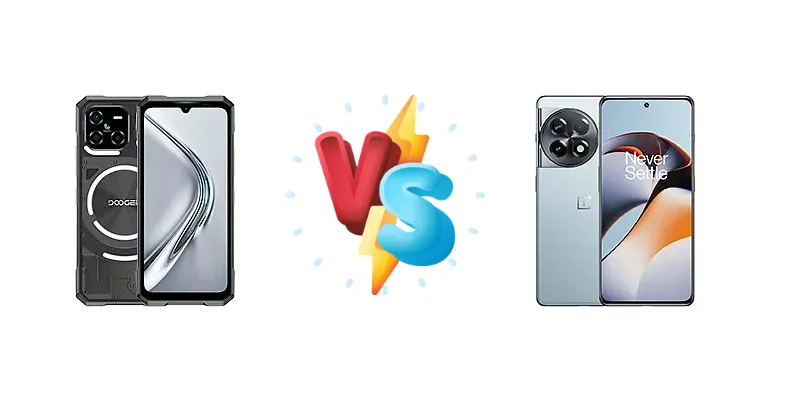
The Doogee Blade GT Ultra and OnePlus 11R represent compelling options in a crowded mid-range market. The Doogee focuses on maximizing battery life and leveraging the efficiency of the Mediatek Dimensity 7300, while the OnePlus 11R prioritizes raw power with the Snapdragon 8+ Gen 1 and blazing-fast 100W charging. This comparison dissects their key differences to help you choose the right phone for your needs.
🏆 Quick Verdict
For the average user prioritizing sustained performance and rapid charging, the OnePlus 11R emerges as the winner. Its Snapdragon 8+ Gen 1 chipset delivers a noticeable performance edge, and the 100W charging significantly reduces downtime. However, the Doogee Blade GT Ultra’s exceptional battery endurance is a strong contender for power users.
| Network |
|---|
| 2G bands | GSM 850 / 900 / 1800 / 1900 | GSM 850 / 900 / 1800 / 1900 |
| 3G bands | HSDPA 850 / 900 / 1700(AWS) / 1900 / 2100 | HSDPA 850 / 900 / 1700(AWS) / 2100 |
| 4G bands | 1, 2, 3, 4, 5, 7, 8, 12, 17, 18, 19, 20, 25, 26, 28, 66 | 1, 3, 4, 5, 8, 28, 34, 38, 39, 40, 41 |
| 5G bands | 1, 3, 7, 8, 28, 38, 41, 77, 78, 79 SA/NSA | 1, 3, 5, 8, 28, 40, 41, 77, 78 SA/NSA |
| Speed | HSPA, LTE, 5G | HSPA, LTE (3CA), 5G |
| Technology | GSM / HSPA / LTE / 5G | GSM / CDMA / HSPA / LTE / 5G |
| | - | CDMA 800 |
| Launch |
|---|
| Announced | 2025, February | 2023, February 07 |
| Status | Available. Released 2025, February | Available. Released 2023, February 21 |
| Body |
|---|
| Build | - | Glass front, glass back (Gorilla Glass 5), plastic frame |
| Dimensions | 178.5 x 83.5 x 10.5 mm (7.03 x 3.29 x 0.41 in) | 163.4 x 74.3 x 8.7 mm (6.43 x 2.93 x 0.34 in) |
| SIM | Nano-SIM + Nano-SIM | Nano-SIM + Nano-SIM |
| Weight | 260 g (9.17 oz) | 204 g (7.20 oz) |
| Display |
|---|
| Protection | Mohs level 6 | - |
| Resolution | 1080 x 2400 pixels, 20:9 ratio (~392 ppi density) | 1240 x 2772 pixels, 20:9 ratio (~451 ppi density) |
| Size | 6.72 inches, 109.0 cm2 (~73.1% screen-to-body ratio) | 6.74 inches, 109.2 cm2 (~90.0% screen-to-body ratio) |
| Type | IPS LCD, 120Hz | Fluid AMOLED, 1B colors, 120Hz, HDR10+, 1450 nits (peak) |
| Platform |
|---|
| CPU | Octa-core (4x2.5 GHz Cortex-A78 & 4x2.0 GHz Cortex-A55) | Octa-core (1x3.0 GHz Cortex-X2 & 3x2.5 GHz Cortex-A710 & 4x1.80 GHz Cortex-A510) |
| Chipset | Mediatek Dimensity 7300 (4 nm) | Qualcomm SM8475 Snapdragon 8+ Gen 1 (4 nm) |
| GPU | Mali-G615 MC2 | Adreno 730 |
| OS | Android 14 | Android 13, upgradable to Android 15, OxygenOS 15 |
| Memory |
|---|
| Card slot | microSDXC (uses shared SIM slot) | No |
| Internal | 512GB 16GB RAM | 128GB 8GB RAM, 256GB 16GB RAM, 512GB 18GB RAM |
| | - | UFS 3.1 |
| Main Camera |
|---|
| Dual | 100 MP, f/1.8, (wide), 1/1.8", PDAF
5 MP, f/2.2, 120˚ (ultrawide) | - |
| Features | LED flash, HDR, panorama | Color spectrum sensor, LED flash, HDR, panorama |
| Single | - | 16 MP, f/2.4, 24mm (wide), 1/3.09", 1.0µm |
| Triple | - | 50 MP, f/1.8, 24mm (wide), 1/1.56", 1.0µm, multi-directional PDAF, OIS
8 MP, f/2.2, 120˚ (ultrawide), 1/4.0", 1.12µm
2 MP (macro) |
| Video | 4K@30fps, 1080p@30fps, gyro-EIS | 4K@30/60fps, 1080p@30/60/240fps, gyro-EIS |
| Selfie camera |
|---|
| Features | - | HDR |
| Single | 32 MP, f/2.3, (wide), 1/2.8" | 16 MP, f/2.4, 24mm (wide), 1/3.09", 1.0µm |
| Video | 1080p@30fps | 1080p@30fps |
| Sound |
|---|
| 3.5mm jack | - | No |
| 35mm jack | No | No |
| Loudspeaker | Yes | Yes, with stereo speakers |
| | - | 24-bit/192kHz audio |
| Comms |
|---|
| Bluetooth | 5.2, A2DP, LE | 5.3, A2DP, LE, aptX HD |
| Infrared port | Yes | Yes |
| NFC | Yes | Yes |
| Positioning | GPS, GLONASS, GALILEO, BDS | GPS (L1+L5), GLONASS (G1), BDS (B1I+B1c+B2a), GALILEO (E1+E5a), QZSS (L1+L5) |
| Radio | FM radio | No |
| USB | USB Type-C 2.0 | USB Type-C 2.0 |
| WLAN | Wi-Fi 802.11 a/b/g/n/ac/6, dual-band | Wi-Fi 802.11 a/b/g/n/ac/6, dual-band |
| Features |
|---|
| Sensors | Fingerprint (side-mounted), accelerometer, gyro, proximity, compass | Fingerprint (under display, optical), accelerometer, gyro, proximity, compass |
| Battery |
|---|
| Charging | 33W wired | 100W wired |
| Type | 5500 mAh | Li-Po 5000 mAh |
| Misc |
|---|
| Colors | Black, Silver | Galactic Silver, Sonic Black, Solar Red |
| Models | - | CPH2487 |
| Price | About 480 EUR | About 600 EUR |
| SAR | - | 1.16 W/kg (head) 0.61 W/kg (body) |
| EU LABEL |
|---|
| Battery | 30:21h endurance, 1300 cycles | - |
| Energy | Class E | - |
| Free fall | Class A (270 falls) | - |
| Repairability | Class C | - |
Doogee Blade GT Ultra
- Exceptional battery endurance (30:21h)
- Long-lasting battery health (1300 cycles)
- Efficient Mediatek Dimensity 7300 chipset
- Slower 33W charging
- Potentially less powerful CPU for demanding tasks
OnePlus 11R
- Powerful Snapdragon 8+ Gen 1 processor
- Blazing-fast 100W wired charging
- Superior graphics performance
- Likely shorter battery life compared to Doogee
- Potentially faster battery degradation
Display Comparison
While display specifications aren't provided, both phones likely feature AMOLED panels given their market positioning. However, the core difference lies in the processing power driving them. The OnePlus 11R, with its Snapdragon 8+ Gen 1, will likely deliver smoother animations and faster response times, particularly noticeable in graphically intensive applications. The Doogee, while capable, will rely on the Dimensity 7300’s GPU to handle similar tasks.
Camera Comparison
Without specific camera details, it’s difficult to make a definitive judgment. However, given the price points, we can assume both phones will feature multi-camera systems. The OnePlus 11R, benefiting from Qualcomm’s image signal processor (ISP) within the Snapdragon 8+ Gen 1, likely offers more advanced image processing capabilities, potentially resulting in better dynamic range and low-light performance. The Doogee’s camera performance will depend heavily on the sensor and lens quality, and the capabilities of the Dimensity 7300’s ISP.
Performance
The OnePlus 11R’s Snapdragon 8+ Gen 1 (4nm) is a significant step up in processing power compared to the Doogee Blade GT Ultra’s Dimensity 7300 (4nm). The Snapdragon 8+ Gen 1 features a Cortex-X2 prime core clocked at 3.0 GHz, offering superior single-core performance crucial for responsive app launches and smooth multitasking. The Dimensity 7300’s Cortex-A78 cores, while efficient, peak at 2.5 GHz. This translates to a tangible advantage for the OnePlus 11R in demanding games and applications. The Snapdragon’s Adreno GPU also provides a more robust graphics experience. The 4nm fabrication process in both chips contributes to thermal efficiency, but the Snapdragon 8+ Gen 1’s architecture is generally more refined for sustained performance.
Battery Life
The Doogee Blade GT Ultra boasts impressive battery endurance, rated at 30:21 hours. This is likely achieved through a combination of the Dimensity 7300’s efficiency and optimized software. While the exact battery capacity isn’t specified, the endurance figure suggests a larger battery than the OnePlus 11R. However, the OnePlus 11R compensates with its 100W wired charging, capable of fully charging the device in a fraction of the time compared to the Doogee’s 33W charging. The Doogee’s 1300 charge cycles also suggest a focus on long-term battery health, potentially mitigating degradation over time.
Buying Guide
Buy the Doogee Blade GT Ultra if you need exceptional battery life and prioritize longevity, potentially benefiting from the 1300 charge cycles. This phone is ideal for users who frequently travel or rely heavily on their phone throughout the day without easy access to power outlets. Buy the OnePlus 11R if you prefer a more powerful processor for demanding tasks like gaming and video editing, and value the convenience of incredibly fast 100W charging, making it perfect for users who need to quickly top up their battery.
Frequently Asked Questions
❓ Does the Dimensity 7300 in the Doogee Blade GT Ultra throttle under sustained load, like during extended gaming sessions?
While the Dimensity 7300 is a 4nm chip and therefore relatively efficient, it's unlikely to match the sustained performance of the Snapdragon 8+ Gen 1. The OnePlus 11R’s superior thermal management and more powerful chipset will likely result in less throttling during prolonged gaming or video editing.
❓ How long does it *actually* take to fully charge the OnePlus 11R with the 100W charger?
OnePlus claims the 100W SuperVOOC charging can take the 11R from 1-100% in around 25 minutes. Real-world results may vary slightly depending on usage and ambient temperature, but it’s significantly faster than the Doogee Blade GT Ultra’s 33W charging.
❓ Is the difference in CPU performance between the Snapdragon 8+ Gen 1 and Dimensity 7300 noticeable in everyday tasks?
For basic tasks like browsing, social media, and email, the difference will be minimal. However, when launching demanding apps, multitasking heavily, or playing graphically intensive games, the Snapdragon 8+ Gen 1’s superior processing power will become readily apparent.