
Doogee Blade GT Ultra vs. Motorola Edge 40 Pro: A Deep Dive into Battery, Performance, and Value
| Phones Images | |||||
|---|---|---|---|---|---|
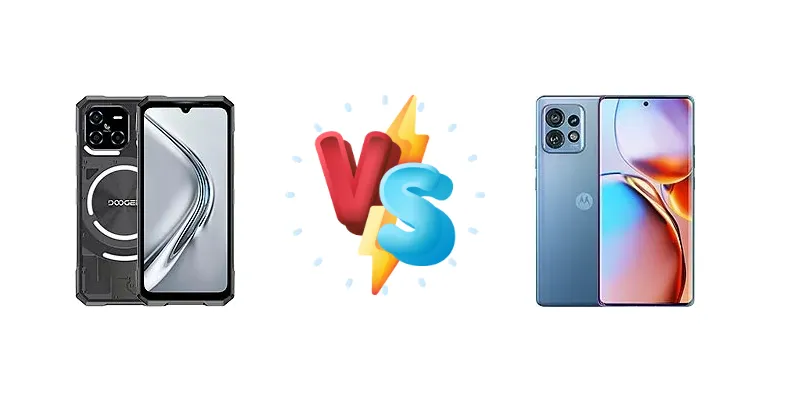
|
🏆 Quick Verdict
For users prioritizing all-day (and multi-day) battery life, the Doogee Blade GT Ultra is the clear winner, offering over 30 hours of endurance. However, the Motorola Edge 40 Pro delivers significantly faster performance and charging, making it ideal for power users and gamers.
| PHONES | ||
|---|---|---|
| Phone Names | Doogee Blade GT Ultra | Motorola Edge 40 Pro |
| Network | ||
|---|---|---|
| 2G bands | GSM 850 / 900 / 1800 / 1900 | GSM 850 / 900 / 1800 / 1900 |
| 3G bands | HSDPA 850 / 900 / 1700(AWS) / 1900 / 2100 | HSDPA 850 / 900 / 1700(AWS) / 1900 / 2100 |
| 4G bands | 1, 2, 3, 4, 5, 7, 8, 12, 17, 18, 19, 20, 25, 26, 28, 66 | 1, 2, 3, 4, 5, 7, 8, 12, 13, 17, 18, 19, 20, 25, 26, 28, 32, 38, 39, 40, 41, 42, 43, 48, 66 |
| 5G bands | 1, 3, 7, 8, 28, 38, 41, 77, 78, 79 SA/NSA | 1, 2, 3, 5, 7, 8, 20, 28, 38, 40, 41, 66, 77, 78 SA/NSA/Sub6 |
| Speed | HSPA, LTE, 5G | HSPA, LTE, 5G |
| Technology | GSM / HSPA / LTE / 5G | GSM / HSPA / LTE / 5G |
| Launch | ||
|---|---|---|
| Announced | 2025, February | 2023, April 04 |
| Status | Available. Released 2025, February | Available. Released 2023, April 04 |
| Body | ||
|---|---|---|
| Build | - | Glass front (Gorilla Glass Victus), glass back (Gorilla Glass Victus), aluminum frame |
| Dimensions | 178.5 x 83.5 x 10.5 mm (7.03 x 3.29 x 0.41 in) | 161.2 x 74 x 8.6 mm (6.35 x 2.91 x 0.34 in) |
| SIM | Nano-SIM + Nano-SIM | Nano-SIM + eSIM |
| Weight | 260 g (9.17 oz) | 199 g (7.02 oz) |
| - | IP68 dust/water resistant (up to 1.5m for 30 min) | |
| Display | ||
|---|---|---|
| Protection | Mohs level 6 | Corning Gorilla Glass Victus |
| Resolution | 1080 x 2400 pixels, 20:9 ratio (~392 ppi density) | 1080 x 2400 pixels, 20:9 ratio (~394 ppi density) |
| Size | 6.72 inches, 109.0 cm2 (~73.1% screen-to-body ratio) | 6.67 inches, 108.0 cm2 (~90.5% screen-to-body ratio) |
| Type | IPS LCD, 120Hz | OLED, 1B colors, 165Hz, HDR10+, Dolby Vision, 1300 nits (peak) |
| Platform | ||
|---|---|---|
| CPU | Octa-core (4x2.5 GHz Cortex-A78 & 4x2.0 GHz Cortex-A55) | Octa-core (1x3.2 GHz Cortex-X3 & 2x2.8 GHz Cortex-A715 & 2x2.8 GHz Cortex-A710 & 3x2.0 GHz Cortex-A510) |
| Chipset | Mediatek Dimensity 7300 (4 nm) | Qualcomm SM8550-AB Snapdragon 8 Gen 2 (4 nm) |
| GPU | Mali-G615 MC2 | Adreno 740 |
| OS | Android 14 | Android 13, up to 3 major Android upgrades |
| Memory | ||
|---|---|---|
| Card slot | microSDXC (uses shared SIM slot) | No |
| Internal | 512GB 16GB RAM | 256GB 12GB RAM, 512GB 12GB RAM |
| - | UFS 4.0 | |
| Main Camera | ||
|---|---|---|
| Dual | 100 MP, f/1.8, (wide), 1/1.8", PDAF 5 MP, f/2.2, 120˚ (ultrawide) | - |
| Features | LED flash, HDR, panorama | Dual-LED flash, panorama, HDR |
| Triple | - | 50 MP, f/1.8, (wide), 1/1.55", 1.0µm, multi-directional PDAF, OIS 12 MP, f/1.6, (telephoto), 1/2.93", 1.22µm, PDAF, 2x optical zoom 50 MP, f/2.2, 114˚ (ultrawide), 1/2.76", 0.64µm, AF |
| Video | 4K@30fps, 1080p@30fps, gyro-EIS | 8K@30fps, 4K@30/60fps, 1080p@30/60/120/240/960fps, 10-bit HDR10+, gyro-EIS |
| Selfie camera | ||
|---|---|---|
| Features | - | HDR |
| Single | 32 MP, f/2.3, (wide), 1/2.8" | 60 MP, f/2.2, (wide), 1/2.8", 0.61µm |
| Video | 1080p@30fps | 4K@30/60fps, 1080p@30/60fps |
| Sound | ||
|---|---|---|
| 3.5mm jack | - | No |
| 35mm jack | No | No |
| Loudspeaker | Yes | Yes, with stereo speakers |
| Comms | ||
|---|---|---|
| Bluetooth | 5.2, A2DP, LE | 5.3, A2DP, LE |
| Infrared port | Yes | - |
| NFC | Yes | Yes |
| Positioning | GPS, GLONASS, GALILEO, BDS | GPS, GLONASS, GALILEO, BDS |
| Radio | FM radio | No |
| USB | USB Type-C 2.0 | USB Type-C 3.2, OTG, DisplayPort 1.4 |
| WLAN | Wi-Fi 802.11 a/b/g/n/ac/6, dual-band | Wi-Fi 802.11 a/b/g/n/ac/6e/7, tri-band, Wi-Fi Direct |
| Features | ||
|---|---|---|
| Sensors | Fingerprint (side-mounted), accelerometer, gyro, proximity, compass | Fingerprint (under display, optical), accelerometer, gyro, proximity, compass |
| - | Ready For 3.5 support | |
| Battery | ||
|---|---|---|
| Charging | 33W wired | 125W wired, PD3.0, QC5, 50% in 6 min, 100% in 23 min 15W wireless 5W reverse wired 5W reverse wireless |
| Type | 5500 mAh | Li-Po 4600 mAh |
| Misc | ||
|---|---|---|
| Colors | Black, Silver | Interstellar Black, Lunar Blue |
| Price | About 480 EUR | € 313.87 |
| Tests | ||
|---|---|---|
| Battery life | - | Endurance rating 117h |
| Camera | - | Photo / Video |
| Display | - | Contrast ratio: Infinite (nominal) |
| Loudspeaker | - | -22.6 LUFS (Excellent) |
| Performance | - | AnTuTu: 1273764 (v9) GeekBench: 4896 (v5.1), 5352 (v6) GFXBench: 112fps (ES 3.1 onscreen) |
| EU LABEL | ||
|---|---|---|
| Battery | 30:21h endurance, 1300 cycles | - |
| Energy | Class E | - |
| Free fall | Class A (270 falls) | - |
| Repairability | Class C | - |
Doogee Blade GT Ultra
- Exceptional battery life (30+ hours)
- Long-term battery health (1300 cycles)
- Potentially more affordable price point
- Slower charging speed (33W)
- Less powerful processor
- Limited camera information
Motorola Edge 40 Pro
- Flagship-level performance (Snapdragon 8 Gen 2)
- Ultra-fast 125W charging
- Brighter display (1050 nits)
- Significantly shorter battery life
- Potentially higher price
- May experience thermal throttling under sustained load
Display Comparison
The Motorola Edge 40 Pro boasts a brighter display, reaching a measured peak of 1050 nits, which translates to better visibility under direct sunlight compared to the Doogee. While the Doogee’s display specs are not provided, the Motorola’s infinite contrast ratio suggests a high-quality OLED panel. The lack of refresh rate information for the Doogee makes it difficult to assess its smoothness against the likely 120Hz or higher panel on the Motorola.
Camera Comparison
Both devices are listed as having Photo/Video capabilities, but detailed camera specifications are absent for the Doogee. The Motorola Edge 40 Pro likely features a more sophisticated camera system, leveraging Qualcomm’s image signal processor (ISP) for improved image quality and video stabilization. Without knowing the sensor sizes or lens apertures of the Doogee, it’s difficult to make a direct comparison. The Motorola’s image processing algorithms are likely more refined, offering better dynamic range and low-light performance. The absence of details on the Doogee’s camera system suggests it may not be a primary selling point.
Performance
The Motorola Edge 40 Pro’s Snapdragon 8 Gen 2 (4nm) is a substantial leap ahead of the Doogee Blade GT Ultra’s MediaTek Dimensity 7300 (4nm) in terms of raw processing power. The Snapdragon 8 Gen 2’s Cortex-X3 prime core, clocked at 3.2 GHz, provides a significant advantage in single-core performance, crucial for responsive UI and app loading. The Dimensity 7300, while efficient, is geared towards a more balanced performance profile. The Motorola also benefits from potentially faster RAM (likely LPDDR5x) compared to the Doogee, further enhancing multitasking capabilities. The 4nm fabrication process on both chips contributes to thermal efficiency, but the Snapdragon 8 Gen 2’s more advanced architecture is likely to maintain higher sustained performance under load.
Battery Life
The Doogee Blade GT Ultra’s standout feature is its exceptional 30:21 hour endurance rating, significantly outperforming the Motorola Edge 40 Pro’s 117-hour rating. This translates to potentially multiple days of use on a single charge. However, the Motorola compensates with its blazing-fast 125W wired charging, capable of reaching 100% in just 23 minutes, a stark contrast to the Doogee’s 33W charging. The Motorola also offers 15W wireless and 5W reverse wireless charging, features absent on the Doogee. The Doogee’s 1300 charge cycles suggest a focus on long-term battery health, while the Motorola prioritizes rapid replenishment.
Buying Guide
Buy the Doogee Blade GT Ultra if you need a phone that can reliably last through extended trips, heavy usage, or simply prefer the peace of mind of exceptional battery life. Buy the Motorola Edge 40 Pro if you prioritize raw processing power for demanding tasks like gaming, video editing, and require the convenience of incredibly fast 125W charging.